

Every 2027 freight budget starts with the same question: will truckload rates keep climbing, level off or finally come down? The forecasts released this fall mostly agree. Rates are expected to rise again in 2027, by less than in 2026, because truck capacity is slow to come back while demand improves only gradually.
This outlook puts the public 2027 forecasts side by side, explains why the national average can mislead you and lays out what brokers and shippers can do before 2027 contracts are signed. Every figure is dated and sourced as of November 23, 2026. For background on the supply side, see our guide to the EPA 2027 truck emissions rule and our freight market update on why capacity is tightening.
The 2027 Freight Market in One Paragraph
2026 turned into a supply-driven market. DAT reported that dry van spot rates averaged $3.05 per mile in October, the highest monthly average since February 2022 and 98 cents above a year earlier, while its dry van volume index was 2% lower than a year ago. [DAT, Nov 10, 2026] For 2027, the public forecasts call for another increase of about 5% to 14% depending on the measure, with the most pressure in the first half. The drivers are on the supply side: high diesel prices, weak new truck orders and an unsettled federal engine rule. Demand is improving, but it is not the main story.
Trucking Industry Outlook 2027: What the Forecasters Say
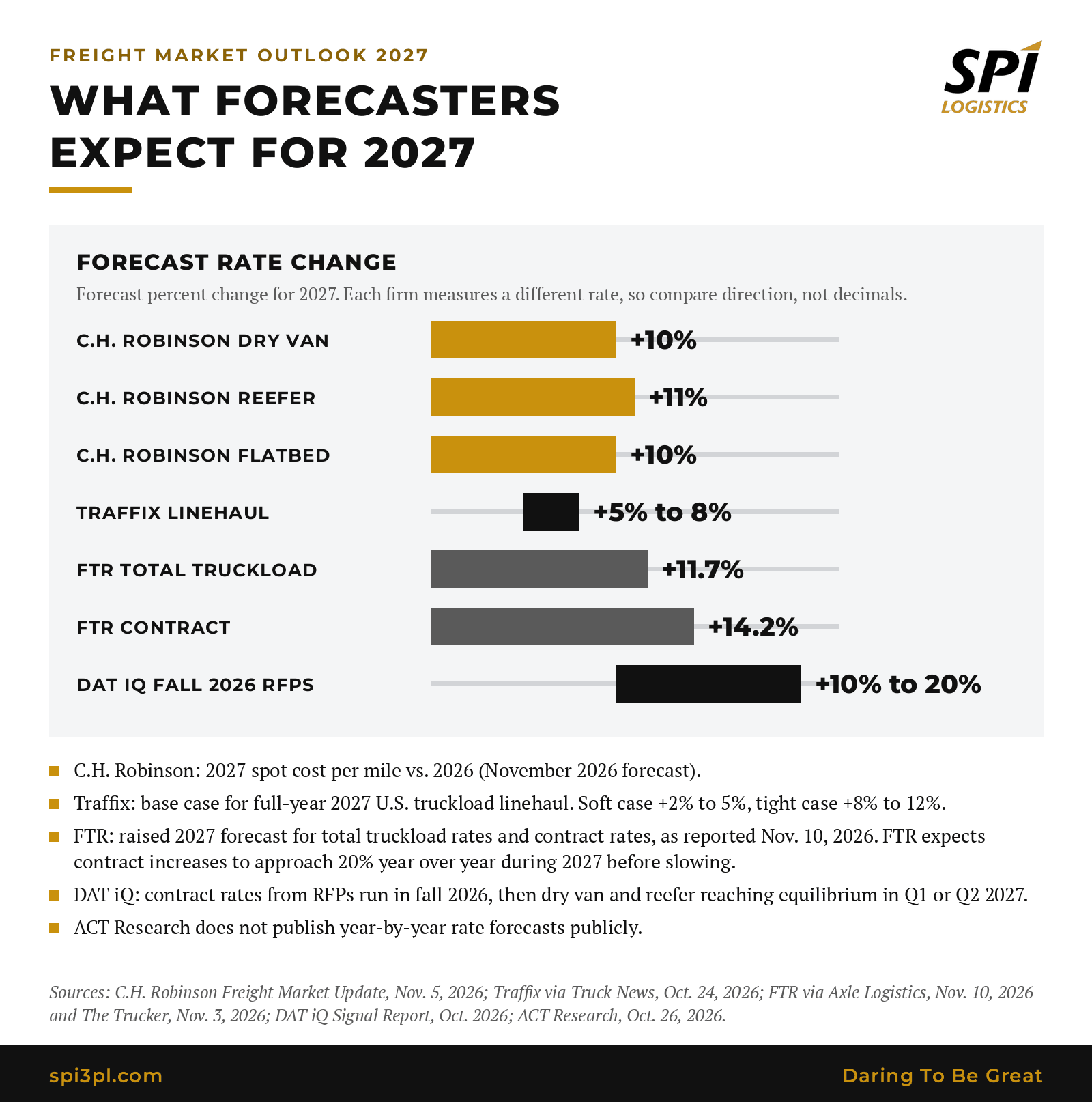
Each firm measures a slightly different rate, so read the numbers for direction and timing, not decimals.
| Forecaster | 2027 view | What it measures | Published |
| C.H. Robinson | +10% dry van, +11% temperature-controlled, +10% flatbed | Spot linehaul cost per mile | Nov 2026 |
| FTR | +11.7% total truckload rates, +14.2% contract rates; contract increases approach 20% year over year during 2027 before slowing | Total and contract truckload rates | Nov 2026 |
| DAT iQ | Fall 2026 bids 10% to 20% higher; dry van and reefer reach equilibrium in Q1 or Q2 2027 | Contract rates | Oct 2026 |
| Traffix | +5% to 8% base case (2% to 5% soft, 8% to 12% or more tight) | Full-year truckload linehaul excluding fuel | Oct 24, 2026 |
| ACT Research | Tightness persists well into 2027; no public annual figure | Market balance and capacity | Oct 2026 |
C.H. Robinson: Another Double-Digit Year, Driven by Supply
C.H. Robinson’s November forecast calls for 2027 spot linehaul cost per mile to rise 10% for dry van and flatbed and 11% for temperature-controlled freight, after gains of 28% to 32% in 2026. [C.H. Robinson, Nov 5, 2026] It expects 2027 to start higher than any point in 2026 and, after the usual early-year dip, to settle “at a place generally higher than rates have been throughout 2026,” calling it “a supply-driven market.” [C.H. Robinson, Nov 11, 2026]
FTR: A Higher Forecast, Led by Contract Rates
In November, FTR raised its 2027 forecast to an 11.7% increase in total truckload rates and 14.2% for contract rates, and expects active truck utilization to stay at essentially 100% through the first quarter of 2027. [FTR, as reported by Axle Logistics, Nov 10, 2026] FTR chairman Eric Starks said contract increases should approach 20% year over year during 2027 before slowing. His advice on bids: “Right now, capacity is the winner.” [The Trucker, Nov 3, 2026]
DAT iQ: Contract Rates Should Level Off in the First Half
DAT iQ expects bids run in fall 2026 “to yield higher contract rates in the 10% to 20% range,” with dry van and temperature-controlled freight reaching equilibrium “in Q1 or Q2 of 2027.” It does not expect a return to the lows of 2022 to 2025. [DAT iQ, Oct 2026]
Traffix: A 5% to 8% Base Case
Traffix expects U.S. truckload linehaul rates, excluding fuel, to rise 5% to 8% in 2027, with a 2% to 5% soft case and an 8% to 12% or more tight case. As Traffix’s Alex Fuller put it, “shippers are paying for a lack of capacity, not a surge in freight.” [Truck News, Oct 24, 2026]
ACT Research: Capacity Responds Slowly
ACT Research does not publish its annual rate forecast, but it reminds budget owners that “an order is not the same as a productive truck on a freight lane.” [ACT Research, Oct 26, 2026] ACT’s Tim Denoyer sees “the freight cycle shifting into the mid cycle phase heading into 2027.” [Cass, Nov 2026]
Is the Freight Recession Over?
On pricing, yes. The expenditures component of the Cass Freight Index rose 26.5% year over year in October and is on track for a 13% gain in 2026 after three years of declines. The Cass Truckload Linehaul Index was up 9.9%. [Cass, Oct 2026]
Volume is more mixed. Cass shipments rose 5.9% year over year in October, while DAT’s Truckload Volume Index showed dry van loads down 2%, reefer down 9% and flatbed down 7%. [Cass, Oct 2026; DAT, Nov 10, 2026] The rate downturn is over, but demand is recovering slowly, not booming.
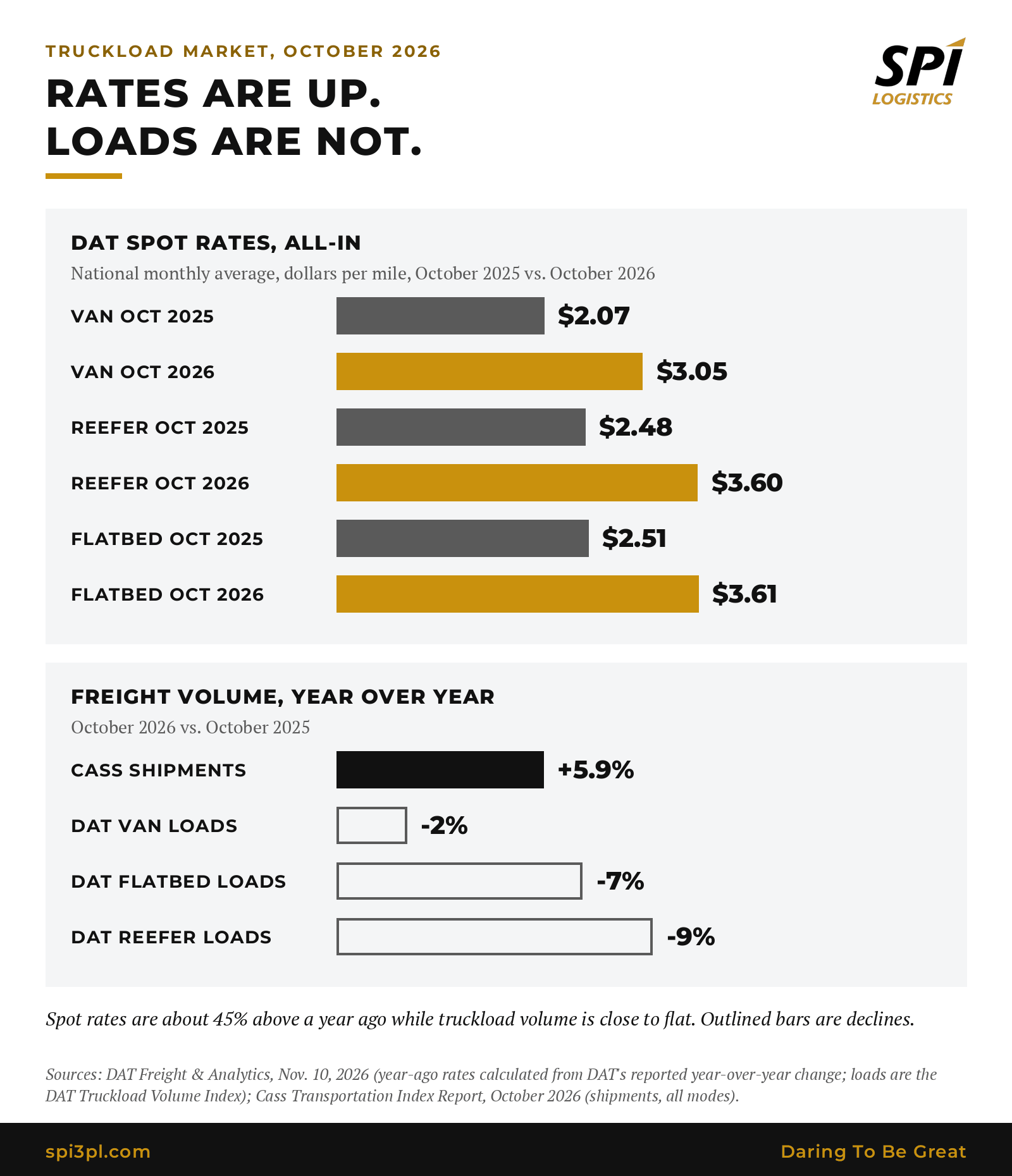
A supply-driven market can turn faster once trucks and drivers return, which is why forecasters expect rates to level off at some point in 2027 rather than keep rising at 2026’s pace.
Why Trucking Capacity Stays Tight in 2027
Higher rates usually pull new trucks into the market. Four things are slowing that response.
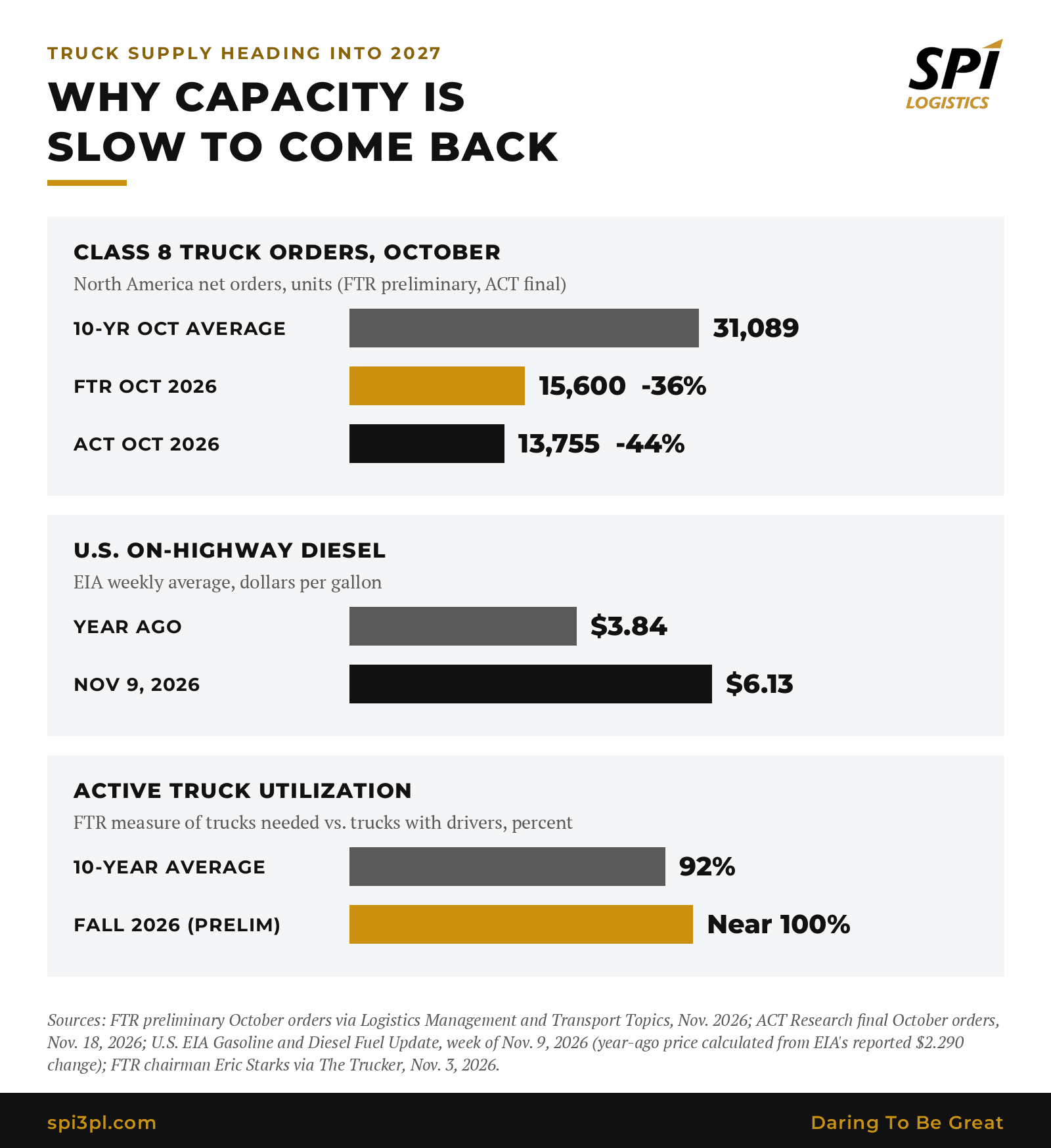
- Trucks are nearly fully used. FTR’s active truck utilization has a 10-year average of 92%, and its preliminary analysis suggests utilization could be near 100%. [The Trucker, Nov 3, 2026]
- New truck orders are weak. FTR reported preliminary October Class 8 orders of 15,600, down 36% and about half the 10-year October average of 31,089. ACT Research’s final October figure was 13,755, down 44%. [ACT Research, Nov 18, 2026; Logistics Management, Nov 2026; Transport Topics, Nov 2026]
- Engine rules are not settled. EPA sent its final revisions to the July 2026 changes to the model year 2027 engine rule to the White House Office of Management and Budget for review on November 19, 2026. As of November 23, the rule had not been issued. [Transport Topics, Nov 20, 2026] ACT’s Carter Vieth said the “lack of clarity around EPA 2027 rules and associated costs has left OEMs and fleets unable to plan for next year.” Our EPA 2027 guide explains what is final.
- Diesel is expensive. The U.S. average diesel price was $6.127 per gallon for the week of November 9, $2.29 higher than a year earlier. [EIA] C.H. Robinson expects diesel to stay above historical norms into at least the first half of 2027. [C.H. Robinson, Nov 11, 2026]
Why the National Average Will Mislead You in 2027
Nobody ships freight on the national average. In the week ending November 6, DAT’s national dry van spot linehaul rate was $2.26 per mile. California origins averaged $2.77 and the Great Lakes $2.52, while Florida and South Georgia averaged $1.38. [DAT, Nov 9, 2026] That is a $1.39 spread across the top 10 origin regions in a single week.
With less slack in the market, C.H. Robinson warns that events like winter storms or produce season “may spur sharper rate increases for specific lanes, regions, or periods of time.” [C.H. Robinson, Nov 11, 2026]
The Short above was recorded in mid-2026, when spot rates first spiked, and its point carries into 2027: how you price a tight market shapes the relationship after it loosens. As the speaker puts it, “the shipper has this funny memory thing. They won’t forget that.” He also notes that rates were leveling off “in most areas, not in every area,” which is the national-average problem in one line. Price each lane on its own 12-month history, not the headline number. We covered how that plays out with carrier relationships in spot market trucking vs. foundational carriers.
Where Freight Is Moving: Intermodal and LTL
When truckload gets expensive, some freight changes modes. AAR reported U.S. rail intermodal volume of 298,369 units for the week ending November 7, up 11.0% from a year earlier. [AAR, Nov 11, 2026] FreightWaves SONAR put road-to-rail savings at 30.2%. [FreightWaves, Nov 11, 2026]
C.H. Robinson suggests reviewing freight that moves roughly 550 to 1,500 miles where an extra day or two of transit is acceptable, and expects smaller shipments to keep moving back into LTL networks in 2027. [C.H. Robinson, Nov 11, 2026] ACT adds a caution: “movement between modes should not be mistaken for growth in total freight demand.” [ACT Research, Oct 26, 2026] For a lane-by-lane view, see truckload vs. intermodal: which lanes actually convert and partial truckload vs. LTL vs. full truckload.
What 2027 Means for a Broker With a $1M Book
A tight market is good for revenue and hard on margin. In the third quarter, C.H. Robinson’s truckload cost per mile rose 33.5% while its price to customers rose 31.5%. [C.H. Robinson, Oct 28, 2026] TIA reported broker gross margins of 17.8% in the second quarter, down 120 basis points from a year earlier. [Logistics Management, 2026]
If FTR is right that contract rates rise faster than total rates in 2027 (14.2% vs. 11.7%), freight committed at last year’s rates gets harder to cover profitably. Three habits help:
- Reprice more often. Quarterly reviews or indexed pricing on volatile lanes protect both sides. See our freight market volatility strategies for brokers.
- Commit only to what you can cover. A promise you keep is worth more than four you scramble to fill.
- Know your lanes better than the average. Lane history beats the national number in every customer conversation.
In the Short above, the conversation turns to exactly that kind of promise: “Listen, I’m going to be in touch if I can cover any more, but this one you’re going to count on.”
Doing all of that alone means carrying your own back office, carrier relationships and working capital through a demanding year. SPI Logistics has 45+ years in business and 75+ North American offices, and our agents keep their focus on customers while SPI handles back-office support. If you are weighing your options, start with freight agent vs. freight broker and what successful brokers evaluate before joining a freight agent program.
Running a $1M book and planning for 2027? See how independent brokers grow with SPI.
6 Steps Shippers Can Take When Setting 2027 Budgets
1. Budget for Higher Rates, Not a Return to 2025
Forecasts range from a 5% to 8% linehaul increase (Traffix) to about 10% higher cost per mile (C.H. Robinson) and 14.2% higher contract rates (FTR). Build the budget on that range, not on hoped-for relief.
2. Budget Linehaul, Fuel and Accessorials Separately
Traffix recommends separate lines for linehaul, fuel and accessorials. [Truck News, Oct 24, 2026] DAT put the October van spot fuel surcharge at 83 cents per mile, about double a year earlier. [DAT, Nov 10, 2026]
3. Aim for Tender Acceptance, Not the Lowest Rate on Paper
C.H. Robinson cites research with MIT showing that shippers who work through their whole routing guide before turning to the spot market can pay 23% to 35% extra on a shipment. [C.H. Robinson, Nov 11, 2026]
4. Segment Your Lanes
Decide which lanes to bid, which to award directly and which to leave for the spot market because volume is low or irregular.
5. Test Intermodal Where the Lane Fits
Lanes of roughly 550 to 1,500 miles with flexible transit times are the first candidates while road-to-rail savings stay near 30%.
6. Plan for a Tight First Half
Shorter contract terms or indexed pricing on volatile lanes can keep you flexible until rates level off, which DAT iQ expects in the first or second quarter.
Planning 2027 freight? Talk to SPI about steady capacity through independent motor carriers that know your lanes.
What to Watch in Q1 2027
- EPA’s final action on the 2027 engine rule changes, now under White House review, which affects new truck pricing and orders.
- Monthly Class 8 orders, and whether deferred orders come back.
- Tender rejections, which FreightWaves SONAR put at 12.88% on November 11. [FreightWaves, Nov 11, 2026]
- The contract-spot gap. DAT put October dry van contract linehaul at $2.45 per mile vs. $2.22 spot, a 23-cent gap, down from 34 cents a year earlier. [DAT, Nov 9, 2026]
- Diesel prices, still more than $2 a gallon above a year ago.
Frequently Asked Questions (FAQs)
What is the freight market outlook for 2027?
Most public forecasts expect truckload rates to rise again in 2027, by less than in 2026, because capacity is limited. C.H. Robinson projects about 10% higher spot cost per mile, FTR 11.7% higher total truckload rates and Traffix a 5% to 8% base case.
Will freight rates go up in 2027?
Most forecasters say yes, with the biggest increases early in the year. FTR expects contract rates to rise 14.2%, and no major forecaster expects a return to 2022 to 2025 lows.
Is the freight recession over?
On rates, yes. Cass freight expenditures rose 26.5% year over year in October 2026. Volume is recovering more slowly, and some truckload volume measures are still below a year ago.
When will truckload rates level off?
DAT iQ points to the first or second quarter of 2027 for dry van and reefer, and FTR expects contract rate growth to slow later in 2027.
How should shippers budget for freight in 2027?
Budget on current forecasts, separate linehaul, fuel and accessorials, aim for tender acceptance over the lowest rate on paper and consider intermodal on longer lanes.
Plan 2027 Around Capacity, Not Hope
The forecasts differ on how much rates will rise in 2027, but they agree on why: capacity is slow to return and costs are high. SPI Logistics arranges freight through a network of independent motor carriers across North America. Whether you need dependable capacity for 2027 or want to build a freight business of your own, we can help.
Ready to plan your 2027 freight? Contact SPI Logistics today.
References
C.H. Robinson. (2026, November 11). Key trends for truckload and LTL shipping in 2027. Retrieved from
https://www.chrobinson.com/en-us/resources/blog/2027-trucking-market-outlook-rates-capacity-rfp-strategies/
C.H. Robinson. (2026, November 5). Truckload rate pressure builds heading into the holidays (Freight Market Update: November 2026). Retrieved from
https://www.chrobinson.com/en-us/resources/insights-and-advisories/north-america-freight-insights/nov-2026-freight-market-update/na-truckload/
C.H. Robinson. (2026, October 28). C.H. Robinson Reports 2026 Third Quarter Results. Retrieved from
https://investor.chrobinson.com/news/press-releases/news-details/2026/C-H–Robinson-Reports-2026-Third-Quarter-Results/default.aspx
Axle Logistics. (2026, November 10). Freight Market Strength: Beyond Holiday Demand (citing FTR). Retrieved from
https://axlelogistics.com/newsletter/freight-market-strength-beyond-holiday-demand/
CDLWire. (2026, November 3). FTR’s Eric Starks: truck utilization may be near 100% and contract rates could climb toward 20% in 2027. Retrieved from
https://cdlwire.com/2026/11/03/ftr-starks-utilization-near-100-contract-2027
The Trucker. (2026, November 3). Higher rates, higher costs: FTR’s Eric Starks sees trucking recovery bringing uneven relief. Retrieved from
https://www.thetrucker.com/trucking-news/business/higher-rates-higher-costs-ftrs-eric-starks-sees-trucking-recovery-bringing-uneven-relief
DAT iQ. (2026, October). Signal Report: North America Truckload Freight Rate Index and Forecast. Retrieved from
https://cdn.bfldr.com/8CX31GU6/as/854q87w4jxfzwcxt3jjh5jrz/DAT_iQ_Signal_Report_-_free_version
DAT Freight & Analytics. (2026, November 10). DAT: Van spot rate rises to $3.05 a mile, highest since early 2022. Retrieved from
https://www.dat.com/company/news-events/news-releases/dat-van-spot-rate-rises-to-3-05-a-mile-highest-since-early-2022
DAT Freight & Analytics. (2026, November 9). Dry Van Report: Intermodal is a third cheaper than truckload. Retrieved from
https://www.dat.com/blog/dry-van-report-tight-capacity-keeps-spot-rates-climbing
Truck News. (2026, October 24). Traffix forecasts 5-8% increase in US truckload rates for 2027. Retrieved from
https://www.trucknews.com/business-management/traffix-forecasts-5-8-increase-in-us-truckload-rates-for-2027/1003223976/
ACT Research. (2026, October 26). Trucking Industry Forecast for 2027. Retrieved from
https://www.actresearch.net/resources/blog/trucking-industry-forecast-for-2027
ACT Research. (2026, November 18). Regulatory Uncertainty Weighs on Class 8 Orders as Medium-Duty Demand Remains Resilient. Retrieved from
https://www.actresearch.net/resources/blog/north-america-class-8-blog
Cass Information Systems. (2026, November). Cass Transportation Index Report: October 2026. Retrieved from
https://www.cassinfo.com/freight-audit-payment/cass-transportation-indexes/october-2026
Logistics Management. (2026, November). Preliminary October Class 8 truck orders plunge as EPA 2027 uncertainty delays fleet decisions. Retrieved from
https://www.logisticsmgmt.com/article/preliminary_october_class_8_truck_october_class_8_truck_orders_plunge_as_epa_2027_uncertainty_delays_fleet_decisions
Transport Topics. (2026, November). Class 8 orders fall on cloudy regulatory picture. Retrieved from
https://www.ttnews.com/articles/class-8-orders-fall-october
Transport Topics. (2026, November). Buying a Class 8 truck in 2027? Here’s what we know. Retrieved from
https://www.ttnews.com/articles/class-8-truck-model-2027-cost
Transport Topics. (2026, November 20). EPA’s revised 2027 NOx rule enters final review. Retrieved from
https://www.ttnews.com/articles/epa-2027-nox-final-review
U.S. Energy Information Administration. (2026, November 9). Gasoline and Diesel Fuel Update. Retrieved from
https://www.eia.gov/petroleum/gasdiesel/
Association of American Railroads via AJOT. (2026, November 11). AAR reports weekly rail traffic for the week ending November 7, 2026. Retrieved from
https://www.ajot.com/news/aar-reports-weekly-rail-traffic-for-the-week-ending-november-7-2026
FreightWaves. (2026, November 11). Spot Rates Up 50%, Rail Volumes at Highs. Retrieved from
https://www.freightwaves.com/news/spot-rates-up-50-rail-volumes-at-highs
Logistics Management. (2026). TIA report signals continued recovery in freight brokerage market. Retrieved from
https://www.logisticsmgmt.com/article/tia_report_signals_continued_recovery_in_freight_brokerage_market