

If you own a brokerage with roughly a $1M book, the freight agent vs. freight broker question got a lot more practical this October.
On October 5, C.H. Robinson agreed to buy RXO in a $5.8 billion stock-and-cash deal, creating a combined company valued at about $25 billion. [CNBC, Oct. 5, 2026]
Transport Topics quoted Morgan Stanley’s Guru Gupta calling it “the largest asset-light logistics acquisition in the Americas.” C.H. Robinson CEO Dave Bozeman said the deal would help “create a more scaled, resilient North American third-party logistics provider.” [Transport Topics, Oct. 6, 2026; CNBC, Oct. 5, 2026]
For independent owners, the more useful signal came a day later. An M&A adviser told FreightWaves, “I think there’s going to be a lot of smaller truckload brokers are going to come to market.” [FreightWaves, Oct. 6, 2026]
Add rising buy rates, tight capacity and thinner spreads, and the question gets simple.
Do you keep running the business, sell it, or keep your customers and change the structure around them?
This guide is written for owners who already have the book. If you are new to freight, start with what a freight agency is.
“Consolidation is reshaping freight brokerage. For a $1M book, the real question is where your hours create the most value.”
Freight Agent vs. Freight Broker: What Actually Changes
Both models serve the same customer. What changes is who carries the overhead and the administrative load.
Freight Broker
A freight broker holds the brokerage operating authority and runs the company behind it. That means sales and service, plus everything behind each load: billing, carrier payments, credit and collections, technology, compliance and working capital.
Freight Agent
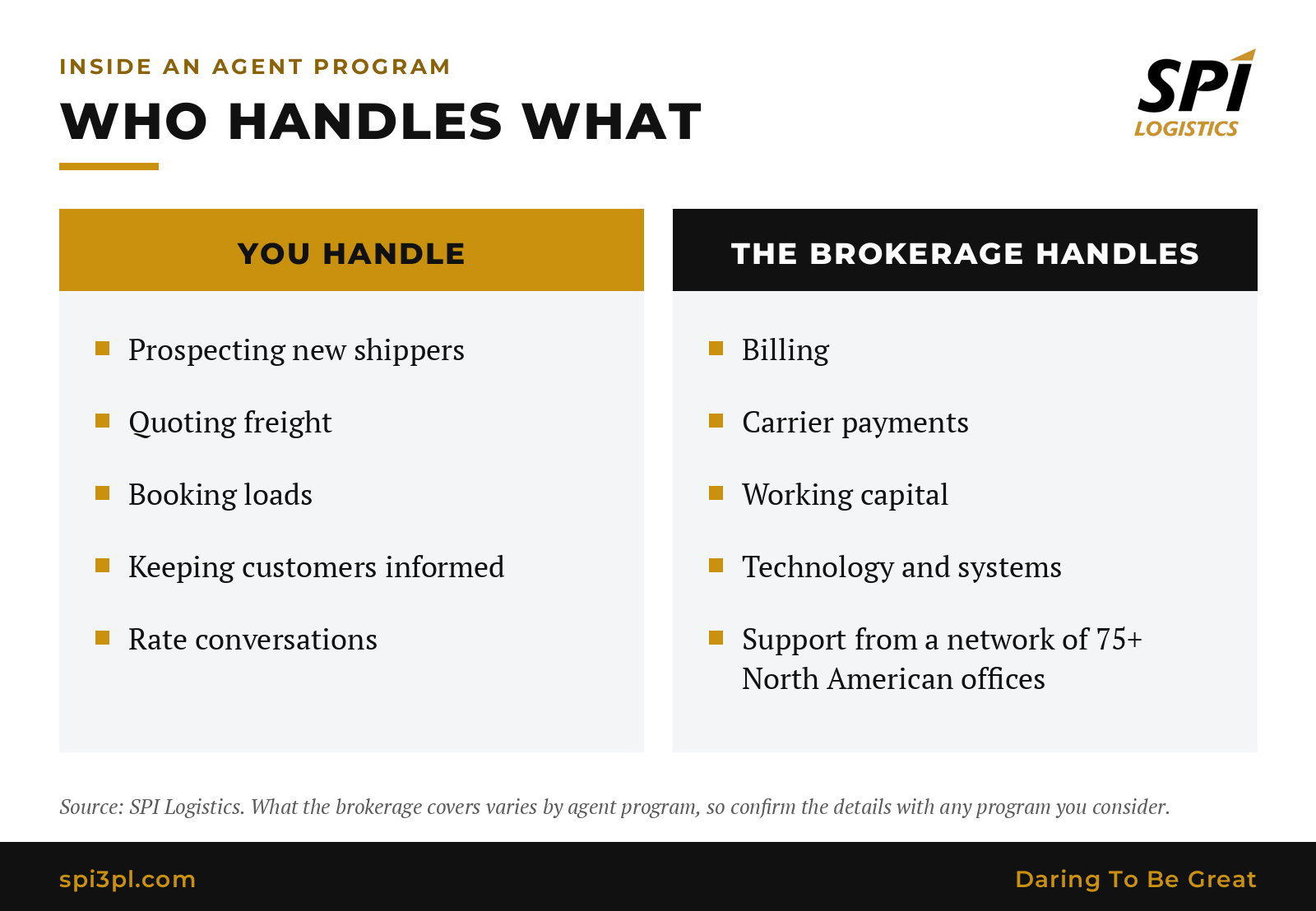
A freight agent books freight under a brokerage’s authority. The brokerage provides the back office, systems and financial backing. The agent focuses on selling, quoting and serving shippers.
The Two Models Side by Side
| Area | Freight broker (owner) | Freight agent |
| Operating authority | Holds its own | Works under the brokerage’s authority |
| Back office | Runs it in house | Provided by the brokerage |
| Working capital | Funds carrier payments and receivables | Brokerage provides the financial backing |
| Technology | Buys, runs and updates it | Provided by the brokerage |
| Daily focus | Sales plus every back office task | Selling, quoting and serving shippers |
In both models, the brokerage arranges transportation through independent motor carriers. The customer still expects a responsive person who knows their freight.
How much of your week goes to work your customers never see?
What a $1M Book Asks of an Owner in 2026
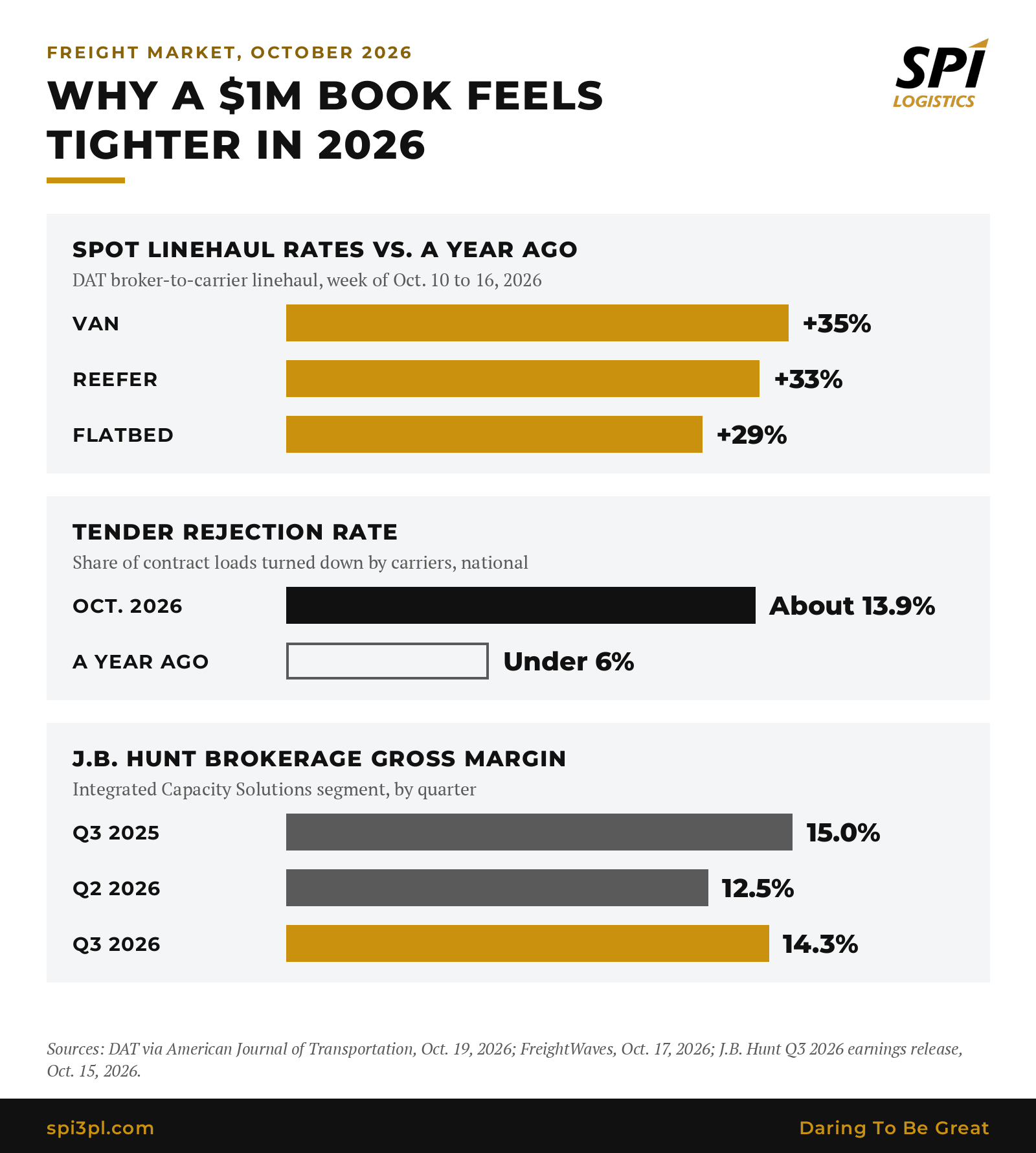
The market did not make running a small brokerage easier this year. Three numbers explain most of the pressure.
Buy Rates Moved Faster Than Many Contracts
DAT’s national averages for the week of October 10 to 16 put broker-to-carrier spot rates at $3.09 per mile for van, $3.66 for reefer and $3.64 for flatbed. Linehaul rates are “about a third above last year”: 35% for van, 33% for reefer and 29% for flatbed. [DAT via AJOT, Oct. 19, 2026]
Capacity is the reason. Truck posts on DAT One are 21% to 27% below a year ago, while load posts run 12% to 23% above. [DAT via AJOT, Oct. 19, 2026]
FreightWaves reports the national tender rejection rate holding near 13.9%. A year ago, the market entered peak season with rejections under 6%. [FreightWaves, Oct. 17, 2026]
The October 2026 Operating Reality
| Market condition | What it means for a $1M book |
| Van linehaul up 35% year over year | Buy rates rose faster than many contracts |
| Truck posts 21% to 27% below a year ago | Fewer trucks for each load |
| Load posts 12% to 23% above a year ago | More freight competing for capacity |
| Tender rejections near 13.9% | Covering freight takes more calls |
| J.B. Hunt brokerage margin 14.3% vs. 15.0% | Spreads are thinner, even at scale |
When buy rates rise faster than your customers’ contracts reprice, the spread on each load gets thinner.
Even Large Brokers Felt the Squeeze
J.B. Hunt’s brokerage segment (Integrated Capacity Solutions) reported a gross profit margin of 14.3% in the third quarter of 2026. That improved from 12.5% in the second quarter but remained below 15.0% a year earlier. [J.B. Hunt Q3 2026 Earnings Release, Oct. 15, 2026]
If a national brokerage with scale spent much of 2026 rebuilding its margin, a smaller shop carrying its own overhead felt it too.
Working Capital Does More of the Work
Higher rates mean larger carrier payments going out before customer payments come in. CNBC noted that “fuel surcharges and spot rates often lag cost increases, creating short-term cash-flow pressure” for brokers. [CNBC, Oct. 5, 2026]
On a $1M book, that gap is your money. Every point of rate inflation increases the cash you need to float between paying for capacity and collecting from shippers.
The Hats You Wear
Most owners did not start a brokerage to chase invoices. Many end up doing it anyway.
In this SPI Short, the speaker describes brokerage owners who are “wearing multiple hats” and “working 16 hours a day most days.” Many “didn’t know that the agent route was even really an option.”
As the speaker puts it, some people “just want to sell,” “operate” and “go home at night.”
“Not everybody wants to build a billion-dollar brand.”
If rates stay high into 2027, how much more cash and time will your book need from you?
What Changes When You Join an Agent Program
For an established owner, the move changes more than the paperwork. It changes how you spend your day.
Who Owns the Accounts
This is usually the first question. Before you compare splits or technology, ask in writing who owns your customer relationships if you leave.
In this SPI Short, a speaker from SPI explains that agents who join bring their existing book of business, and that SPI does not ask them to sign a non-compete that gives SPI control of those accounts. He also explains why that puts the responsibility on the brokerage to keep agents happy through support, including sales support.
Back Office Support So You Can Sell
The biggest daily change is what comes off your desk. In an agent model, the brokerage handles billing and carrier payments. That gives you time back for customers and new business.
In the Short above, the “lightbulb moment” for new agents is summed up in one line: “So, I just need to book freight and talk with my customers.”
Want to see what comes off your desk? Explore how SPI’s freight brokerage back office support works day to day.
Network Support in a Tight Market
With tender rejections near 13.9%, finding capacity takes more calls than it did a year ago. [FreightWaves, Oct. 17, 2026]
As an agent with SPI, you work alongside a transportation network of 75+ North American offices and a company with 45+ years in business. Other agents run into the same lanes and markets you do.
How You Get Paid
Agent compensation is usually a commission split on the gross margin of each load. Splits, payment timing and what the brokerage covers vary by program, so compare them side by side.
Comparing programs? See how freight broker commission structures work before you sign anything.
Keep It, Sell It or Go Agent: Three Paths Compared
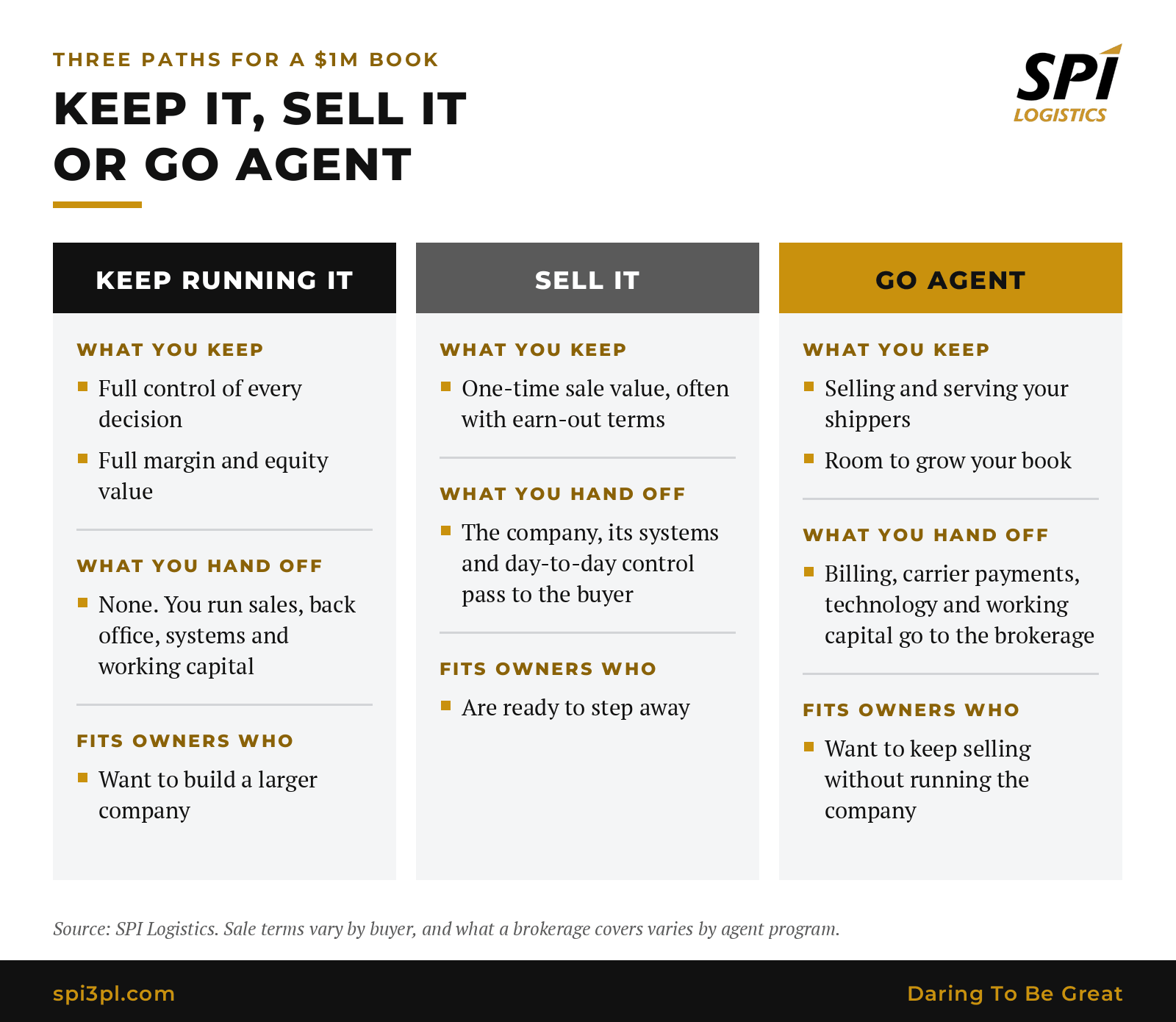
Every $1M book has three realistic paths. Each one trades control, time and capital differently.
The Three Paths Side by Side
| Factor | Keep running your brokerage | Sell your brokerage | Join an agent program |
| Control | Full control of every decision | Ends at closing, or per earn-out terms | You run your book; the brokerage sets operating standards |
| Your time | Sales plus every back office task | Depends on transition terms | Mostly sales and customer service |
| Working capital | You fund carrier payments and receivables | Converted to sale proceeds | Funded by the brokerage |
| Customer relationships | Yours | Transfer to the buyer | Depends on the agent agreement, so read it closely |
| Technology and systems | You buy, run and update them | Buyer’s systems | Provided by the brokerage |
| Upside | Full margin and equity value | One-time value, often with earn-out conditions | Commission split, with room to grow the book |
| Best fit | Owners who want to build a larger company | Owners ready to step away | Owners who want to keep selling without running the company |
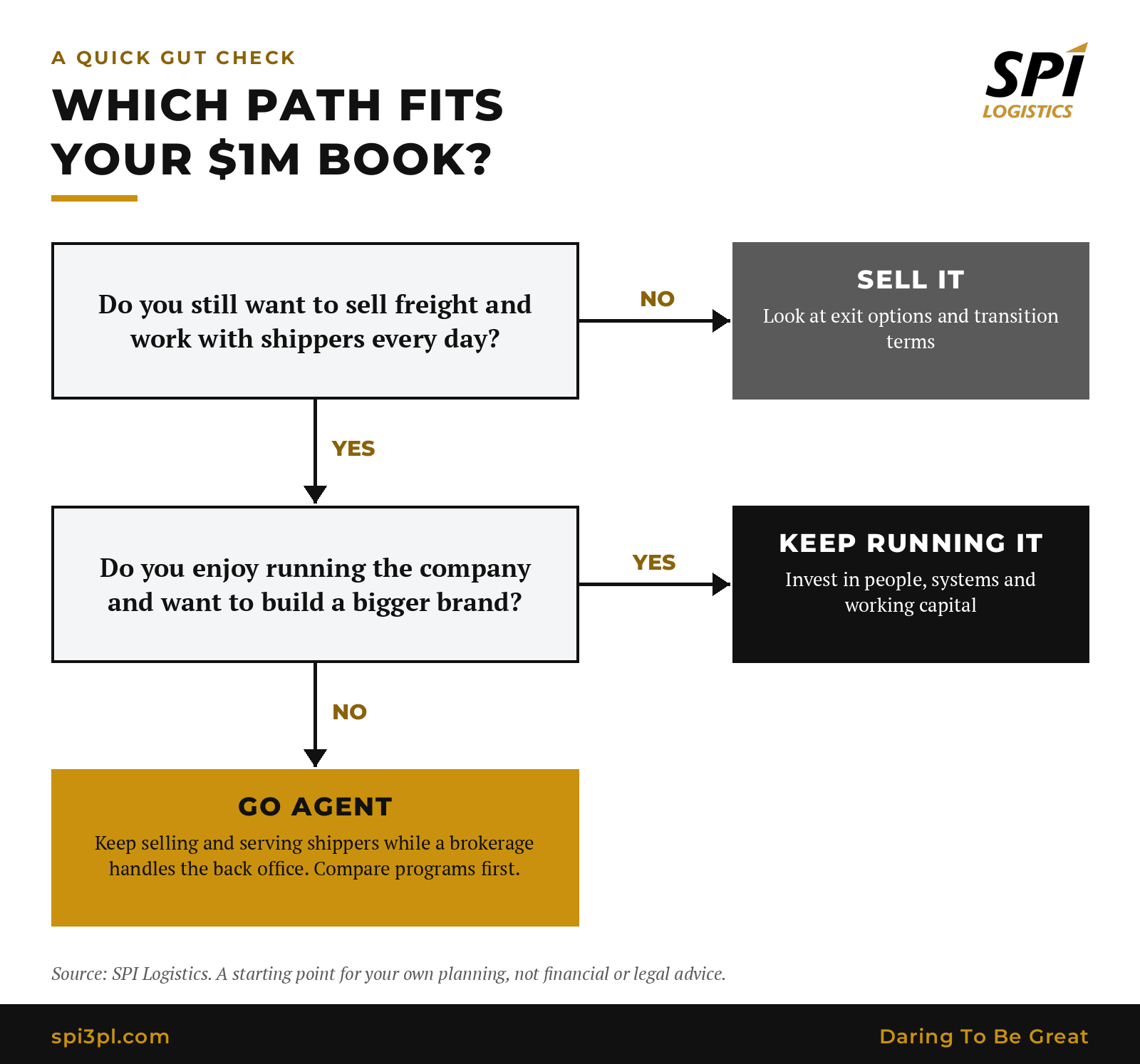
There is no single right answer. Owners who want to build a large brand and enjoy running the company should keep going.
Owners ready to step away should look at a sale. Our guide to exit strategies for independent freight brokers covers those options in detail.
The agent path fits the owner in the middle: someone who likes the customers and the freight, and is tired of the overhead.
“The right path is the one that matches how you want to spend your time, not just what the book is worth today.”
Which path matches how you want to spend the next five years?
Why the Timing Matters Now
Freight demand is starting to turn. The Cass Freight Index shipments measure rose 1.9% year over year in September, the second straight annual gain after a 3.5-year downturn, the longest on record. [Cass Information Systems, Oct. 2026]
FreightWaves expects “a market that stays tighter for longer, into 2027.” [FreightWaves, Oct. 17, 2026]
Recovering volume with tight capacity rewards brokers who can spend their hours on customers and rate conversations.
It is also when a structural change is easier to make, before peak season and 2027 bid season fill your calendar.
Want more market context? Read our freight market update on tightening capacity.
What Shippers Should Know About Agent-Based Freight Brokerages
If you ship freight, consolidation news can raise a fair question: will my service change?
In an agent-based freight brokerage, your day-to-day contact is an experienced agent who knows your freight and lanes. Behind that agent is a brokerage that handles billing, carrier payments and systems, and arranges transportation through independent motor carriers.
Questions worth asking any freight brokerage this season:
- Who is my main contact, and who covers for them after hours?
- How do you source capacity when tender rejections rise?
- How and when will I hear about rate changes on my lanes?
- What happens to my account if my rep changes companies?
SPI arranges freight solutions through its transportation network of 75+ North American offices.
Need clear expectations in a tight market? Explore SPI’s shipping services and see how an agent-based brokerage supports your lanes.
6 Questions to Ask Before You Join a Freight Agent Program
If you are leaning toward the agent route, use these six checkpoints before you sign.
1. Account Ownership
Get the account ownership terms in writing before anything else.
2. Back Office Coverage
Ask what the back office covers: billing, collections, carrier payments and credit.
3. Commission and Payment Timing
Compare commission splits along with payment timing. A split means little if you wait too long to be paid.
4. Technology on Your Lanes
Ask for a technology demo using your own lanes, not a generic walkthrough.
5. Support When Capacity Tightens
Ask how the brokerage supports agents when tender rejections rise.
6. Agents Like You
Talk to current agents with a book similar in size to yours.
For a deeper list, read what successful brokers evaluate before joining a freight agent program. To see what the start looks like, read your first 90 days as an SPI freight agent.
Which of these six questions would be hardest to answer about your current setup?
Frequently Asked Questions (FAQs)
1. Is a freight agent the same as a freight broker?
No. A freight broker holds the operating authority and runs the company. A freight agent books freight under a brokerage’s authority and focuses on customer relationships and sales.
2. Do freight agents need their own broker authority?
Generally, no. Agents work under the authority of the brokerage they partner with. Confirm the specific requirements with any program you consider.
3. Can I bring my existing customers to an agent program?
That depends on the program and the agent agreement. Ask who owns the accounts, and get the answer in writing.
4. What does a freight agent do day to day?
Agents prospect and serve shippers, quote freight, book loads and keep customers informed. The brokerage handles back office work such as billing and carrier payments.
5. Is it better to sell my brokerage or become an agent?
It depends on your goals. Selling usually means stepping away. Joining an agent program lets you keep selling and serving customers without running the company.
Spend More of Your Week on Customers
A $1M book is worth protecting. In 2026, protecting it may mean changing the structure around it.
Rates are up, capacity is tight and consolidation is reaching smaller brokers. That makes how you spend your hours more important going into 2027.
If you run a brokerage with a $1M book and want to keep selling without running the company, see how independent brokers join SPI as agents.
If you ship freight and want clear expectations in a tight market, talk to SPI or explore our shipping services.
References
CNBC. (2026, October 5). C.H. Robinson to buy RXO for $5.8 billion in truck broking expansion. Retrieved from
https://www.cnbc.com/2026/10/05/ch-robinson-buy-freight-broker-rxo.html
Transport Topics. (2026, October 6). C.H. Robinson-RXO deal may spur brokerage consolidation. Retrieved from
https://www.ttnews.com/articles/ch-robinson-rxo-consolidate
FreightWaves. (2026, October 6). Freight’s Next Move Matters More Than the Last 18 Months. Retrieved from
https://www.freightwaves.com/news/freights-next-move-matters-more-than-the-last-18-months
American Journal of Transportation. (2026, October 19). DAT spot truckload pricing and load-to-truck ratios for Oct. 10-16, 2026 (Week 42). Retrieved from
https://www.ajot.com/news/dat-spot-truckload-pricing-and-load-to-truck-ratios-for-oct-1016-2026-week-42
FreightWaves. (2026, October 17). No signs of truckload capacity recovering. Retrieved from
https://www.freightwaves.com/news/no-signs-of-truckload-capacity-recovering
J.B. Hunt Transport Services. (2026, October 15). Third Quarter 2026 Earnings Release. Retrieved from
https://www.jbhunt.com/content/dam/jbhunt/jbh/investor-relations/documents/earnings-releases/Q3_2026_Earnings_Release.pdf
Cass Information Systems. (2026). Cass Transportation Index Report, September 2026. Retrieved from
https://www.cassinfo.com/freight-audit-payment/cass-transportation-indexes/september-2026