The easy answer is: intermodal is cheaper, truckload is faster.
The useful answer is: it depends on the lane.
That distinction matters a lot more in Q3 2026 than it did a year or two ago. Truckload pricing has moved sharply higher, capacity has become less forgiving, and rail is benefiting from the growing gap between what shippers are willing to pay for a truck and what they actually need in terms of transit speed.
DAT’s June data put national dry-van spot linehaul at $2.37 per mile, up 45.6% year over year, while spot rates moved above contract linehaul for the first time since February 2022. At the same time, the dry-van load-to-truck ratio remained 83.2% above year-ago levels. [Ryan Transportation, July 2026]
Rail is moving in the opposite direction. InTek reported U.S. intermodal volume up 7.2% year over year in the week ending July 18, while Union Pacific reported domestic intermodal volume up approximately 19%. InTek also reported that its door-to-door, ex-fuel truck-versus-intermodal spread had widened to roughly $1.19 per mile, compared with about $0.48 a year earlier. [InTek Logistics, July 2026]
So yes, truckload vs intermodal is becoming a much more interesting conversation.
But here’s the catch: not every expensive truckload should be converted to rail.
The best brokers know which lanes are genuinely good candidates and which ones should stay on the road.
Why This Decision Matters More in Q3 2026
The freight market isn’t simply experiencing a demand boom. It’s experiencing a capacity-and-cost problem.
FreightWaves reported that spot and contract rates were rising while truckload capacity remained constrained, with long-term contract rates already up roughly 8% from the previous fall. Attractive rate spreads were also helping drive domestic intermodal growth. [FreightWaves, May 2026]
That creates an unusual situation for brokers.
A shipper may tell you, “We’re not moving more freight.” And they’re right. But the carrier may still say, “That lane costs more now.”
Both can be true.
The 2026 paradox
| What the shipper sees | What the broker sees |
| Freight volumes aren’t exploding | Reliable truck capacity is harder to secure |
| Transportation budget is under pressure | Truckload rates are rising |
| Delivery requirements haven’t changed | Carrier operating economics have |
| Truckload has always worked | Alternative modes now deserve another look |
That’s why truckload vs intermodal shouldn’t be treated as a once-a-year bid decision. It should be a lane-level decision that gets revisited when market economics change.
“When the market changes faster than the customer’s routing guide, the broker’s job is to challenge the routing guide, not blindly follow it.”
Which of your customers still has lanes designed for a freight market that no longer exists?
What Changed in Truckload Pricing and Capacity?
The most important change isn’t simply that rates are higher. It’s that the cost of choosing a truckload has become harder to ignore.
DAT’s June dry-van data showed spot linehaul at $2.37 per mile, up 45.6% year over year. Contract linehaul was also up 13.1% year over year, while spot rates had moved to a 4.4% premium over contract linehaul. [Ryan Transportation, July 2026]
That changes the conversation with shippers.Previously, the question might have been: “Can we get a truck?”
Now it’s increasingly: “Should we pay for a truck for this particular shipment?”
That’s a very different question.
A broker who only searches an intermodal load board after failing to cover a truckload is already late to the conversation.
Instead, mode selection should happen before capacity becomes a problem.
What tightening truckload capacity changes
- Long-haul truckload become more expensive to protect.
- Premium capacity becomes harder to justify for routine freight.
- Shippers become more receptive to rail alternatives.
- Brokers have more room to discuss service-versus-cost tradeoffs.
- Intermodal becomes a strategic option rather than a backup plan.
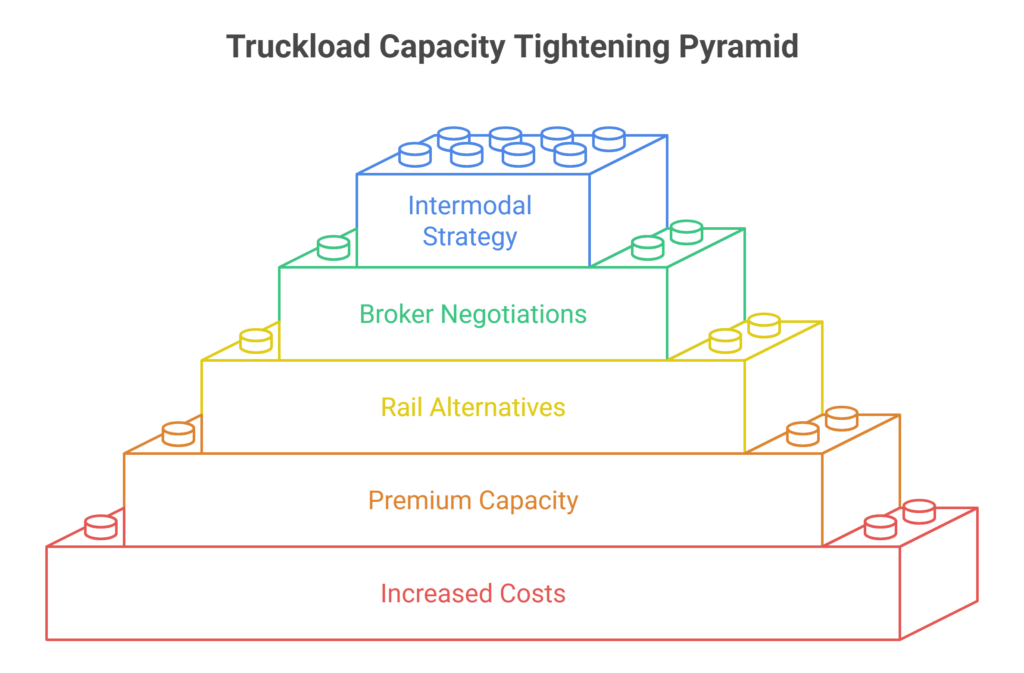
The important point is that higher truckload pricing doesn’t automatically make rail better. It simply makes the cost of ignoring rail higher.
“Intermodal becomes interesting when the premium you’re paying for truckload is buying speed the customer doesn’t actually need.”
How many of your truckload customers are paying for speed they aren’t actually using?
Where Intermodal Is Winning Right Now
The strongest opportunities aren’t necessarily the lanes with the cheapest rail quote. They’re the lanes where the service requirements and rail network actually line up.
Current volume data is encouraging. InTek reported intermodal volume up 7.2% year over year in mid-July, while Union Pacific’s domestic intermodal volume was approximately 19% higher. [InTek Logistics, July 2026]
That growth is happening alongside a widening truck-versus-rail price gap. The result is a pretty compelling proposition for certain shippers:
If the freight can tolerate a little more transit complexity, why pay truckload prices simply because that’s what you’ve always used?
Strong intermodal candidates
| Lane/Freight Characteristic | Intermodal Fit |
| 750+ miles | Strong |
| Predictable weekly volume | Strong |
| Flexible delivery window | Strong |
| High truckload premium | Strong |
| Time-critical shipment | Weak |
| Unpredictable pickup times | Weak |
| Limited rail connectivity | Weak |
| Multiple special handling requirements | Weak |
The strongest intermodal shipping candidates tend to have enough distance and volume to absorb the additional handoffs.
They also have customers who care about transportation cost without requiring every shipment to arrive at exactly the earliest possible minute.
That is where a good broker can uncover savings without compromising the customer’s actual service requirement.
“The best intermodal conversion isn’t the one that produces the biggest rate reduction. It’s the one where the customer barely notices the mode changed.”
Which of your long-haul lanes could tolerate a longer transit window without affecting the customer’s operation?
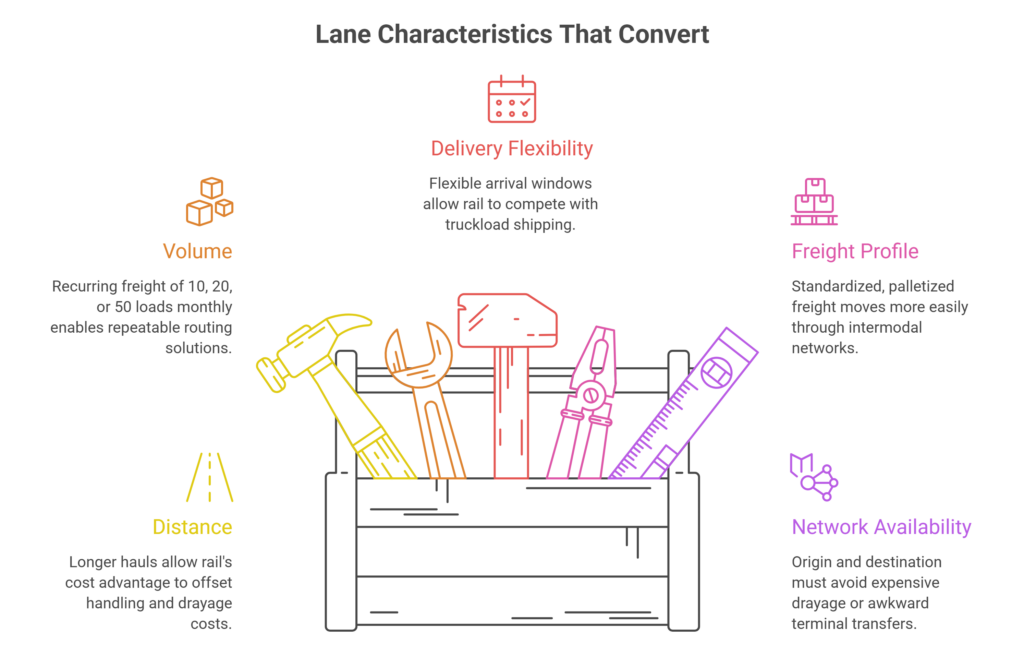
The Lane Characteristics That Actually Convert.
A good broker should evaluate at least five things:
1. Distance
The longer the haul, the more opportunity there is for rail’s cost advantage to offset additional handling and drayage.
A 300-mile shipment isn’t usually where you start. A 1,500-mile shipment? Now the conversation gets much more interesting.
2. Volume
One random shipment isn’t necessarily enough to justify building an intermodal strategy.
Recurring freight is different. If a customer moves 10, 20, or 50 similar loads every month, the broker can build a repeatable routing solution.
3. Delivery Flexibility
If the customer says: “It absolutely has to arrive tomorrow morning.”
Truckload probably wins.
If they say: “It needs to arrive sometime Thursday or Friday.”
Now rail has room to compete.
4. Freight Profile
Standardized, palletized freight tends to be easier to move through an intermodal network than freight requiring unusual handling or specialized equipment.
5. Network Availability
A cheap theoretical rail rate means nothing if the origin and destination require expensive drayage or awkward terminal transfers.
The Conversion Test
| Question | If “Yes” |
| Is the lane long-haul? | Consider intermodal |
| Is volume recurring? | Consider intermodal |
| Is delivery flexible? | Stronger candidate |
| Is freight standardized? | Stronger candidate |
| Is rail service available at both ends? | Strong candidate |
This is why simply searching an intermodal load board isn’t enough. You need to understand the entire door-to-door movement.
“The rail rate is only one number in an intermodal move. The real comparison is total landed transportation cost plus the value of the service you gain or lose.”
Want to make smarter lane and mode decisions for your customers? Explore SPI’s freight broker education and sharpen the expertise behind every recommendation.
Where Truckload Should Stay Truckload
Here’s the part that makes this a real mode-selection guide instead of an intermodal sales pitch: Some freight should absolutely stay on a truck.
Trying to convert every expensive truckload into rail can create a different kind of problem.
Truckload remains the better option when:
- The shipment has a tight delivery appointment.
- The customer has little tolerance for variability.
- The lane is relatively short.
- Pickup or delivery locations are far from rail terminals.
- Freight requires specialized equipment.
- The customer needs direct point-to-point movement.
- A missed delivery would cost more than the transportation savings.
Consider a manufacturer shipping an urgent production component 600 miles to a plant with a scheduled production run.
Saving $500 on transportation isn’t a victory if the plant shuts down because the shipment arrives late.
Truckload vs. Intermodal
| Priority | Better Choice |
| Fastest possible transit | Truckload |
| Direct door-to-door service | Truckload |
| Tight appointment | Truckload |
| Long-haul cost reduction | Intermodal |
| Predictable recurring freight | Intermodal |
| Flexible delivery | Intermodal |
| Specialized equipment | Usually truckload |
The smartest broker isn’t trying to sell rail. They’re trying to protect the customer’s business.
“A mode shift that saves $800 in freight but creates $8,000 in operational exposure isn’t a savings strategy.”
Are you measuring transportation savings against the customer’s actual cost of a service failure?
How Cross-Border and Drayage Complexity Changes the Decision
The cross border freight conversation is more complicated because the shipment rarely moves as a simple origin-to-destination transaction.
C.H. Robinson reported that Mexico-U.S. freight conditions remained under pressure in July, with border congestion, extended dwell times, limited trucking capacity, and coordination challenges affecting onward pickup and delivery. [C.H. Robinson, July 2026]
The company also reported that tighter enforcement around B-1 visas, English-language requirements, and restrictions affecting Mexican carriers had reduced cross-border driver availability. [C.H. Robinson, June 2026]
That makes cross border freight a particularly interesting case for mode diversification, but also one where bad planning gets punished quickly.
Intermodal can help in some long-haul movements, but the drayage component becomes critical.
Think Door-to-Door, Not Rail-to-Rail
A cross-border shipment might involve:
Mexican pickup → border transfer → customs → drayage → rail → destination drayage → final delivery
Every handoff introduces another opportunity for delay. That’s why drayage loads need to be evaluated alongside rail capacity, border timing, customs requirements, equipment availability, and final delivery appointments.
A broker that quotes only the rail portion isn’t really solving the shipment. They’re solving one piece of it.
“Cross-border intermodal works when the handoffs are engineered as carefully as the rail movement itself.”
If you removed the word “rail” from your cross-border plan, would the remaining drayage and border process still make sense?
The Broker Checklist for Presenting a Mode Shift
Before recommending a shift, ask:
- What is the actual delivery requirement?
- How much transit variability can the customer tolerate?
- What does the current truckload solution cost door-to-door?
- What would drayage and accessorials add to the intermodal option?
- How consistent is the rail service on this particular lane?
- Is the freight recurring enough to justify a structured mode strategy?
- What happens financially if the shipment arrives late?
Then present the options side by side.
Example Shipper Conversation
| Option | Cost | Transit | Risk | Best For |
| Truckload | Higher | Fast | Lower handoffs | Time-critical freight |
| Intermodal | Lower potential cost | Longer | More handoffs | Flexible long-haul |
| Hybrid strategy | Variable | Balanced | Managed | Recurring freight |
This is also where terms such as partial truckload vs LTL matter.
Not every shipment needs a full truck, and not every shipment belongs on rail. A broker who understands the entire mode spectrum can find a solution instead of forcing freight into a preferred product.
“The strongest mode recommendation is the one that lets the shipper see exactly what they’re trading: money, time, flexibility, or risk.”
Want to present smarter mode options without doing it all alone? See how SPI’s independent agent model gives experienced brokers the support and resources to serve customers more strategically.
Frequently Asked Questions(FAQs)
1. When is intermodal better than truckload?
Intermodal is generally worth evaluating for longer, recurring lanes with flexible delivery windows, standardized freight, and sufficient rail connectivity. The economics become especially attractive when truckload rates rise significantly above rail alternatives.
2. Does cross-border freight always work well with intermodal?
No. Cross border freight requires careful evaluation of border crossings, customs, drayage availability, rail service, and final-mile delivery. A rail rate can look attractive while the total door-to-door solution is not.
3. Should every expensive truckload be converted to intermodal?
Definitely not. Time-critical shipments, short-haul freight, specialized equipment, tight appointments, and shipments with expensive failure consequences may still be better served by truckload.
Don’t Choose a Mode. Choose the Right Strategy.
The truckload vs intermodal decision in 2026 isn’t really about choosing one mode over another. It’s about knowing when each mode earns its place.
Truckload still wins when speed, control, and simplicity matter most. Intermodal becomes increasingly compelling when the lane is long, recurring, flexible, and expensive to serve with increasingly constrained truck capacity. And for cross border freight, the answer often depends on whether the broker can successfully coordinate the drayage, border, rail, and final-mile pieces as one movement.
That’s where experienced brokers have an advantage.
They don’t simply search for the lowest rate. They look at the lane, the customer’s tolerance for risk, the available capacity, the total door-to-door cost, and what could go wrong after the load leaves the dock.
In a tightening market, having more than one answer is becoming a competitive advantage.
If you already manage a book and want stronger intermodal, drayage, and cross-border execution behind it, talk to SPI about the agent program.
References
C.H. Robinson. (2026). Freight Market Update: July 2026 – Mexico Freight Costs Rise and Canada Waits for Clarity. Retrieved from https://www.chrobinson.com
C.H. Robinson. (2026). June 2026 North America Freight Market Update. Retrieved from https://www.chrobinson.com
FreightWaves. (2026). State of the Industry: May 2026. Retrieved from https://www.freightwaves.com
InTek Logistics. (2026). July 2026 Monthly Intermodal Shipping Report. Retrieved from https://www.inteklogistics.com
Ryan Transportation. (2026). July 2026 Industry Update: Dry Van. Retrieved from https://www.ryantrans.com
The Wall Street Journal. (2026). Rising Trucking Rates Drive U.S. Companies Back to the Railroad. Retrieved from https://www.wsj.com