For years, choosing between truckload and intermodal felt relatively straightforward.
If a shipment needed to get there quickly, you booked a truck. If cost mattered more than transit time, you considered rail. Most of the decision came down to budget and urgency.
That equation is changing.
Now, the freight market is forcing brokers and shippers to think differently. Capacity is tightening, transportation pricing continues to climb, and service reliability has become just as important as rate negotiations. Suddenly, selecting the right mode is no longer just an operational decision, it has become a competitive advantage.
This is exactly why intermodal loads are getting renewed attention.
Many experienced brokers are discovering that certain lanes perform better when moved through intermodal networks rather than traditional truckload. At the same time, truckload remains the best solution for many shipments that require flexibility, tighter appointment windows, or shorter transit distances.
The real skill isn’t choosing one over the other. It’s knowing when each mode creates the best outcome for your customer. That distinction separates experienced brokers from transactional ones.
According to the Logistics Managers’ Index (LMI), May 2026 transportation prices reached 96.0, one of the highest readings in recent years, while transportation capacity remained at 31.7, indicating that available capacity continues to tighten [Logistics Managers’ Index, 2026].
Meanwhile, the Cass Freight Index reported that overall shipments declined 1.2% year-over-year, yet truckload linehaul pricing increased 6.9% during the same period [Cass Information Systems, 2026].
At first glance, those numbers seem contradictory. Fewer shipments usually suggest weaker pricing. Instead, pricing continues to rise because capacity is tightening faster than freight demand is falling.
That changes how experienced brokers evaluate every shipment. Rather than automatically searching an intermodal load board or immediately securing truckload capacity, they begin asking a more valuable question: Which transportation mode gives my customer the best combination of cost, reliability, and service?
Why Tighter Freight Markets Make Mode Choice More Important
Freight markets rarely tighten evenly.
Some regions experience capacity shortages before others. Certain equipment types become scarce faster than dry vans. Long-haul freight may tighten while regional lanes remain relatively stable.
That’s why experienced brokers pay attention to market signals instead of headlines.
A common misconception is that tighter markets simply mean higher truckload rates. In reality, tighter markets force brokers to think differently about how freight moves altogether.
Recent market indicators paint an interesting picture.
| Market Indicator | What It Suggests |
| Transportation Prices: 96.0 | Shipping costs continue climbing |
| Transportation Capacity: 31.7 | Available trucks remain limited |
| Shipments: -1.2% YoY | Freight demand isn’t booming |
| Truckload Linehaul: +6.9% YoY | Capacity is driving pricing |
Sources: Logistics Managers’ Index; Cass Freight Index [LMI, 2026; Cass Information Systems, 2026].
This creates what many brokers call a capacity paradox. Freight volumes haven’t exploded. Yet carriers have become more selective.
Why?
Several factors are contributing:
- Carriers are rejecting low-margin freight more frequently.
- Operating costs remain elevated.
- Drivers are prioritizing consistent, profitable lanes.
- Compliance requirements continue removing some equipment from active capacity.
- More brokers are competing for fewer dependable carriers.
The result is that truckload pricing continues to strengthen even without a dramatic increase in shipments.
This is exactly where intermodal loads become strategically valuable.
Instead of fighting increasingly competitive truckload markets on every long-haul shipment, brokers can evaluate whether rail-supported transportation offers a better balance between service and cost.
Mode selection becomes a margin decision, not just a transportation decision.
The brokers who understand this shift become advisors. The brokers who ignore it often end up competing solely on price.
“Every tightening market rewards brokers who understand options instead of relying on habits.”
When was the last time you challenged an existing truckload lane simply because market conditions had changed?`
When Intermodal Outperforms Truckload on Cost and Consistency
Intermodal transportation isn’t replacing truckload. It’s replacing the assumption that truckload is always the best answer.
There are many situations where intermodal simply performs better. The obvious advantage is cost.
Rail transportation typically becomes more economical over longer distances because fuel efficiency and network scale reduce operating costs.
However, experienced brokers know that cost isn’t the only benefit. Consistency has become equally valuable.
Now, Intermodal networks are significantly more sophisticated than they were a decade ago. Better terminal visibility, improved scheduling, stronger drayage coordination, and enhanced shipment tracking have made intermodal far more predictable on many lanes.
For shippers moving freight across predictable, recurring routes, that consistency often matters more than shaving a few hours off transit time.
Intermodal tends to outperform truckload when:
1.Long-Haul Freight
Rail becomes increasingly efficient on shipments traveling several hundred miles or more.
Examples include:
- Midwest to West Coast
- Southeast to Southwest
- Chicago to Dallas
- Southern California to Memphis
2. Predictable Production Schedules
Manufacturers with recurring freight schedules often benefit from consistent rail departures rather than relying on volatile truckload availability.
3. Cost-Control Initiatives
Companies facing transportation budget pressure frequently evaluate intermodal before reducing shipment frequency or inventory levels.
4. Capacity-Constrained Markets
When truckload capacity tightens, intermodal provides another transportation option rather than forcing brokers into increasingly expensive spot markets.
Truckload vs. Intermodal Comparison
| Factor | Truckload | Intermodal |
| Transit Speed | Faster | Moderate |
| Long-Distance Cost | Higher | Lower |
| Fuel Efficiency | Lower | Higher |
| Capacity During Tight Markets | Can become scarce | Often more stable |
| Best For | Time-sensitive freight | Planned freight with flexible delivery windows |
One important misconception deserves attention. Many people believe intermodal is slow.
That’s not necessarily true.Intermodal is scheduled. Those are very different concepts.
A well-planned intermodal shipment that leaves exactly when expected can outperform a truckload shipment delayed because capacity disappeared overnight.
That’s why many experienced brokers regularly monitor an intermodal load board alongside traditional truckload capacity.
They’re not simply looking for lower prices. They’re evaluating which mode creates the strongest outcome.
Example Lane Scenario
A consumer goods shipper moving recurring freight from Chicago to Southern California initially relied entirely on truckload. As pricing became less predictable, the broker reviewed the lane and identified an intermodal option supported by local drayage at both ends. While transit time increased by one day, transportation costs became more stable, capacity improved, and the shipper was able to plan inventory more effectively without increasing overall logistics spend.
“Customers rarely remember which mode moved their freight. They remember whether their freight arrived when promised.”
Are your customers asking for truckload because it’s truly the best option, or simply because it’s the option they’re familiar with?
Where Intermodal Breaks Down: Timing, Drayage, Inland Rail, and Service Windows
Intermodal is not the answer to every freight challenge.
One mistake inexperienced brokers make is assuming lower transportation costs automatically make intermodal the better solution.
That assumption can create expensive service failures. The reality is that intermodal depends on a network of moving parts working together.
Unlike truckload, where a single driver typically controls the shipment from pickup to delivery, intermodal freight involves multiple handoffs.
Those handoffs introduce additional variables that brokers need to manage carefully.
Common challenges include:
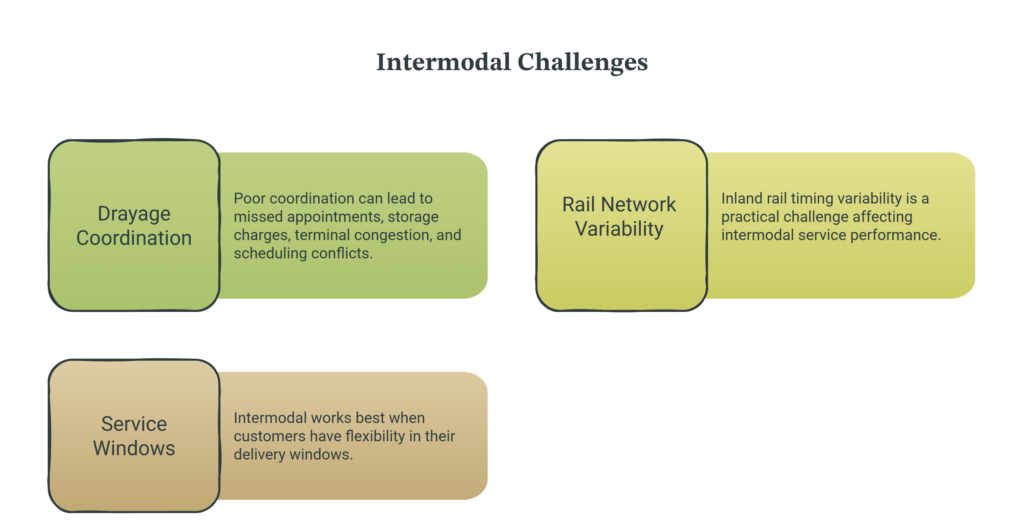
1. Drayage Coordination
Every intermodal shipment requires local drayage movements between customer facilities and rail terminals.
Poor coordination can create:
- Missed appointments
- Additional storage charges
- Terminal congestion
- Scheduling conflicts
This is why experienced brokers don’t just look for intermodal loads. They also maintain reliable relationships through a dependable drayage load board and trusted local drayage providers.
2. Rail Network Variability
According to C.H. Robinson’s June 2026 market update, inland rail timing variability remains one of the most practical challenges affecting intermodal service performance [C.H. Robinson, 2026].
Rail congestion doesn’t happen everywhere. But when it does, it can affect entire transportation schedules.
3. Service Windows
Intermodal works best when customers have flexibility.
If a shipment absolutely must arrive tomorrow morning, truckload usually remains the better solution.
If delivery windows allow additional planning, intermodal often creates stronger overall value.
How Experienced Brokers Decide Between Truckload and Intermodal
The decision starts long before a shipment is posted to an intermodal load board or a truckload marketplace. It begins with understanding the customer’s business, the characteristics of the freight, and the risks associated with the lane.
Experienced brokers don’t ask, “Can I move this load?”. They ask, “What’s the smartest way to move this load?”
That difference creates better service, stronger customer relationships, and healthier margins.
Before recommending truckload or intermodal loads, experienced brokers typically evaluate several operational factors:
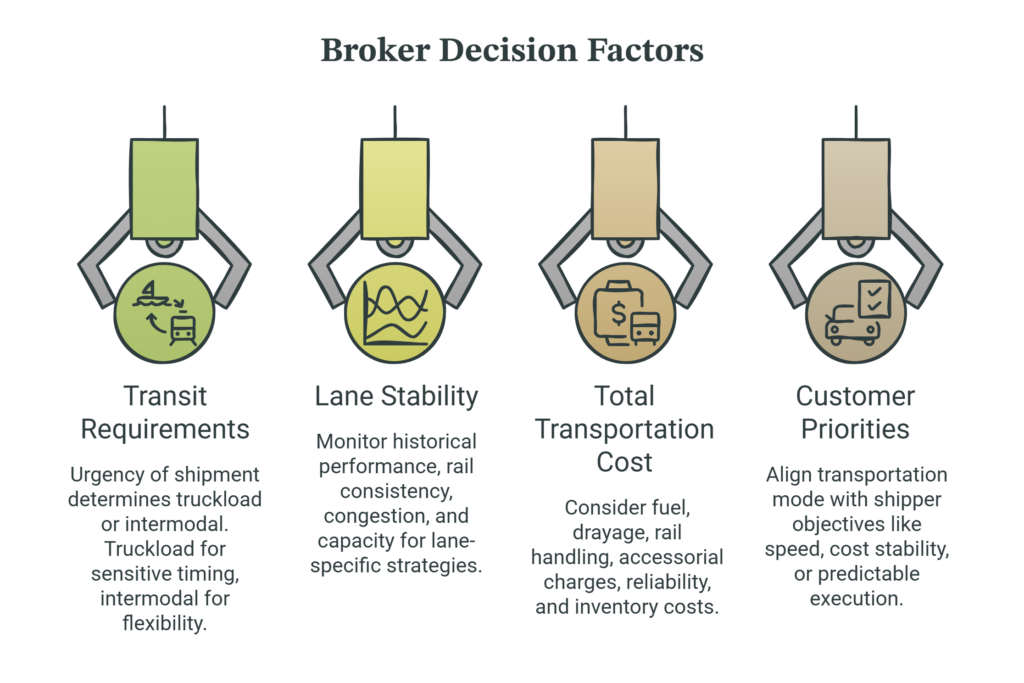
1.Transit Requirements
Every shipment has a different level of urgency.
If timing is extremely sensitive, truckload often remains the preferred option.
If transit flexibility exists, intermodal may provide a more cost-effective and reliable solution.
2. Lane Stability
Some lanes consistently perform well in intermodal networks, while others remain heavily dependent on truckload.
Brokers monitor:
- Historical transit performance
- Rail service consistency
- Seasonal congestion
- Capacity fluctuations
Rather than assuming every lane behaves similarly, they build lane-specific strategies.
3. Total Transportation Cost
Transportation cost is more than the linehaul rate.
Experienced brokers consider:
- Fuel exposure
- Drayage costs
- Rail handling
- Accessorial charges
- Appointment reliability
- Inventory carrying costs
Sometimes truckload appears cheaper until service disruptions create additional expenses.
4. Customer Priorities
Not every shipper measures success the same way.
Some prioritize speed. Others prioritize cost stability. Others simply want predictable execution every week.
The best brokers align transportation mode with business objectives, not assumptions.
| Decision Factor | Truckload | Intermodal |
| Urgent Freight | Best Fit | Limited |
| Long-Distance Lanes | Moderate | Strong Fit |
| Flexible Delivery Windows | Good | Excellent |
| Cost Stability | Moderate | Strong |
| Recurring Freight Programs | Good | Excellent |
The strongest brokers don’t become experts in one transportation mode. They become experts in knowing when to use each one.
“Mode selection is becoming one of the biggest competitive advantages brokers can offer. Customers notice when recommendations are based on strategy instead of habit.”
Wondering what separates top-performing brokers from everyone else when choosing the right mode? Learn what successful freight agents do differently.
What Shippers Should Ask Before Shifting a Lane
Changing transportation modes isn’t something shippers should do simply because someone offers a lower rate.
A successful shift from truckload to intermodal requires planning, communication, and realistic expectations.
Before making that decision, shippers should ask their brokerage partner several important questions.
1. Is this lane actually a good fit for intermodal?
Distance alone doesn’t determine success. Rail availability, terminal access, and local drayage support all matter.
2. What happens if rail schedules change?
Every transportation network experiences disruptions. Strong brokers already have contingency plans in place.
3. Who handles the drayage?
Intermodal success depends heavily on reliable first-mile and final-mile execution. Without dependable drayage providers, even the best rail service can become problematic.
4. What visibility will we have?
Customers should expect:
- Shipment tracking
- Milestone updates
- Delay notifications
- Clear communication
Visibility shouldn’t disappear just because freight moves on rail.
5. How does this affect inventory planning?
Sometimes accepting an additional transit day actually improves supply chain efficiency if transportation costs become significantly more predictable.
A good broker helps customers evaluate these tradeoffs instead of simply quoting rates.
“The best transportation decisions happen before freight moves, not after service problems appear.”
Are your transportation decisions driven by today’s freight rate or by your long-term supply chain strategy?
Why Mode Depth Matters When Brokers Evaluate Brokerage Platforms
One of the biggest misconceptions in brokerage is that success comes from having access to more load boards.
In reality, experienced brokers succeed because they have access to more solutions. Many independent brokers can find truckload capacity.
Fewer have reliable access to:
- Established intermodal load board networks
- Trusted container load board relationships
- Proven drayage load board providers
- Cross-functional operations teams
- Intermodal specialists who understand rail scheduling
That operational depth becomes increasingly valuable as markets tighten.
According to C.H. Robinson’s June 2026 market analysis, average route guide depth sits around 1.48, increasing to 1.78 for longer-haul freight [C.H. Robinson, 2026].
This suggests shippers are relying on multiple carriers to secure capacity, especially on longer-distance lanes.
For brokers, that means one thing: Customers expect options. If your brokerage platform only supports traditional truckload execution, you’re limiting the advice you can offer.
The strongest brokerages provide the flexibility to evaluate truckload, rail, drayage, and cross border logistics together rather than treating them as separate businesses.
That flexibility improves customer trust because recommendations become solution-driven instead of mode-driven.
“Customers rarely ask for an intermodal. They ask for a better outcome. It’s the broker’s job to know when intermodal delivers one.”
Does your current brokerage platform expand your transportation options, or limit them?
How SPI Supports Intermodal and Drayage Execution
The current freight market rewards brokers who can provide transportation solutions, not just transportation capacity.
At SPI, that philosophy shapes how agents approach every shipment.
Rather than defaulting to truckload, experienced agents have access to broader operational support that helps them evaluate the best transportation mode for each customer’s needs.
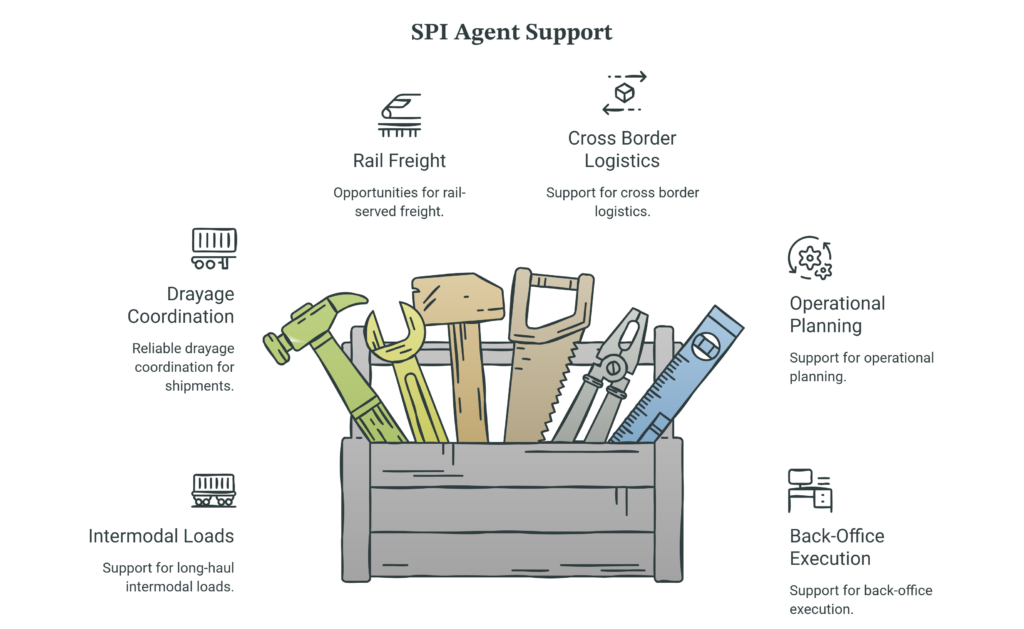
That includes support for:
- Long-haul intermodal loads
- Reliable drayage coordination
- Rail-served freight opportunities
- Cross border logistics
- Operational planning
- Back-office execution
This matters because successful intermodal freight depends on more than simply finding capacity.
It requires coordination between:
- Rail providers
- Drayage carriers
- Customer facilities
- Appointment schedules
- Shipment visibility
- Administrative support
When those pieces work together, intermodal becomes a competitive advantage rather than simply another transportation option.
For independent brokers, having experienced operational support behind the scenes allows them to spend more time advising customers and less time managing avoidable problems.
In tightening freight markets, that’s often the difference between protecting margins and chasing freight.
“The broker who understands multiple transportation modes becomes far more valuable than the broker who only understands one.”
Ready to grow with a brokerage that gives you real intermodal, drayage, and operational support? Discover what it’s like to become an SPI freight agent.
Frequently Asked Questions(FAQs)
1.What are intermodal loads?
Intermodal loads are shipments that move using more than one mode of transportation, typically combining rail and truck. Freight remains inside the same shipping container while the transportation method changes, reducing handling and improving efficiency on longer routes.
2. When is intermodal better than truckload?
Intermodal is often the better choice for long-distance freight, recurring shipping schedules, and customers looking for greater cost stability. Truckload generally remains the better option for expedited shipments, tighter delivery windows, or lanes without strong rail access.
3. How do brokers get intermodal loads?
Brokers typically secure intermodal loads by working with rail providers, intermodal carriers, drayage partners, and an intermodal load board. Success depends on understanding lane characteristics, coordinating drayage, and selecting the right mode based on customer needs rather than simply choosing the lowest rate.
The Right Mode Can Make or Break Your Freight Strategy
As freight markets tighten, choosing between truckload and intermodal is no longer just an operational decision, it is becoming a strategic one.
The data tells a clear story. Transportation prices continue to rise even though overall shipment volumes remain relatively soft. Capacity is becoming more selective, long-haul truckload pricing is strengthening, and shippers are looking for ways to improve both cost control and service reliability. In this environment, experienced brokers separate themselves by understanding when intermodal loads create better outcomes and when truckload remains the smarter option.
That doesn’t mean intermodal is the answer for every shipment. Timing, drayage coordination, rail reliability, and customer expectations all influence the right decision. The brokers who consistently earn long-term trust are the ones who evaluate every lane individually instead of relying on the same solution every time.
As transportation networks become more complex, customers need advisors, not just load coverage. Brokers who understand mode selection, maintain strong operational support, and communicate proactively will be better positioned to protect margins, improve service, and strengthen customer relationships in the months ahead.
If you already manage a strong book of business and want access to real intermodal expertise, drayage support, and a brokerage platform built for smarter mode selection, talk with SPI about joining our independent agent network.
References
C.H. Robinson. (2026). North American Freight Market Update: June 2026. Retrieved from https://www.chrobinson.com
Cass Information Systems. (2026). Cass Freight Index® Report: May 2026. Retrieved from https://www.cassinfo.com
DAT Freight & Analytics. (2026). Freight Market Trends and Lane Analytics. Retrieved from https://www.dat.com
Logistics Managers’ Index. (2026). May 2026 Logistics Managers’ Index Report. Retrieved from https://www.the-lmi.com
Ahrefs. (2026). Keyword Explorer: Intermodal Load Board, Intermodal Loads, Cross Border Logistics. Retrieved from https://ahrefs.com