Not every cross-border shipment should move the same way. That might sound obvious, but in this freight market, it’s one of the most expensive mistakes brokers and shippers continue to make.
For years, the default answer for moving freight across the U.S.-Mexico border was simple: find a truck, book the load, and keep it moving. That approach worked well when capacity was plentiful, transportation costs were predictable, and supply chains weren’t under constant pressure.
Mid-2026 tells a different story.
Border infrastructure is expanding, rail networks are handling more freight, and import volumes continue to climb. At the same time, carriers are becoming more selective, transportation costs remain elevated, and customers expect brokers to provide strategic guidance, not just a truck.
This is where cross border logistics has become far more than simply arranging transportation. Today’s brokers must evaluate whether a shipment should remain on a direct truckload, move through drayage services, be transloaded at the border, or transition into intermodal shipping to improve efficiency.
Making the right decision doesn’t just reduce costs. It improves service consistency, protects margins, and builds long-term trust with customers.
Recent market data reinforces why these decisions matter.
The Port of Los Angeles handled 892,340 TEUs in May 2026, a 6.1% increase year over year, while loaded imports climbed 9.4%, indicating that import activity continues to strengthen despite broader freight market uncertainty [Port of Los Angeles, 2026].
Meanwhile, the Association of American Railroads (AAR) reported that U.S. intermodal traffic increased 7.5% year over year for the week ending June 21, with year-to-date intermodal volume up 8.5%, reflecting continued momentum for rail-supported freight [AAR, 2026].
Those numbers suggest something important. Freight isn’t simply moving more, it is moving differently.
The brokers who understand when to use truckload, drayage trucking, or rail-supported transportation will be far better positioned to advise customers than those relying on a single transportation model.
Why Cross-Border Routing Decisions Matter More in Mid-2026
The freight market has become more selective. Not necessarily busier.
That distinction matters.
Many transportation headlines continue to describe an uneven freight recovery. While overall demand has not returned to previous peaks, the availability of reliable capacity is tightening in many important lanes.
At the same time, customers are becoming increasingly sensitive to transportation costs, inventory planning, and supply chain resilience.
That combination makes routing decisions far more valuable than they were only a few years ago.
Now, brokers are expected to answer questions such as:
- Should this shipment stay on a direct truck?
- Would border transloading reduce costs?
- Is rail practical for this lane?
- Would intermodal shipping improve consistency?
- Should drayage services be introduced earlier in the supply chain?
Those aren’t simply operational questions. They’re business questions.
Customers increasingly expect brokers to provide answers based on current market conditions rather than historical habits.
One major reason is the growing investment in border infrastructure.
On June 17, 2026, CPKC officially opened its $100 million Inland Port rail facility in Laredo, Texas. The project expands rail capacity, increases container-handling capability, and strengthens connections between Mexico and North American rail networks [CPKC, 2026].
That investment signals where the industry is heading. Border freight is no longer just about crossing customs. It’s becoming increasingly connected to inland rail networks, distribution centers, and multimodal transportation strategies.
For brokers, that means every shipment deserves a routing conversation, not simply a carrier search.
Why this matters for brokers
Experienced brokers increasingly evaluate:
- Total transportation cost instead of linehaul alone.
- Capacity stability over spot-market availability.
- Customer inventory goals.
- Border congestion.
- Rail accessibility.
- Final-mile delivery requirements.
The objective isn’t simply moving freight. It’s selecting the transportation strategy that creates the strongest long-term outcome.
| Market Trend | What It Means for Brokers |
| Growing import volumes | More freight entering inland distribution networks |
| Rail expansion | Greater opportunity for multimodal solutions |
| Tight carrier availability | Mode flexibility becomes a competitive advantage |
| Higher transportation costs | Smarter routing protects customer margins |
“The best routing decision often isn’t the fastest one. It’s the one that keeps the customer’s supply chain performing consistently.”
When your customers ask for a truck, are they asking for the best solution, or simply the solution they’re familiar with?
The Three Cross-Border Playbooks
Not every shipment entering the United States has the same destination, urgency, or operational requirements.
That’s why experienced brokers think in terms of transportation playbooks rather than transportation modes.
Let’s look at the three most common approaches used in today’s cross border logistics environment.
Playbook One: Direct Truckload
Sometimes the simplest answer is still the best one. Direct truckload works exceptionally well when:
- Delivery windows are tight.
- Freight is highly time-sensitive.
- Customers require minimal handling.
- Shipment volume fills an entire trailer.
- The destination is relatively close to the border.
Advantages include:
- Faster transit.
- Fewer freight transfers.
- Lower handling risk.
- Simpler communication.
However, truckload also becomes more vulnerable during capacity shortages because every shipment depends on securing available equipment.
Playbook Two: Drayage Plus Transload
This model has become increasingly attractive for many importers.
Instead of moving one trailer throughout the entire journey, freight crosses the border before being transferred into another domestic trailer closer to its destination.
This strategy often works well when:
- Freight arrives in international containers.
- Domestic distribution differs from import packaging.
- Multiple customers receive portions of one shipment.
- Border efficiency matters more than maintaining one trailer.
The success of this model depends heavily on reliable drayage trucking operations.
Strong drayage services coordinate container movement between ports, rail terminals, warehouses, and distribution facilities while minimizing delays.
Playbook Three: Drayage Plus Intermodal
This is where many brokers are discovering new opportunities.
Instead of relying entirely on truckload after the border crossing, freight transitions into intermodal shipping, using rail for long-distance transportation before returning to trucks for final delivery.
This model often becomes attractive when:
- Shipments move several hundred miles inland.
- Transit schedules are predictable.
- Customers prioritize transportation cost stability.
- Rail infrastructure serves both origin and destination.
Rather than competing directly with tightening truckload capacity, brokers gain another transportation option. That flexibility becomes increasingly valuable as freight markets tighten.
| Transportation Model | Best For | Primary Advantage |
| Direct Truckload | Urgent freight | Speed |
| Drayage + Transload | Import distribution | Operational flexibility |
| Drayage + Intermodal | Long-distance freight | Cost stability and capacity |
“Transportation mode should follow business strategy, not tradition.”
If one of your largest cross-border lanes became more expensive tomorrow, which of these three playbooks would you evaluate first?
What Shipment Characteristics Push Each Option?
One of the biggest mistakes in freight is assuming that transportation mode should be selected based only on price. Experienced brokers know better. The right transportation model depends on the characteristics of the shipment itself.
Several operational factors influence whether truckload, transload, or intermodal shipping becomes the better option.
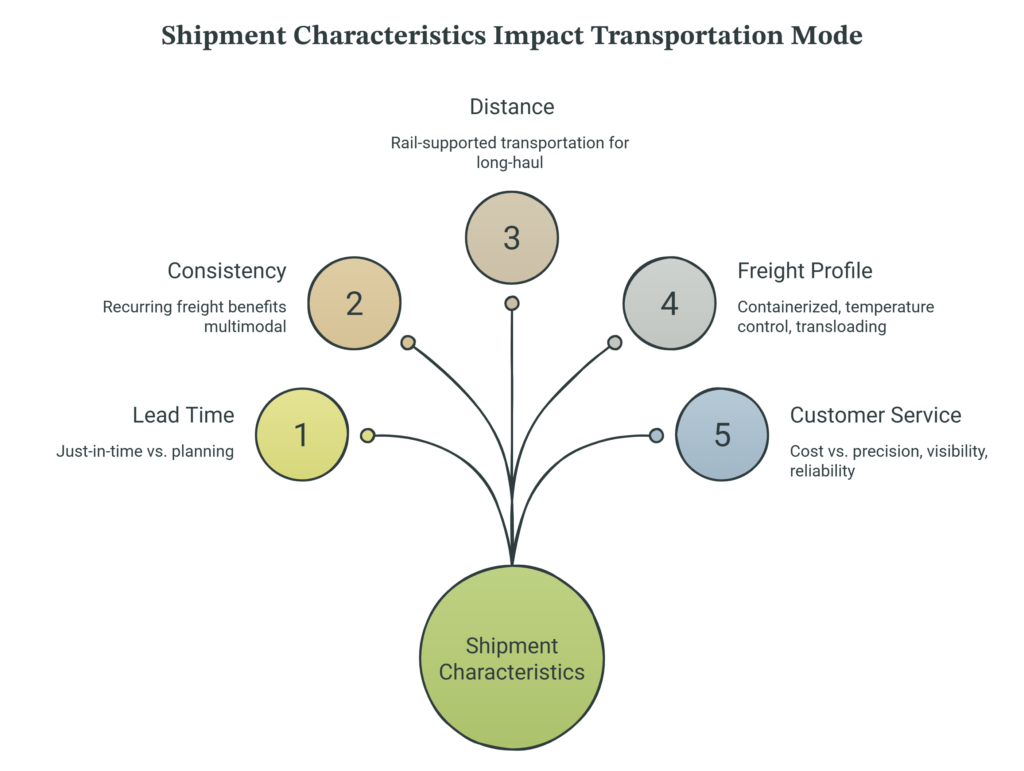
Lead Time
If a shipment supports just-in-time manufacturing or emergency replenishment, truckload usually remains the preferred solution.
If delivery windows allow additional planning, intermodal often becomes much more attractive.
Shipment Consistency
Recurring freight with predictable schedules generally performs well in multimodal networks.
Customers shipping the same freight every week can often benefit from greater transportation consistency.
Distance
The farther freight travels after crossing the border, the stronger the economic case for rail-supported transportation becomes.
Long-haul lanes frequently generate the greatest value from cross border logistics strategies involving intermodal.
Freight Profile
Questions experienced brokers ask include:
- Is the freight containerized?
- Does it require temperature control?
- Can it be transloaded efficiently?
- Is pallet configuration changing after import?
These operational details influence mode selection far more than many customers realize.
Customer Service Expectations
Some customers value:
- Lowest transportation cost.
Others prioritize:
- Delivery precision.
- Shipment visibility.
- Capacity reliability.
- Reduced supply chain variability.
Understanding those priorities often determines the best transportation strategy.
Example Lane Scenario: A consumer products importer moving containers from Monterrey, Mexico, to Kansas City initially relied on direct truckload for every shipment. As transportation costs increased, the broker evaluated the lane and recommended a drayage plus intermodal solution. While transit time increased slightly, the shipper gained more predictable transportation costs and improved capacity during peak shipping periods without disrupting customer delivery schedules.
“Great brokers don’t recommend transportation modes, they recommend business outcomes.”
Are you choosing transportation modes based on current shipment or your customer’s long-term supply chain goals?
Where Laredo and Inland Rail Fit Now
If there is one place that tells the story of where cross border logistics is heading, it’s Laredo.
For decades, Laredo has been one of North America’s busiest freight gateways. Thousands of trucks cross the border every day, moving everything from automotive parts and electronics to food products and industrial equipment.
What’s changing in 2026 isn’t Laredo’s importance. It’s how freight is moving once it gets there.
On June 17, 2026, CPKC officially opened its $100 million Inland Port rail park in Laredo, creating additional opportunities to connect Mexican manufacturing directly with North American rail networks instead of relying exclusively on long-haul truckload transportation [CPKC, 2026].
At the same time, the Association of American Railroads (AAR) reported that U.S. intermodal traffic increased 7.5% year over year during the week ending June 21, while year-to-date intermodal volume rose 8.5% [AAR, 2026].
Those numbers aren’t simply interesting statistics. They indicate that rail-supported freight is becoming a more practical option for many cross-border lanes.
That doesn’t mean truckload is becoming less important.Instead, brokers now have another tool available when evaluating transportation strategies.
Consider how each mode fits within a typical cross-border shipment.
| Transportation Option | Best Use Case | Primary Strength | Primary Limitation |
| Direct Truckload | Urgent deliveries, shorter distances | Speed and flexibility | Higher cost over long distances |
| Drayage + Transload | Distribution to multiple customers | Flexible inventory allocation | Additional handling |
| Drayage + Intermodal | Long-haul freight with predictable schedules | Cost stability and capacity | Longer planning horizon |
The expanding rail infrastructure also creates opportunities for brokers serving customers with recurring freight.
Rather than treating every shipment as a spot move, brokers can begin designing transportation programs that balance truckload flexibility with rail efficiency.
This becomes especially valuable for customers shipping:
- Automotive freight
- Consumer packaged goods
- Retail replenishment
- Industrial products
- Building materials
These freight categories often move in consistent volumes and can benefit from scheduled intermodal shipping supported by reliable drayage services.
Why this matters for brokers
The reality is customers don’t wake up asking for truckload, transloading, or rail. They ask for freight to arrive on time without blowing up their budget. Brokers who can confidently explain why one mode makes more sense than another stop being “the person who books trucks” and start becoming the advisor customers call before making shipping decisions. In a more competitive cross border logistics market, that’s a much harder position to replace.
“Infrastructure investments don’t replace trucks.They expand the number of smart transportation decisions brokers can make.”
If one of your customers doubled their cross-border freight volume tomorrow, would your current transportation strategy still scale efficiently?
Common Mistakes When Forcing the Wrong Mode
One of the quickest ways to disappoint a customer is by forcing a transportation mode that doesn’t fit the shipment.
This happens more often than many people realize.Sometimes a broker recommends truckload because it’s familiar. Other times, intermodal is suggested simply because the linehaul rate looks attractive.
Neither approach considers the shipment itself.
Experienced brokers understand that every transportation mode has strengths and limitations. Trying to make one mode solve every problem usually creates new ones.
Here are some of the most common mistakes.
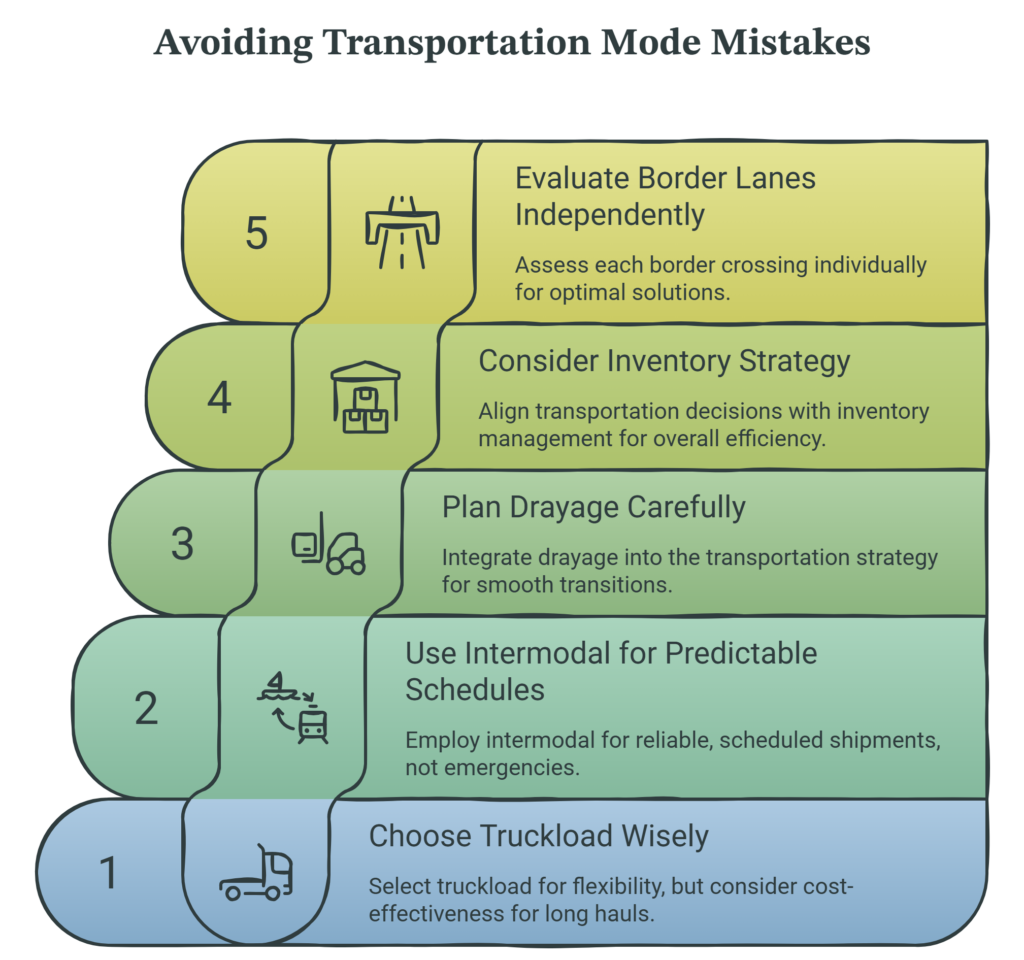
Choosing Truckload for Every Long-Haul Shipment
Truckload provides excellent flexibility, but it isn’t always the most economical option for recurring freight traveling hundreds or thousands of miles.
As transportation costs remain elevated, long-haul truckload may not deliver the best value when rail infrastructure is readily available.
Using Intermodal for Time-Critical Freight
Intermodal excels when schedules are predictable. It struggles when every shipment is an emergency.
Customers expecting same-day flexibility may become frustrated if rail schedules cannot accommodate last-minute changes.
Ignoring Drayage Planning
One of the biggest operational mistakes is treating drayage trucking as an afterthought.Without dependable local carriers, even a well-planned rail movement can experience delays.
Reliable drayage services should be considered part of the transportation strategy, not simply a pickup or delivery task.
Forgetting the Customer’s Inventory Strategy
Transportation decisions affect more than freight costs.
They influence:
- Warehouse operations
- Inventory levels
- Production schedules
- Customer service
- Working capital
A lower transportation rate may actually increase total supply chain costs if inventory planning suffers.
Assuming Every Border Lane Behaves the Same
Each crossing has different traffic patterns, customs processes, infrastructure, and carrier availability. The solution that works well in one corridor may perform poorly in another.
Experienced brokers evaluate every lane independently rather than applying the same strategy everywhere.
“The wrong transportation mode rarely fails because it’s a bad mode. It fails because it wasn’t the right fit for the shipment.”
Think about your last five cross-border shipments. Were they routed based on customer needs, or simply based on availability?
A Shipper Checklist for Choosing the Right Operating Model
Shippers don’t need to become transportation experts.That’s what brokers are for.
However, asking the right questions before tendering freight can significantly improve transportation performance.
Before deciding between truckload, transload, or intermodal shipping, consider the following.
Is this shipment time-sensitive?
If delivery appointments are strict or production depends on immediate arrival, truckload may remain the strongest option.
Is the freight moving a long distance after crossing the border?
Long-haul freight often benefits from rail-supported transportation, particularly when schedules are consistent.
Will the freight stay in the same configuration?
If products need to be separated, reconfigured, or distributed to multiple destinations, transloading may improve efficiency.
Does the shipment require consistent weekly execution?
Predictable freight often performs well through multimodal transportation programs.
Is there reliable drayage support available?
Strong drayage services are essential for successful intermodal execution.
Without dependable local carriers, delays can quickly offset potential savings.
Does the brokerage partner explain tradeoffs?
The best brokers don’t simply recommend a transportation mode.
They explain:
- Cost implications
- Transit expectations
- Service considerations
- Capacity outlook
- Contingency planning
That level of transparency builds trust and helps customers make informed decisions.
“The best transportation decisions begin with better questions, not faster quotes.”
Not sure which shipping model is the best fit for your freight? Discover how SPI’s shipping solutions help businesses choose the right mode for every shipment.
How Experienced SPI Agents Build Mode Options Around Real Customer Books
The strongest freight relationships aren’t built by covering the next load. They’re built by helping customers make better transportation decisions over time.
That’s the mindset many experienced SPI agents bring to their customer relationships.
Instead of treating every shipment as a truckload opportunity, they evaluate the customer’s freight network as a whole.
Questions they commonly explore include:
- Which lanes consistently experience capacity issues?
- Which shipments could benefit from intermodal shipping?
- Where would drayage services improve efficiency?
- Which freight should remain direct truckload?
- Are there recurring import lanes that would benefit from a multimodal strategy?
This approach allows agents to present customers with multiple transportation options instead of a single solution.
Just as importantly, SPI’s operational support helps independent agents execute those recommendations with confidence.
Rather than building carrier relationships, back-office systems, and operational processes from scratch, agents gain access to an established platform that supports:
- Cross-border freight execution
- Carrier management
- Drayage coordination
- Intermodal planning
- Customer support
- Back-office operations
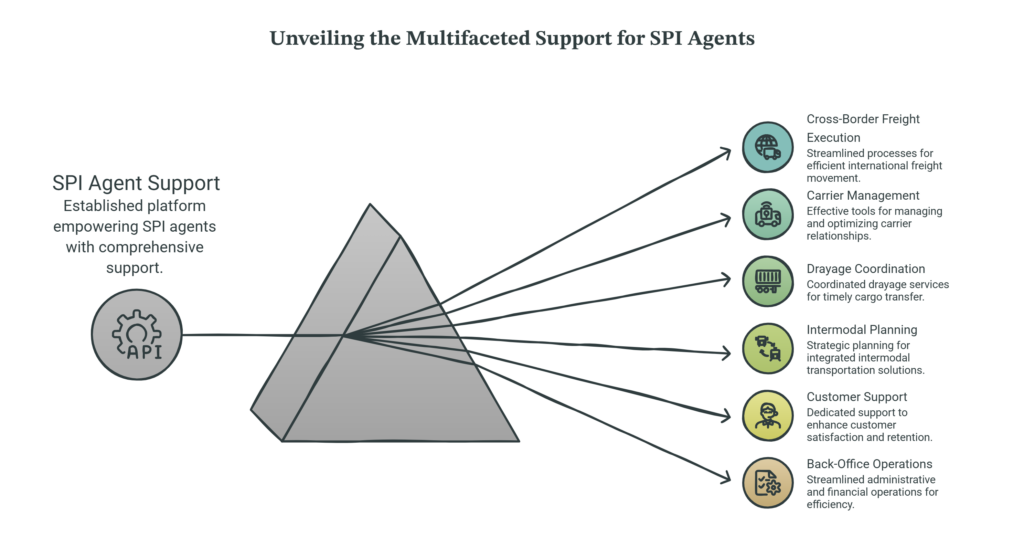
That infrastructure allows agents to focus on growing customer relationships while delivering practical transportation solutions.
Now, customers increasingly value brokers who understand cross border logistics from a network perspective, not just from a load-by-load perspective.
“Customers don’t remember who quoted the lowest rate. They remember who consistently solved transportation problems.”
Ready to give your customers more than one mode solution? Learn how becoming an SPI freight agent gives you the support to grow with confidence.
Frequently Asked Questions(FAQs)
1. What is the difference between drayage and transloading?
Drayage is the short-distance movement of containers between ports, rail terminals, warehouses, and distribution facilities. Transloading involves transferring freight from one trailer or container into another, often to improve distribution or support domestic transportation.
2. When should brokers recommend intermodal shipping instead of truckload?
Intermodal shipping is generally most effective for long-haul, predictable freight where customers value cost stability over maximum transit speed. Truckload remains the better choice for urgent shipments and tighter delivery windows.
3. Why is cross-border logistics becoming more complex in 2026?
Growing import volumes, expanded rail infrastructure, tighter transportation capacity, and increased customer expectations all require brokers to evaluate multiple transportation modes rather than relying exclusively on truckload.
Conclusion
Cross-border freight is no longer just about getting shipments across the border—it’s about choosing the operating model that creates the best long-term outcome for the customer. As infrastructure expands, rail networks continue to grow, and import volumes remain strong, brokers have more transportation options than ever before.
The challenge isn’t deciding whether truckload, transloading, or intermodal is the “best” solution. The challenge is understanding when each one fits the shipment, the lane, and the customer’s business objectives. That requires more than access to carriers; it requires operational knowledge, planning, and the ability to evaluate tradeoffs before freight begins moving.
For independent brokers, this creates an opportunity to move beyond transactional load coverage and become a strategic supply chain advisor. Customers increasingly value partners who can explain why a shipment should move a certain way, not simply who can book the next truck.
As cross border logistics continues to evolve, the brokers who combine market knowledge, mode flexibility, and strong operational support will be the ones who build lasting customer relationships in an increasingly competitive freight market.
If your book includes import, border, or rail-adjacent freight and you’re looking for a brokerage platform that supports smarter mode selection, intermodal execution, and cross-border operations, talk with SPI about joining our independent agent network.
References
Association of American Railroads. (2026). Weekly Rail Traffic Report. Retrieved from https://www.aar.org
CPKC. (2026). CPKC Opens $100 Million Inland Port Rail Facility in Laredo. Retrieved from https://www.cpkcr.com
Port of Los Angeles. (2026). Port of Los Angeles Cargo Statistics: May 2026. Retrieved from https://www.portoflosangeles.org
Ahrefs. (2026). Keyword Explorer: Cross Border Logistics, Drayage Services, Intermodal Shipping. Retrieved from https://ahrefs.com