Truckload capacity isn’t disappearing, but it is becoming more selective. Here’s why experienced brokers are looking beyond one-mode solutions and helping customers rethink how freight moves.
If someone told you in 2024 that a truck would eventually become the premium option, you probably would have laughed while refreshing your load board for the twentieth time.
Yet here we are.
The freight market isn’t booming across every sector, but it also isn’t the oversupplied market brokers became accustomed to over the past two years. Capacity is tightening in specific regions, fuel costs remain unpredictable, and cross-border freight continues to experience operational pressure. Meanwhile, shippers are asking a different question than they were twelve months ago.
Instead of asking, “Who can move this the cheapest?” They’re increasingly asking, “What’s the smartest way to move this?”
That distinction matters.
Now, most successful brokers aren’t winning because they know more carriers. They’re winning because they understand when truckload is the right answer, and when intermodal freight, drayage services, or smarter cross border logistics create a better outcome.
Recent market data supports that shift.
While shipment demand remains relatively uneven, pricing continues to strengthen. According to Cass Information Systems, April 2026 shipments declined year over year, but transportation expenditures increased while truckload linehaul pricing continued climbing, showing that available capacity is tightening faster than freight demand itself [Cass Information Systems, 2026].
At the same time, DAT reported that truckload spot and contract pricing reached their strongest levels in more than two years, with van, reefer, and flatbed activity all improving [DAT Freight & Analytics, 2026].
That combination changes how experienced brokers think. It changes how customers should think too.
Why 2026 Routing Decisions Are Different from 2024–2025
For much of 2024 and early 2025, transportation decisions were relatively straightforward. Truckload capacity was widely available. If one carrier declined a load, another usually accepted it within minutes. Mode selection often became an afterthought because truckload solved almost every problem.
That’s no longer the case. Now, the freight market requires brokers to think less like dispatchers and more like supply chain consultants.
Several market forces are converging simultaneously.
- Truckload capacity is becoming more selective.
- Fuel prices continue creating pricing volatility.
- Cross-border freight volumes remain elevated.
- Rail networks continue adding capacity.
- Customers expect both cost control and service reliability.
Those changes mean routing decisions now have a much larger financial impact.
Instead of simply asking whether a truck is available, experienced brokers are evaluating whether truckload is the best operational choice.
What changed?
| 2024–2025 Market | Mid-2026 Market |
| Capacity widely available | Capacity tightening in key lanes |
| Truckload solved most moves | Multiple modes require evaluation |
| Price-first conversations | Cost, service, and resilience conversations |
| Spot market dominated | Strategic routing becoming more valuable |
| Carrier selection | Mode selection + carrier selection |
This doesn’t mean truckload is losing relevance.Far from it. Truckload remains the fastest and most flexible transportation solution for many lanes.
What’s changing is that it isn’t automatically the most profitable or the most reliable for every shipment. Customers are beginning to recognize that.
The brokers who adapt first will likely strengthen customer relationships long before competitors notice the shift.
Lane Scenario: A shipper moving consumer goods from Monterrey, Mexico, to Chicago had traditionally relied on long-haul truckload because it offered simplicity. As truckload rates became more volatile and transit consistency tightened, the brokerage reviewed the lane and shifted the long-haul portion to intermodal freight, while using drayage services on both ends. Transit increased by one day, but transportation costs became more predictable, carrier availability improved, and the shipper gained a more resilient routing option during peak periods. The goal wasn’t simply lowering rates, it was reducing operational uncertainty.
“The biggest routing mistake in this market isn’t choosing the wrong carrier. It’s assuming every shipment deserves the same transportation mode.”
If your top five customers asked why you’re still recommending truckload on every lane, would you have a strategic answer, or just a familiar one?
What Tight Truckload Capacity Is Doing to Cost and Service
Capacity doesn’t need to disappear for pricing to change. It only needs to become more selective.
That’s exactly what many brokers are seeing.
Truckload carriers today have more opportunities to choose the freight they want. As a result, brokers covering freight in desirable lanes often experience:
- Longer tender acceptance times
- More carrier negotiation
- Higher replacement costs
- Greater service variability
- Increased exposure to spot-market swings
Recent market indicators reinforce this trend.
According to DAT, dry-van spot rates continued climbing through May, while load-to-truck ratios improved across several equipment types, signaling stronger competition for available capacity [DAT Freight & Analytics, 2026].
Meanwhile, Cass Information Systems reported that although shipment volumes remained relatively soft, transportation expenditures and truckload linehaul pricing continued rising, another sign that tighter capacity, rather than explosive demand, is driving the market [Cass Information Systems, 2026].
| Market Indicator | Latest Trend | Why It Matters |
| DAT Spot Rates | Continuing upward | Replacement costs increasing |
| Cass Shipments | Mixed demand | Freight isn’t booming everywhere |
| Cass Linehaul | Rising | Truckload pricing strengthening |
| Capacity | Becoming selective | Better planning required |
The takeaway is simple. Waiting until a load is ready to move is becoming more expensive.
The brokers protecting margins today are discussing routing strategies with customers before freight is tendered, not after capacity becomes difficult to secure.
That often means evaluating intermodal freight, considering drayage services, or redesigning cross border logistics instead of relying exclusively on long-haul truckload.
This isn’t about replacing trucks. It’s about using trucks where they create the most value.
“In tightening markets, transportation strategy becomes a competitive advantage long before customers realize they’re paying for poor routing decisions.”
How many of your customers still view transportation as simply booking the next available truck rather than optimizing the entire shipment?
When Intermodal Is Winning Right Now
Let’s clear up one of the biggest misconceptions in freight.
Intermodal freight isn’t replacing truckload. It’s replacing the wrong truckload moves.
That’s an important distinction.
For years, many brokers only considered rail when transportation budgets became tight. Now, experienced brokers evaluate intermodal freight much earlier in the planning process because it has become a strategic option rather than simply a cost-cutting measure.
Why? Because the market has changed.
Truckload rates continue to strengthen while rail networks have become more reliable for many long-haul lanes. According to Uber Freight’s 2026 Market Outlook, Mexico truckload contract rates are expected to increase 8–15% year over year, while spot pricing could finish 20–25% above 2025 levels. By comparison, intermodal pricing is projected to increase a more modest 3–5% through the end of the year [Uber Freight, 2026].
That doesn’t automatically make rail cheaper. It makes it more predictable.
For many shippers, predictable transportation costs are just as valuable as low transportation costs.
Intermodal performs particularly well when freight has:
- Consistent weekly volume.
- Transit flexibility of one or two additional days.
- Long-haul mileage.
- Stable production schedules.
- Limited need for mid-route changes.
These shipments allow brokers to leverage intermodal freight while using drayage services at both ends of the move.
Where Intermodal Creates the Biggest Advantage
| Lane Characteristic | Truckload | Intermodal Freight |
| Emergency shipments | Best choice | Limited flexibility |
| Long-haul recurring freight | Good | Often stronger value |
| Predictable production schedules | Good | Excellent fit |
| Highly variable freight | Better | Moderate |
| Cost stability | Moderate | Strong |
This doesn’t mean brokers should push rail whenever possible.
Good brokers recommend the transportation mode that fits the customer’s business, not the mode that fits a trend.
Sometimes truckload remains the right answer. Sometimes intermodal freight protects both margin and service.
The difference lies in understanding the shipment before recommending the solution.
“The strongest transportation strategy isn’t mode-first, it’s customer-first. The mode simply follows the business objective.”
If one of your customers has shipped the same long-haul lane by truckload for years, when was the last time you evaluated whether intermodal now makes more sense?
Where Cross-Border Execution Is Tightening First
Most people think cross-border transportation becomes difficult at the border itself.
That’s only part of the story. The real pressure points often appear before and after customs clearance.
The current cross border logistics environment is becoming increasingly sensitive to several operational factors:
- Driver availability near border crossings.
- Equipment positioning.
- Customs processing variability.
- Cross-border carrier capacity.
- Rail terminal congestion.
- Drayage scheduling.
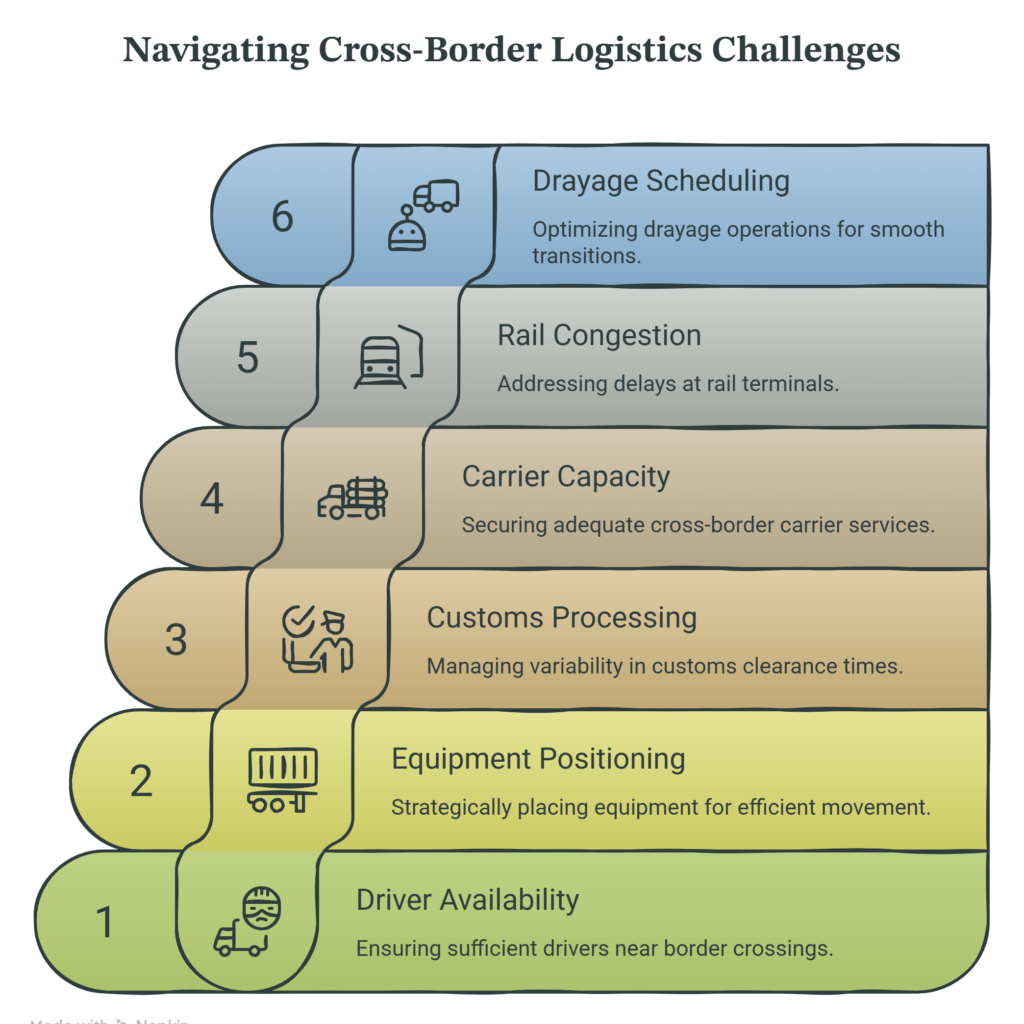
As freight volumes continue shifting toward Mexico manufacturing, these operational details become increasingly important.
The challenge isn’t simply getting freight across the border. It’s keeping freight moving once it crosses.
For brokers, that means thinking beyond customs documentation. Successful cross border logistics planning now includes:
- Reliable drayage services.
- Carrier redundancy.
- Rail availability.
- Distribution center timing.
- Warehouse receiving schedules.
- Customer inventory requirements.
Many of these issues become invisible to customers until a shipment is delayed. Experienced brokers solve them before customers even notice.
Market Outlook
Uber Freight continues to report strengthening conditions across Mexico corridors as manufacturing activity supports higher transportation demand. As rates continue increasing, planning shipments earlier, and selecting the appropriate transportation mode becomes increasingly important [Uber Freight, 2026].
That creates a competitive opportunity. Customers don’t necessarily need more trucks. They need brokers who understand how different transportation modes fit together.
“Cross-border execution isn’t won at customs. It’s won during planning.”
If a border crossing experiences unexpected congestion tomorrow, how many alternative routing options can you confidently offer your customer?
What Brokers Should Ask Shippers Before Shifting Modes
Before recommending a transportation mode, experienced brokers focus on understanding the shipment, not just quoting a rate. Asking the right questions often uncovers opportunities the customer hasn’t considered.
Ask about:
- Delivery priorities: speed or schedule flexibility?
- Shipment frequency: recurring or one-time?
- Freight profile: containerized, palletized, or suitable for transloading?
- Distribution: one destination or multiple facilities?
- Business goals: lower transportation costs or greater supply chain stability?
These conversations shift the broker’s role from simply booking freight to helping customers make smarter transportation decisions.
“Customers rarely remember the cheapest quote. They remember the broker who asked the questions nobody else did.”
Want to ask the questions that win more shipper trust? See what successful freight agents do differently.
A Simple Decision Framework: Truckload vs. Intermodal vs. LTL/Pallet
One transportation mode isn’t better. It’s simply better for a particular shipment. A practical decision framework makes mode selection much easier.
Here’s a simple way many experienced brokers think about it:
Choose truckload when:
- Speed matters most.
- Freight fills the trailer.
- Delivery appointments are tight.
Consider intermodal freight when:
- The lane is long.
- Transit flexibility exists.
- Capacity is tightening.
- Cost consistency matters.
Evaluate pallet shipping or LTL when:
- The shipment doesn’t justify a full trailer.
- Customers ship smaller, recurring quantities.
- Network consolidation creates savings.
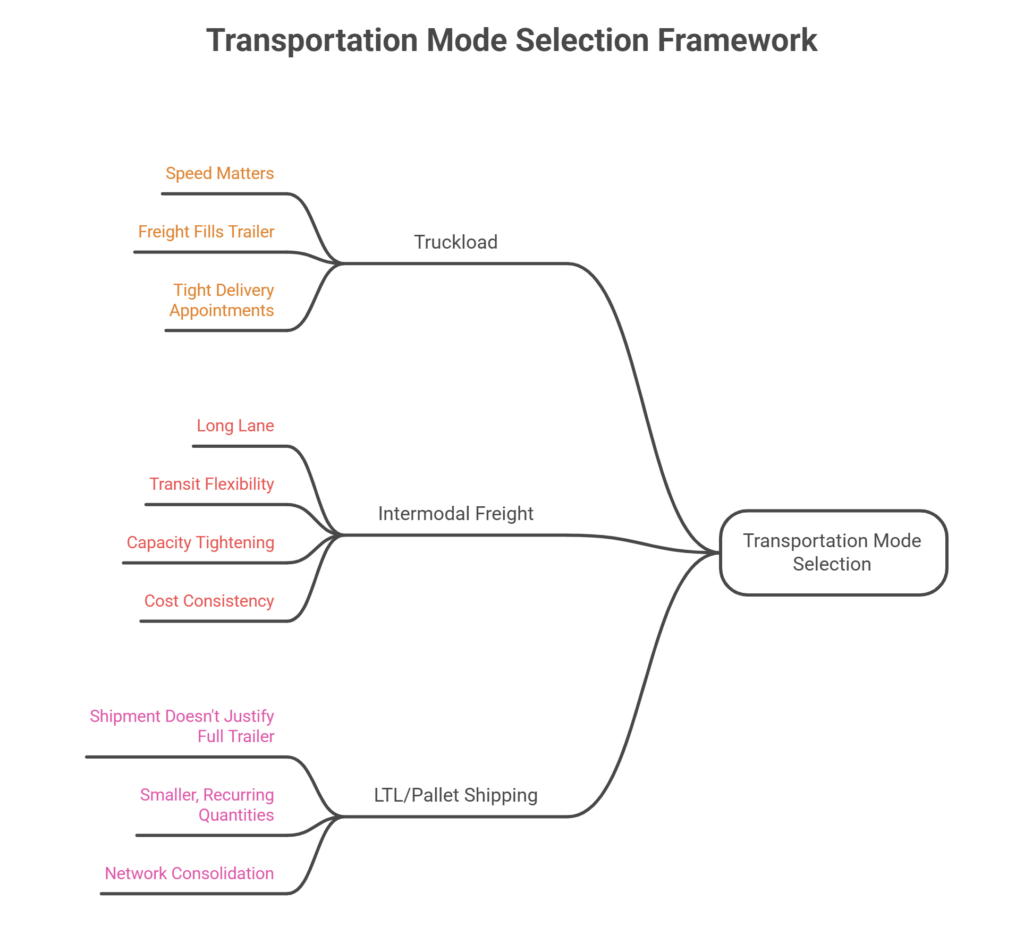
The goal isn’t finding the cheapest mode. The goal is finding the most efficient operating model.
“Mode selection isn’t about transportation. It’s about matching supply chain priorities with transportation capabilities.”
How often do you recommend LTL or intermodal because they’re genuinely the best fit, not simply because truckload pricing changed?
How SPI Helps Agents and Shippers Execute Without Adding Friction
As transportation options become more diverse, execution becomes more complicated. That’s where many brokerages struggle. It’s one thing to recommend intermodal freight, drayage services, or a cross border logistics solution—it’s another to coordinate multiple providers, communicate with the shipper, and keep the shipment moving without creating additional work.
That’s where support infrastructure becomes a competitive advantage.
Experienced SPI agents don’t have to build every operational capability from scratch. They have access to a network designed to support multiple transportation modes, allowing them to focus on customer relationships while leveraging experienced operational resources behind the scenes. Whether a shipment stays truckload, requires drayage services, or transitions into intermodal freight, the objective is the same: provide customers with practical solutions without adding unnecessary complexity.
Rather than forcing every shipment into a single mode, SPI helps agents evaluate the shipment, the lane, and the customer’s priorities before recommending the most effective transportation strategy.
This approach helps agents spend less time chasing capacity and more time strengthening customer relationships. For shippers, it means working with a brokerage partner that evaluates the entire transportation strategy instead of simply quoting the next available truck.
“The strongest brokerages don’t win because they offer more modes. They win because they know when each mode creates the greatest value.”
Looking for a brokerage model that helps you execute, not just sell? Explore the SPI independent agent model.
Frequently Asked Questions (FAQs)
1. When is intermodal freight a better choice than truckload?
Intermodal is often the better option for long-haul, recurring shipments that have flexible delivery windows. While truckload generally provides faster transit, intermodal can improve cost consistency and reduce exposure to tightening truckload capacity, especially on predictable lanes.
2. How do drayage services fit into cross-border transportation?
Drayage is the short-haul movement of freight between ports, rail terminals, warehouses, or border crossings. In cross border logistics, drayage often connects truckload and rail operations, making it an essential component of many intermodal and import supply chains.
3. Should brokers recommend truckload, intermodal, or LTL vs FTL based only on price?
No. Price is only one factor. Experienced brokers also evaluate shipment size, delivery deadlines, lane distance, consistency, handling requirements, and customer expectations before recommending the right transportation mode.
The Freight Market Has Changed. Has Your Strategy?
The freight market in 2026 isn’t rewarding brokers who simply cover loads. It’s rewarding those who solve transportation problems. As truckload capacity becomes more selective, fuel costs remain unpredictable, and cross-border freight grows more complex, customers are looking for guidance, not just quotes.
That doesn’t mean truckload is becoming obsolete. It means brokers who understand when to use intermodal freight, where drayage services add value, and how to build resilient cross border logistics strategies are creating a meaningful competitive advantage. They’re protecting customer margins, improving service reliability, and strengthening long-term relationships through smarter mode selection.
For shippers, the lesson is equally important. Choosing the right transportation mode is no longer just an operational decision. It’s a business decision that affects cost, service, and supply chain resilience.
The brokers who thrive over the next several years won’t necessarily have the largest carrier network. They’ll be the ones who know when to recommend a different route, a different mode, or a different strategy before capacity pressures force the conversation.
If your book includes import, port, Mexico, or palletized freight, talk with SPI about execution support that protects margin without slowing your sales motion.
References
Cass Information Systems. (2026). Cass Transportation Index Report – April 2026. Retrieved from https://www.cassinfo.com/freight-audit-payment/cass-transportation-indexes
DAT Freight & Analytics. (2026). Truckload Freight Market Updates. Retrieved from https://www.dat.com
Uber Freight. (2026). 2026 Market Outlook. Retrieved from https://www.uberfreight.com
FreightWaves. (2026). Freight Market News and Analysis. Retrieved from https://www.freightwaves.com
American Association of Railroads. (2026). Rail Industry Overview. Retrieved from https://www.aar.org