
Every freight broker knows the feeling. A customer tenders a load, you post it, and then you wait for the phone to ring.
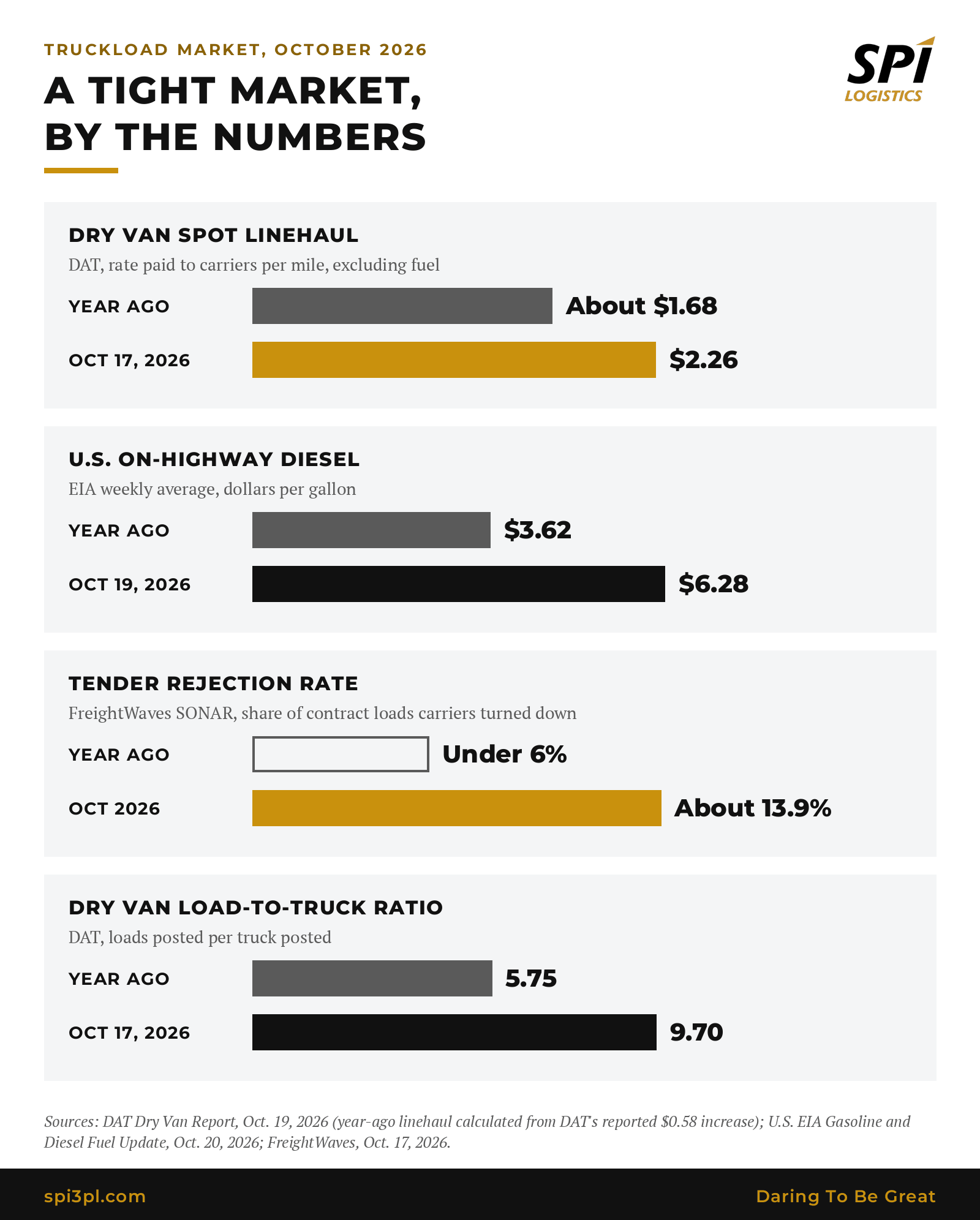
In a loose market, that works often enough. This fall, it does not. Dry van spot rates paid to carriers are 34.5% above a year ago, diesel is above $6 a gallon, and carriers are turning down about one contract tender in seven. [DAT, Oct. 19, 2026; EIA, Oct. 20, 2026; FreightWaves, Oct. 17, 2026]
The brokers who stay calm in a market like this are not the ones with the best load board strategy. They are the ones who built foundational carriers on their lanes, so most loads cover before the spot market ever sees them.
This guide explains spot market trucking and contract freight in plain terms, what the 2026 numbers mean for your margins, and how experienced agents build lanes that cover themselves. Shippers will find a short section on what to ask their freight brokerage when the routing guide starts to fail.
“Post and pray is not a plan. Foundational carriers are.”
Why Covering Freight Got Harder in Fall 2026
Capacity, not demand, is driving this market. FreightWaves describes 2026 as a supply-led cycle: fewer trucks available, not a surge in freight. [FreightWaves, Oct. 17, 2026]
The Numbers Behind a Tight Market
Dry van spot linehaul hit $2.26 a mile in the week ending Oct. 17, up 58 cents from a year earlier, and the load-to-truck ratio reached 9.70, up from 5.75. [DAT, Oct. 19, 2026]
What a Failing Routing Guide Means for Shippers and Brokers
A tender rejection happens when a carrier turns down a load offered under contract terms. SONAR’s definition lists two reasons: not enough capacity, or a rate that is too low. [SONAR Knowledge Center]
When rejections sit near 14%, a shipper’s backup plan gets tested every week. Loads fall to the second or third carrier in the routing guide, and some fall all the way to the spot market at today’s price.
For brokers, that spillover is opportunity and pressure at once: more freight needs a home, but covering it from scratch on a load board costs more.
Want the bigger picture? Read our freight market update on tightening capacity.
“A tight market does not reward the busiest broker. It rewards the most prepared one.”
How many of your loads last month covered without a single load board post?
Spot Market Trucking vs. Contract Freight: The Plain Definitions
Spot Freight: One Load, Today’s Price
Spot market trucking is freight priced and booked one load at a time, at the current market rate, usually close to pickup through load boards, calls and emails.
Contract Freight and the Routing Guide
Contract freight is volume a shipper commits to a carrier or freight brokerage on specific lanes, at agreed rates, usually for months at a time.
Those commitments live in the shipper’s routing guide: a ranked list of who gets offered each lane first, second and third. When everyone in the routing guide says no, the load goes to the spot market.
Most contract rates come out of a freight RFP, where a shipper asks carriers and brokerages to bid on its lanes. A rate set in a soft market can sit well below spot a few months later, and that is when tender rejections climb.
| Factor | Spot freight | Contract freight |
| Pricing | Per load, at today’s rate | Agreed lane rate, set in advance |
| Price holds for | One shipment | Months, often an RFP cycle |
| Best for | Surges and one-offs | Repeat lanes with steady volume |
| Main risk | Price swings, late coverage | Rates falling behind the market |
Spot Rates vs. Contract Rates in 2026
This year shows how fast the two can trade places. In June, dry van spot linehaul ran 8 cents a mile above contract. By August, contract rates were 22 cents above spot, at $2.39 a mile vs. $2.17. [U.S. Bank and DAT, Oct. 1, 2026]
Both rates were far above last year: in August 2025, spot averaged $1.60 a mile and contract $1.99. [FreightWaves, Oct. 3, 2026]
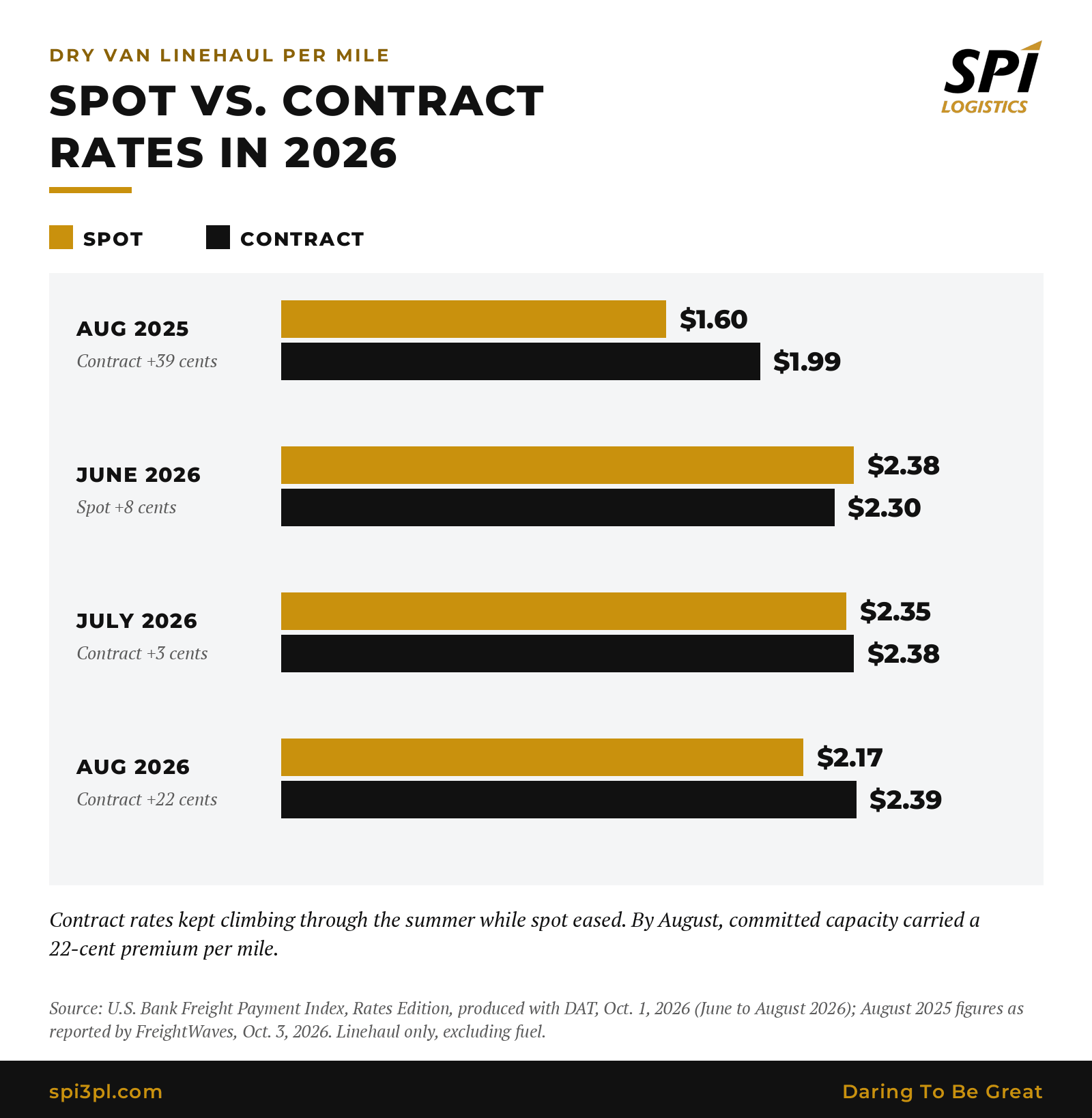
Spot then climbed again, to $2.26 a mile by mid-October. [DAT, Oct. 19, 2026] Fuel adds another layer: about 21% of the broker-to-shipper spot van rate in June and 24% by August. [U.S. Bank and DAT, Oct. 1, 2026]
“Spot and contract trade places. Steady lanes are how you stop guessing which one wins this month.”
Do you know which of your lanes are priced above today’s spot market, and which are below it?
What Is a Foundational Carrier?
A foundational carrier is an independent carrier that runs a specific lane for you week after week. It is the first call when that lane’s freight comes in.
In this SPI video, the speaker puts it simply: “there might be one or two, three carriers on this particular lane, but between those three, all of those loads are covered.”
If you do go to the spot market, “it’s for one or two shipments and then it’s gone,” because “you’ve covered seven, eight, 10 loads already.”
Set It and Forget It: Reliability You Can Schedule Around
In another SPI conversation, an agent describes the peace of mind a foundational carrier brings: “When he says 8 a.m. I’ll be at the shipper. 7:50 he’s rolling through their gate.”
The point is not perfection: “there’s always going to be issues, but controlling some of those variables, I think, is what helps you scale in business.”
The other side of the conversation asks the question every owner should ask: “If you had to sit there and spot market, post, and pray for all of those… How could you build anything from doing that?”
Why Steady Freight Beats a $500 Spot Bump for the Carrier Too
Foundational relationships pay off on both sides. In this SPI video, the speaker tells of a carrier on a steady lane who saw similar loads posted for $500 more. The carrier stayed: the lane runs Monday through Friday, and the rate had gone up the week before. The carrier’s answer: “We count on three or four of these every single week.”
And from the broker’s side: “I count on their capacity.” Dependable freight for one, dependable coverage for the other.
Why do small carriers value that consistency? Read why small carriers still need freight brokers.
“A $500 spot load is one good day. Freight every week is a business.”
Which of your lanes already has a carrier who would call you first?
When the Spot Market Is the Right Call
Foundational carriers do not replace the spot market. They shrink it to the loads where it fits.
Surge Loads, Project Freight and One-Offs
- Volume surges. Your foundational carriers cover the base, and the extra loads go to the market.
- Project freight. A one-time move with no repeat lane behind it.
- New lanes. Freight you have not run before.
- Time-sensitive shipments. A same-day request outside your regular lanes.
When truckload capacity is tight, some freight is a fit for intermodal, another option before paying a spot premium.
See where rail can help: read when intermodal beats truckload in a tight market.
Use Load Boards Last, Not First
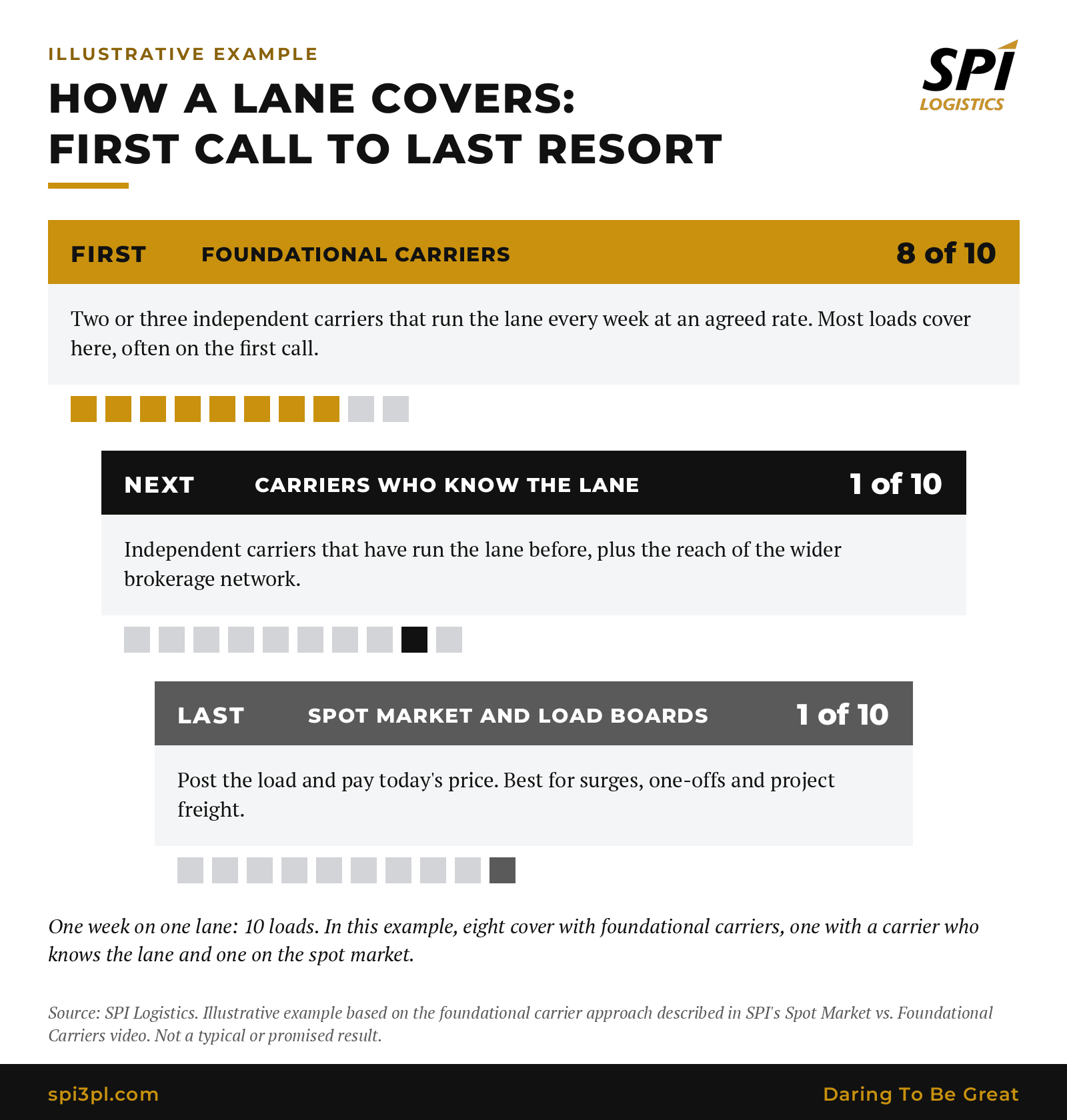
Think of coverage in three layers. Your first call goes to your foundational carriers. Next come carriers who have run the lane before, plus the reach of your wider brokerage network. The load board comes last. It works best as the backup, not the system.
Want to get more from the boards you do use? Read load boards, freight matching and quoting strategies for brokers.
“The load board should catch the loads that slip through, not carry your whole book.”
If every load board went down tomorrow, how much of your freight would still cover?
5 Steps to Build Lanes That Cover Themselves
1. Map the Repeat Lanes in Your Book
Pull the last 90 days of loads and group them by origin, destination and equipment. The lanes that show up every week are where foundational carriers pay off first.
2. Offer Consistency, Not Just Price
Carriers plan their weeks too. A lane that runs Monday through Friday, at a fair rate that keeps up with the market, is worth more to many carriers than a one-time premium.
3. Price Lanes Against the Current Market
Check your committed rates against current spot data before the next freight RFP or rate review. A lane priced far below the market is the lane most likely to fall to spot.
4. Give Everyone a Heads-Up
Share pickup schedules and volume changes with your foundational carriers as early as you can. A carrier who knows next week’s loads can plan trucks around them.
5. Track What Covers First and What Falls to Spot
Keep a simple record by lane: loads covered on the first call, by backup carriers and on the spot market. If that last number grows, the lane needs attention.
“Lanes that cover themselves are built on purpose, one repeat load at a time.”
Which one of these five steps would free up the most time in your week?
Why This Is Easier Inside an Agent Program
Building foundational carriers takes time on the phone. For an owner running everything alone, that time competes with billing, collections and technology.
Network Reach Across 75+ North American Offices
As an SPI agent, you work inside a network of 75+ North American offices, so a lane that is new to you has a wider network behind it before a load reaches the spot market.
Back Office Support So You Can Work the Lanes
SPI’s back office support covers work such as invoicing, document management and payment processing, so your time goes to customers and lanes. SPI has 45+ years in business supporting brokers who already have a book.
See what is covered: read about SPI’s freight brokerage back office support.
Comparing your options? Read freight agent vs. freight broker in 2026.
“Your lanes are your book. Spend your week building them, not chasing paperwork.”
How many hours a week do you spend on work that is not selling or covering freight?
What Shippers Should Ask Their Freight Brokerage
If your routing guide is failing more often this fall, you are not alone. DAT’s Patrick Pretorius said shippers “would do well to shift focus to consolidation and network planning, as the market is tightening from two directions at once.” [U.S. Bank and DAT, Oct. 1, 2026]
Ask these questions to see whether a freight brokerage is planning capacity or just posting your loads:
- How many of my loads cover on the first call? Ask for it by lane.
- Who runs my lanes week to week? A broker with foundational carriers can explain who covers them and how consistently.
- What is the backup plan when my routing guide fails? Listen for a backup that comes before the load board.
- How do you price my lanes against the current market? A good answer uses current spot and contract data.
Need capacity you can plan around? SPI arranges freight through independent motor carriers that know your lanes. Explore SPI shipping services.
Does your freight brokerage have a plan for your lanes, or just a load board login?
Frequently Asked Questions (FAQs)
1. What is spot market trucking?
Spot market trucking is truckload freight priced and booked one load at a time at the current market rate, usually close to pickup. It is flexible, but prices can change quickly from week to week.
2. What is the difference between spot and contract freight?
Spot freight is priced per load at today’s rate. Contract freight is committed volume on specific lanes at agreed rates, usually set through a freight RFP and held for months. In August 2026, dry van contract ran 22 cents a mile above spot.
3. What is a routing guide in shipping?
A routing guide is a shipper’s ranked list of carriers and freight brokerages for each lane, with agreed rates. The load is offered to the first choice, then the next. If everyone declines, it goes to the spot market.
4. What is a tender rejection?
A tender rejection is when a carrier turns down a load offered under contract terms, usually because it lacks capacity or the rate is too low. The national rate was about 13.9% in mid-October 2026, compared with under 6% a year earlier.
5. Should a freight agent rely on load boards?
Load boards are useful for surges, new lanes and one-off loads. Experienced agents use them as a backup and cover most repeat freight with foundational carriers.
Cover Freight First, Post It Last
Rates, fuel and tender rejections are all running well above last year. In this market, the spot market is an expensive place to start.
Foundational carriers on your repeat lanes give you steadier coverage and steadier margins.
Stop posting and praying. See how independent brokers build steady lanes as SPI agents, with the support of 75+ North American offices and 45+ years in business.
Have questions about how SPI works with agents? Talk to SPI.
References
DAT Freight & Analytics. (2026, October 19). Dry Van Report: Rates hold as load posts cool and capacity stays thin. Retrieved from
https://www.dat.com/blog/dry-van-report-rates-hold-as-load-posts-cool-and-capacity-stays-thin
U.S. Energy Information Administration. (2026, October 20). Gasoline and Diesel Fuel Update. Retrieved from
https://www.eia.gov/petroleum/gasdiesel/
FreightWaves. (2026, October 17). No signs of truckload capacity recovering. Retrieved from
https://www.freightwaves.com/news/no-signs-of-truckload-capacity-recovering
U.S. Bank. (2026, October 1). U.S. Bank and DAT: Contract and spot truck freight rates diverge. Retrieved from
https://ir.usbank.com/news-events/news/news-details/2026/U-S–Bank-and-DAT-Contract-and-spot-truck-freight-rates-diverge/default.aspx
FreightWaves. (2026, October 3). U.S. Bank: Contract rates open 22-cent gap over spot freight. Retrieved from
https://www.freightwaves.com/news/us-bank-dat-contract-spot-rate-gap
SONAR Knowledge Center. (n.d.). Tender Rejection (OTRI). Retrieved from
https://knowledge.gosonar.com/resources/sonar-data/trucking/tender-rejection-tri/