
Most shippers do not buy trucks, so a federal engine rule can feel like someone else’s problem. The EPA 2027 truck emissions rule is different. It changes what new heavy-duty trucks cost, when fleets buy them and how fast the carrier base can add capacity in a market that is already tight.
The rule itself is settled. Starting with model year 2027, new heavy-duty diesel engines must meet a much lower nitrogen oxides (NOx) limit. What is not settled is a July 2026 EPA proposal that would change how parts of the rule work, including penalties for engines that miss the limit and how trucks respond to diesel exhaust fluid (DEF) problems. As of November 2, 2026, that proposal is still a proposal.
This guide separates what is final from what is proposed, then looks at what truck orders, carrier costs and rate forecasts suggest for 2027 freight capacity.
If you want the bigger market picture first, start with our freight market update on why capacity is tightening.
What the EPA 2027 Truck Emissions Rule Actually Changes
EPA adopted its final heavy-duty engine and vehicle standards on December 20, 2022, and published them in the Federal Register on January 24, 2023. The standards take effect starting with model year 2027 heavy-duty highway engines. [EPA; Federal Register, 2023]
What Is Locked In for Model Year 2027
The headline number is the NOx limit. Under the current federal regulation, model year 2027 and later compression-ignition (diesel) engines must emit no more than 35 milligrams of NOx per horsepower-hour on the main duty-cycle tests. [eCFR, 40 CFR 1036.104] The standard that has applied to diesel heavy-duty engines since model year 2007 is 0.20 grams, or 200 milligrams. [eCFR, 40 CFR 86.007-11] That is an 82.5% cut.
The current regulation also extends how long engines must keep meeting the standard. For the heaviest engine class, the useful life period rises to 650,000 miles for model year 2027 and later engines, up from 435,000 miles. [eCFR, 40 CFR 1036.104]
What EPA Proposed in July 2026, and Why It Is Not Final Yet
On July 9, 2026, EPA announced proposed amendments to the model year 2027 program, and the proposal was published in the Federal Register on July 14, 2026. [EPA, proposed rule page; Federal Register, July 14, 2026] It would:
- Change the useful life and warranty periods for model year 2027 and later heavy-duty highway engines.
- Create nonconformance penalties (NCPs) for medium and heavy heavy-duty engines starting in model year 2027. NCPs would let a manufacturer sell an engine that misses the NOx limit, up to a cap, by paying a per-engine penalty.
- Replace the DEF and selective catalytic reduction (SCR) inducement derates and speed reductions on new diesel engines with audible and/or visible alerts.
EPA held a public hearing on July 29 and 30, 2026, and the comment period closed on August 29, 2026. [EPA, proposed rule page] As of November 2, 2026, EPA had not issued a final rule on these amendments. Until it does, the 35 mg NOx limit and the existing rule text are what manufacturers have to plan around.
According to the American Trucking Associations, the proposed penalties would apply only for model years 2027 through 2029 and would rise each year. ATA’s example: a model year 2027 heavy heavy-duty engine certified at 100 mg would pay $5,875, while one certified at 45 mg would pay $904. [ATA] Those figures come from a proposal and could change in a final rule.
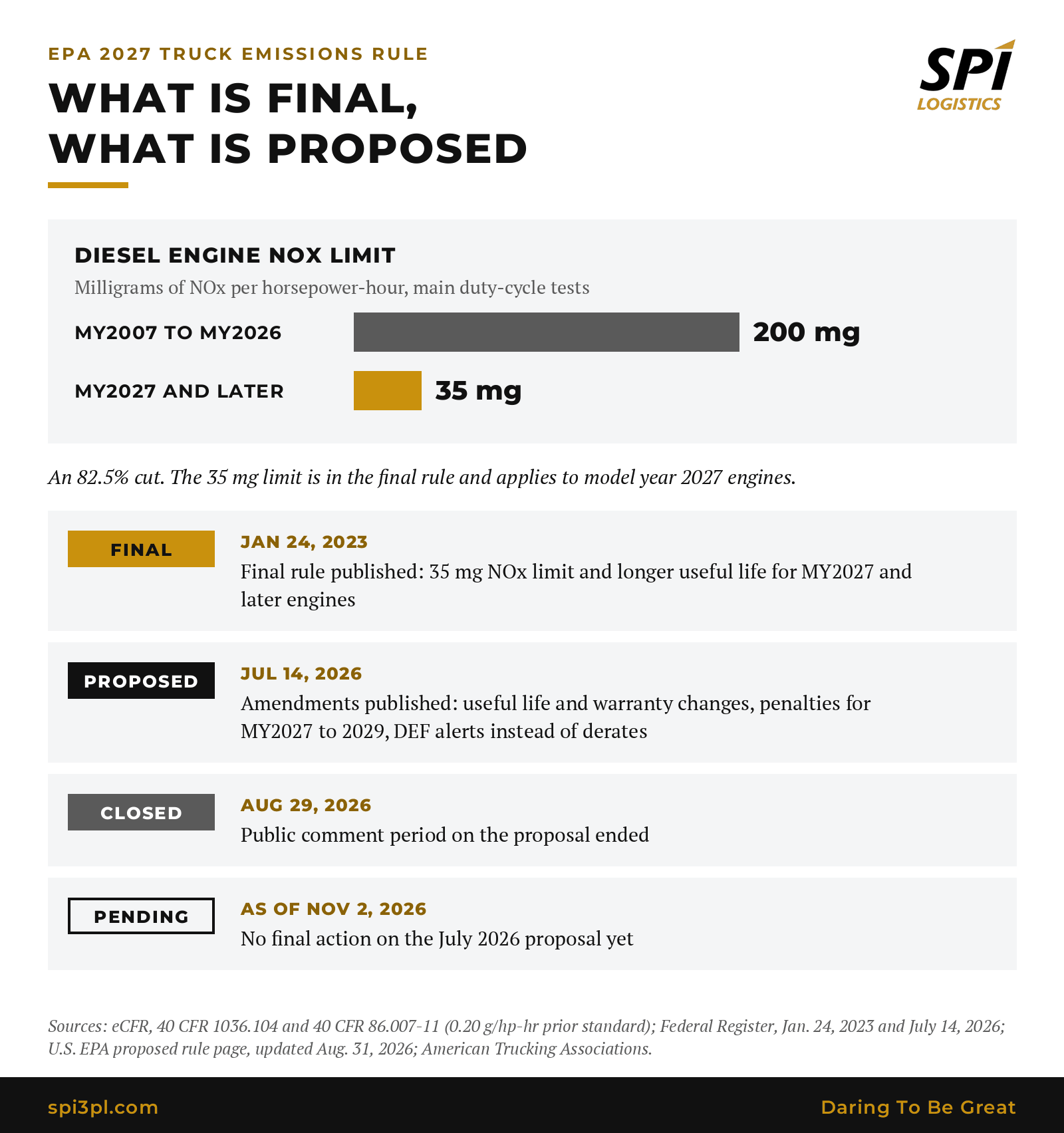
| Item | Status as of Nov 2, 2026 | What it means for freight |
| 35 mg/hp-hr NOx limit for MY2027+ diesel engines | Final (2023 rule) | New compliant trucks cost more, which can slow fleet replacement |
| Longer useful life and warranty periods | Final, but the July 2026 proposal would change them | Engine pricing is not fully settled |
| Nonconformance penalties for MY2027 to 2029 | Proposed only | Could lower the upcharge on some new trucks if finalized |
| DEF derates replaced with alerts on new engines | Proposed only | Could mean fewer roadside slowdowns tied to DEF faults if finalized |
| Final action on the July 2026 proposal | Not issued yet | Fleets are ordering with open questions |
Why a Truck Engine Rule Shows Up in Your Freight Bill
Shippers pay for capacity, and capacity depends on how many trucks carriers can afford to run. A rule that raises the cost of a new tractor affects that math in three ways.
The Pre-Buy Is Over
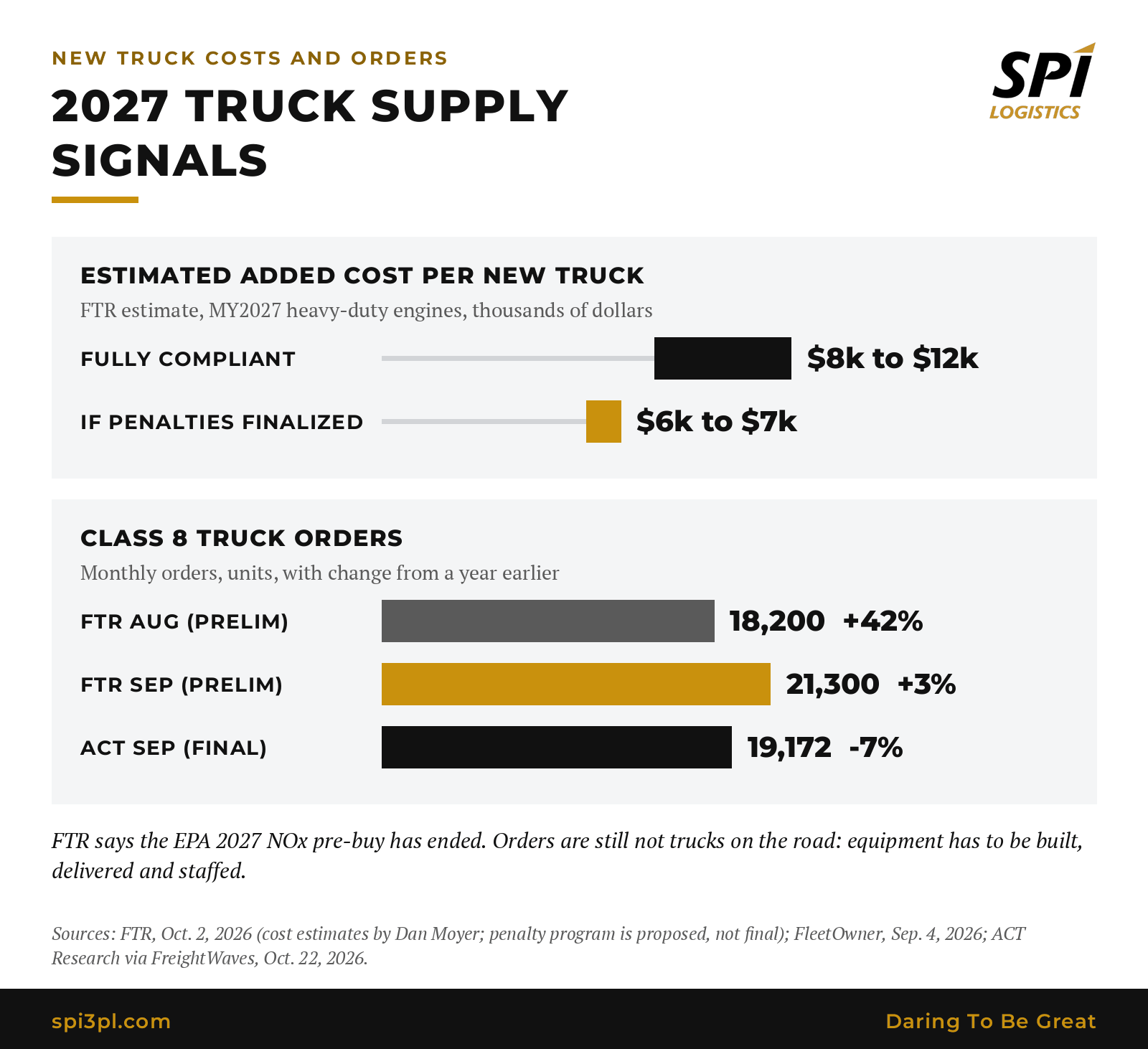
Fleets spent much of 2026 buying trucks with model year 2026 engines to get ahead of the new standard. FTR reported preliminary Class 8 orders of 18,200 in August, up 42% from a year earlier, and FleetOwner reported that second-half 2026 backlogs were oversubscribed by about 35,000 units. [FleetOwner, Sep 4, 2026] In September, FTR’s preliminary count was 21,300 orders, up 3% year over year, with year-to-date orders up 95%. FTR said, “The EPA 2027 NOx pre-buy has ended, and surcharge-free MY 2026 engine build slots are effectively sold out.” [FTR, Oct 2, 2026]
Pre-buys pull demand forward. Trucks bought in 2026 will not be bought in 2027.
New Trucks Will Cost More, and Prices Are Not Settled
FTR’s Dan Moyer has estimated that a fully compliant engine could carry an upcharge of about $8,000 to $12,000, while an engine sold under the proposed penalty program could mean a pass-through to fleets of about $6,000 to $7,000. [FTR, Oct 2, 2026] Either way, the new truck costs more, and the final number depends on a rule EPA has not finished.
An Order Is Not a Truck on Your Lane
The order data is mixed. ACT Research’s final count put September Class 8 orders at 19,172, down 7% from a year earlier. [FreightWaves, Oct 22, 2026] ACT said uncertainty about 2027 engine requirements complicates the interpretation of that total, and that the real question is “when purchase intentions become firm specifications and production slots, not whether one month’s order count settles the capacity outlook.” [ACT Research, Oct 26, 2026]
Even a strong order month does not add trucks to your lanes right away. Equipment has to be built, delivered and staffed, and carriers need rates that cover higher fuel, insurance and financing costs before they expand.
What the Freight Market Looks Like Going Into 2027
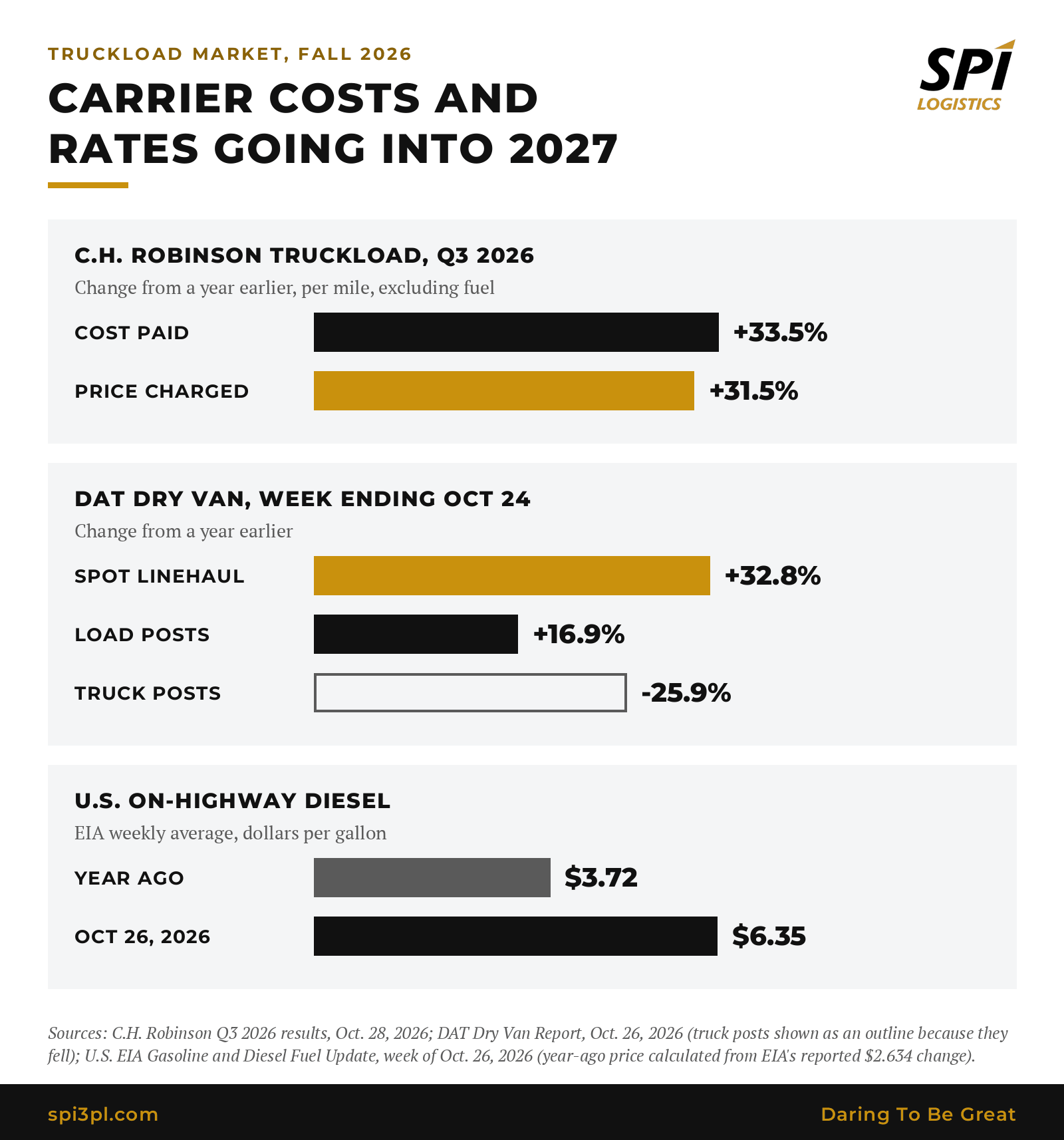
The EPA 2027 transition is landing on a market that has already tightened. DAT reported a national van spot linehaul rate of $2.24 per mile for the week ending October 24, up 32.8% from a year earlier. Truck posts were 25.9% below last year while load posts were 16.9% higher. [DAT, Oct 26, 2026]
Carrier costs have climbed with rates. C.H. Robinson reported that in the third quarter its truckload linehaul cost per mile, excluding fuel, rose 33.5%, while the rate per mile it charged customers rose 31.5%. [C.H. Robinson, Oct 28, 2026] Fuel is adding to the pressure: the U.S. average on-highway diesel price was $6.352 per gallon for the week of October 26, up $2.634 from a year earlier. [EIA]
Forecasters expect that pressure to carry into next year. ACT Research’s Tim Denoyer said, “With the supply response limited in part by the uncertain engine transition and tighter driver regulations, market tightness will persist well into 2027.” [The Trucker, Oct 19, 2026] C.H. Robinson’s September outlook projected 2027 dry van cost per mile up about 10% year over year, with the largest increases in the first half of the year. [C.H. Robinson, Sep 3, 2026]
In a market like this, the cheapest truck on the board is rarely the safest choice. Paying a fair rate to a dependable carrier often costs less than a missed pickup or a rebooked load. We covered that tradeoff in detail in spot market trucking vs. foundational carriers.
As one SPI team member put it in the Short above: “It’s not worth rolling the dice, man.”
5 Steps Shippers Can Take Before 2027 Contracts Lock In
1. Budget for 2027 on Current Forecasts, Not Hoped-For Relief
If your 2027 budget assumes rates fall back to early 2026 levels, test it against forecasts like C.H. Robinson’s projected 10% rise in dry van cost per mile. ACT Research suggests shippers “stress-test transportation budgets and routing guides against a range of capacity conditions.” [ACT Research, Oct 26, 2026]
2. Put Your Steadiest Lanes With Dependable Carriers
Carriers protect consistent, fairly paid freight when the market tightens. Keep your weekly lanes with carriers who know the freight and the facilities.
3. Review Pricing More Often
With equipment costs, fuel and regulations all moving, an annual rate set in January can be out of line by spring. Review pricing on high-volume lanes more often so your routing guide holds up.
4. Make Your Freight Easier to Haul
Longer tender lead times, reliable pickup windows and fast loading make your loads more attractive when trucks are scarce, often at no extra cost.
5. Check Which Lanes Can Move Off the Road
Long, steady lanes are worth a second look for intermodal. ACT has noted that intermodal contract rates sit about 40% below dry van. [The Trucker, Oct 19, 2026] Not every lane converts, so see our guide to truckload vs. intermodal in 2026 and when intermodal beats truckload in a tight market.
Need help planning 2027 capacity? Explore SPI’s shipping services or talk to our team about your lanes.
What Brokers and Agents Should Tell Customers Now
Much of what shippers hear about EPA 2027 mixes the final rule with the proposal. Brokers and freight agents can earn trust by keeping the message clear:
- Separate final from proposed. The 35 mg NOx limit is final. The penalty program, warranty changes and DEF alert changes are proposals until EPA says otherwise.
- Do not promise relief. Forecasters expect tightness to last into 2027.
- Show the cost side. Carriers are paying more for fuel, equipment and financing.
- Lean on relationships. Carriers treated well are more likely to stay on the load when the spot market spikes.
The independent carriers SPI works with are business partners, and small fleets in particular value stable freight, as we explain in why small carriers still need freight brokers.
For freight agents, a tight 2027 market is a chance to show customers what a good agent does. SPI has 75+ North American offices, 45+ years in business and back-office support that lets agents focus on customers and carriers. Learn the difference between the two roles in freight agent vs. freight broker.
Thinking about building your own freight business? Learn about becoming an SPI agent.
What to Watch in Q1 2027
- EPA’s final action on the July 2026 proposal, which would affect engine pricing.
- Monthly Class 8 orders from FTR and ACT Research, and whether they firm up into production slots.
- DAT truck posts, a sign of whether capacity is returning to the spot market.
- Diesel prices, one of the largest carrier costs.
- First-quarter contract bids, which will show how much 2026 tightening carries into 2027.
EPA 2027 Truck Emissions Rule FAQ
What is the EPA 2027 rule?
It is EPA’s heavy-duty engine standard adopted in December 2022. Starting with model year 2027, new heavy-duty diesel engines must meet a 35 mg/hp-hr NOx limit, down from 200 mg.
When does the EPA 2027 rule take effect?
It applies to heavy-duty highway engines starting with model year 2027. Manufacturers have already opened model year 2027 order boards.
Is the July 2026 EPA proposal final?
No. EPA proposed the amendments in July 2026 and the comment period closed on August 29, 2026. As of November 2, 2026, EPA had not issued a final rule.
Will diesel trucks still need DEF in 2027?
Yes. Neither the final rule nor the July 2026 proposal removes DEF. The proposal would change what happens when DEF runs low or the system has a fault, replacing derates and speed reductions on new engines with audible or visible alerts. That change is proposed, not final.
How could the EPA 2027 rule affect freight rates and capacity?
Higher truck prices, a finished pre-buy and rule uncertainty can slow how fast carriers add trucks. With high fuel costs and a tight market, that points to continued capacity pressure in 2027, though no one can say exactly how much.
Plan for Steady Capacity, Not Quick Relief
The EPA 2027 truck emissions rule will not decide the freight market by itself, but it adds cost and uncertainty while carrier supply is already shrinking. Shippers who budget realistically and protect their key lanes will be better placed than those waiting for rates to fall.
SPI Logistics arranges freight with a network of independent motor carriers across North America. Whether you need capacity for 2027 or want to build a freight business of your own, we can help.
Ready to plan your 2027 freight? Contact SPI Logistics today.
References
U.S. Environmental Protection Agency. (n.d.). Final Rule and Related Materials for Control of Air Pollution from New Motor Vehicles: Heavy-Duty Engine and Vehicle Standards. Retrieved from
https://www.epa.gov/regulations-emissions-vehicles-and-engines/final-rule-and-related-materials-control-air-pollution
Federal Register. (2023, January 24). Control of Air Pollution From New Motor Vehicles: Heavy-Duty Engine and Vehicle Standards. Retrieved from
https://www.federalregister.gov/documents/2023/01/24/2022-27957/control-of-air-pollution-from-new-motor-vehicles-heavy-duty-engine-and-vehicle-standards
Electronic Code of Federal Regulations. (2026). 40 CFR 1036.104, Criteria pollutant exhaust emission standards. Retrieved from
https://www.ecfr.gov/current/title-40/chapter-I/subchapter-U/part-1036/subpart-B/section-1036.104
Electronic Code of Federal Regulations. (2026). 40 CFR 86.007-11, Emission standards for 2007 and later model year diesel heavy-duty engines and vehicles. Retrieved from
https://www.ecfr.gov/current/title-40/chapter-I/subchapter-C/part-86/subpart-A/section-86.007-11
U.S. Environmental Protection Agency. (2026, August 31). Proposed Rule: Amendments and Nonconformance Penalties for Model Year 2027 and Later Heavy-Duty Highway Engines and Amendments to Inducement Provisions for SCR-Equipped Diesel Engines. Retrieved from
https://www.epa.gov/regulations-emissions-vehicles-and-engines/proposed-rule-amendments-and-nonconformance-penalties
Federal Register. (2026, July 14). Amendments and Nonconformance Penalties for Model Year 2027 and Later Heavy-Duty Highway Engines. Retrieved from
https://www.federalregister.gov/documents/2026/07/14/2026-14112/amendments-and-nonconformance-penalties-for-model-year-2027-and-later-heavy-duty-highway-engines-and
American Trucking Associations. (2026). Why EPA’s NOx Rule Needs NCPs. Retrieved from
https://www.trucking.org/news-insights/why-epas-nox-rule-needs-ncps
FTR Transportation Intelligence. (2026, October 2). Class 8 Truck Orders. Retrieved from
https://www.ftrintel.com/class-8-truck-orders
FleetOwner. (2026, September 4). August 2026 Class 8 truck orders dip as 2027 prebuy reaches limit. Retrieved from
https://www.fleetowner.com/equipment/news/55402914/august-2026-class-8-truck-orders-dip-as-2027-prebuy-reaches-limit
FreightWaves. (2026, October 22). US trailer orders soar 385% as Class 8 truck market sends mixed signals. Retrieved from
https://www.freightwaves.com/news/us-trailer-orders-soar-385-as-class-8-truck-market-sends-mixed-signals
ACT Research. (2026, October 26). Trucking Industry Forecast for 2027. Retrieved from
https://www.actresearch.net/resources/blog/trucking-industry-forecast-for-2027
The Trucker. (2026, October 19). ACT: Capacity tightening early ahead of holiday season. Retrieved from
https://www.thetrucker.com/trucking-news/business/act-capacity-tightening-early-ahead-of-holiday-season
DAT Freight & Analytics. (2026, October 26). Dry Van Report: Spot rates slip as load posts cool, but tight capacity holds them up. Retrieved from
https://www.dat.com/blog/dry-van-report-spot-rates-slip-as-load-posts-cool-but-tight-capacity-holds-them-up
C.H. Robinson. (2026, October 28). C.H. Robinson Reports 2026 Third Quarter Results. Retrieved from
https://investor.chrobinson.com/news/press-releases/news-details/2026/C-H–Robinson-Reports-2026-Third-Quarter-Results/default.aspx
C.H. Robinson. (2026, September 3). North America Freight Insights: Truckload. Retrieved from
https://www.chrobinson.com/en-us/resources/insights-and-advisories/north-america-freight-insights/sep-2026-freight-market-update/na-truckload/
U.S. Energy Information Administration. (2026, October 26). Gasoline and Diesel Fuel Update. Retrieved from
https://www.eia.gov/petroleum/gasdiesel/