For years, the standard answer to cross-border freight was simple: Book a truck and get it across the border.
That approach worked reasonably well when capacity was abundant, fuel prices were stable, and transit expectations were relatively predictable.
Mid-2026 looks different.
Cross-border freight is moving through an environment where truckload capacity is becoming more selective, inland rail networks continue expanding, manufacturing activity in Mexico remains strong, and import volumes are keeping border infrastructure busy. None of these trends make truckload less valuable, but they do make cross border logistics decisions much more important.
The brokers gaining market share today aren’t simply finding available trucks. They’re helping customers answer a more strategic question:
What’s the smartest way to move this shipment from origin to destination?
Sometimes the answer is direct truckload.Sometimes it’s drayage services followed by transloading. Sometimes it’s intermodal shipping supported by drayage on both ends.
The difference isn’t the transportation mode. The difference is understanding which mode best fits the shipment before service problems develop.
“The biggest routing mistakes in cross-border freight aren’t caused by customs. They’re caused by choosing the wrong transportation strategy before the shipment ever leaves the dock.”
Why Cross-Border Freight Feels Less Forgiving in July 2026
The freight market hasn’t suddenly become impossible. It has simply become less forgiving.
Two years ago, a poor routing decision often had limited consequences because replacement capacity was readily available. If one carrier backed out, another could usually cover the shipment without significantly affecting service.
The current market offers less room for error.
Capacity is tightening in important freight corridors, transportation costs remain volatile, and customers expect higher levels of visibility than ever before. Small planning mistakes that once caused minor inconveniences can now create missed appointments, detention charges, unnecessary drayage costs, or inventory disruptions.
The market data reflects this shift.
The American Association of Railroads (AAR) reported that U.S. intermodal traffic increased 8.5% year over year through late June 2026, signaling continued growth in rail-supported freight movements [AAR, 2026]. At the same time, the Port of Los Angeles reported loaded import containers were up 9.4% year over year, indicating that more international freight is entering North American supply chains [Port of Los Angeles, 2026].
Those numbers don’t suggest a freight boom. They suggest a more complex freight network.
As freight volumes diversify across truckload, rail, ports, and border crossings, choosing the wrong operating model becomes more expensive.
Why Routing Decisions Matter More Today
| 2024–2025 | Mid-2026 |
| Capacity covered many mistake | Planning matters before freight moves |
| Truckload solved most shipments | Multiple mode options deserve evaluation |
| Lower service expectations | Customers expect proactive guidance |
| Simple carrier selection | Smarter routing strategy becomes the advantage |
Experienced brokers understand that today’s transportation challenges often begin days before a shipment reaches the border. They’re solved through planning, not scrambling.
“Cross-border execution is becoming less about reacting to problems and more about preventing them through better routing decisions.”
If one of your largest cross-border lanes experienced unexpected delays tomorrow, would you change carriers, or rethink the entire routing strategy?
The First Signs a Lane Is Losing Reliability
Most freight lanes don’t suddenly become unreliable. They send warning signs first.
Experienced brokers notice these changes long before customers begin asking difficult questions.
Unfortunately, many transportation teams focus only on rate changes while overlooking operational indicators that usually appear earlier.
Some of the first signs include:
- Tender acceptance takes longer than normal.
- Backup carrier options become harder to secure.
- Transit times fluctuate between shipments.
- Appointment flexibility begins shrinking.
- Border handoffs require more coordination.
- Customers request shipment updates more frequently.
Individually, these issues may seem minor. Together, they often indicate that the lane is becoming less predictable.
That doesn’t necessarily mean service has failed. It means the operating strategy deserves another look.
Lane Health Checklist
| Early Warning Sign | What It Usually Means |
| Longer tender acceptance | Capacity becoming selective |
| Rising accessorial charges | Operational friction increasing |
| Frequent ETA changes | Lane consistency declining |
| Multiple carrier substitutions | Reduced network stability |
| Increased customer check calls | Lower shipment confidence |
This is where experienced brokers create value.
Instead of continuing to force the same operating model, they begin asking whether another solution, such as drayage services, transloading, or intermodal shipping, could reduce risk before customers experience service failures.
A smarter routing discussion today is often less expensive than recovering from a service disruption tomorrow.
Quick Lane Scenario: A broker managing recurring freight from Monterrey to Kansas City noticed transit times becoming increasingly inconsistent despite using the same truckload carriers. Rather than continuing to rebid the lane every week, the brokerage reviewed the operation and identified that the delays consistently occurred after the border crossing. By incorporating drayage services to a nearby transload facility before moving the freight inland, the customer gained more consistent delivery performance even though the transportation mode changed very little. The lesson wasn’t that truckload failed; it was that the original routing strategy no longer matched current lane conditions.
“Reliable transportation isn’t about finding the fastest truck. It’s about identifying the weakest point in the route before it becomes a customer problem.”
Are you monitoring your lanes for early warning signs, or waiting until service failures force a change?
When Direct Truckload Still Wins
With so much attention on alternative transportation modes, it’s easy to assume truckload is losing relevance.
It isn’t.
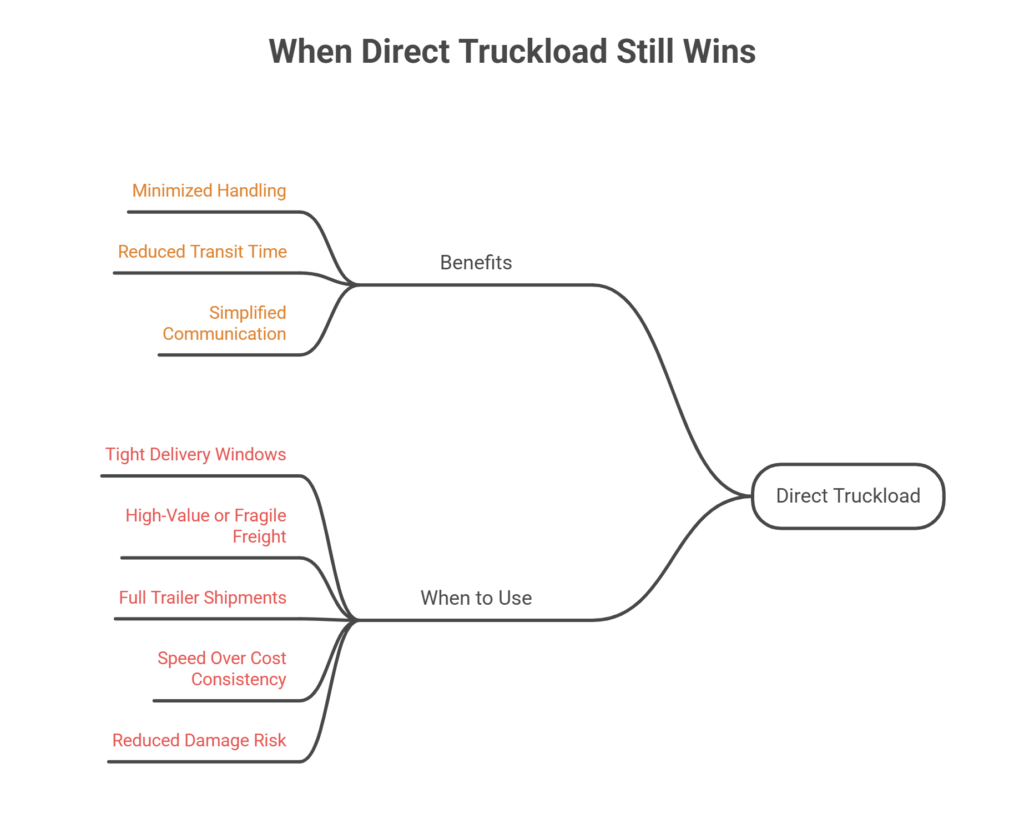
Direct truckload remains the best option for many cross-border shipments because it minimizes handling, reduces transit time, and simplifies communication.
The mistake isn’t using truckload. The mistake is assuming every shipment belongs on a truck simply because that’s how it moved last year.
Direct truckload is still the strongest choice when:
- Delivery windows are tight.
- Freight is high-value or fragile.
- Shipments fill an entire trailer.
- Customers prioritize speed over cost consistency.
- Multiple handling points increase damage risk.
For these shipments, introducing additional transfers or rail movements often creates unnecessary complexity.
The key is understanding why truckload is the right solution, not defaulting to it out of habit.
The strongest brokers don’t try to replace truckload. They make sure truckload is solving the right problem.
“Good brokers sell capacity. Great brokers know when capacity alone isn’t the answer.”
When was the last time you challenged an existing truckload lane to see if it was still the best operational choice?
When Drayage Plus Transload Protects Service
Not every shipment benefits from staying on the same trailer from origin to destination.
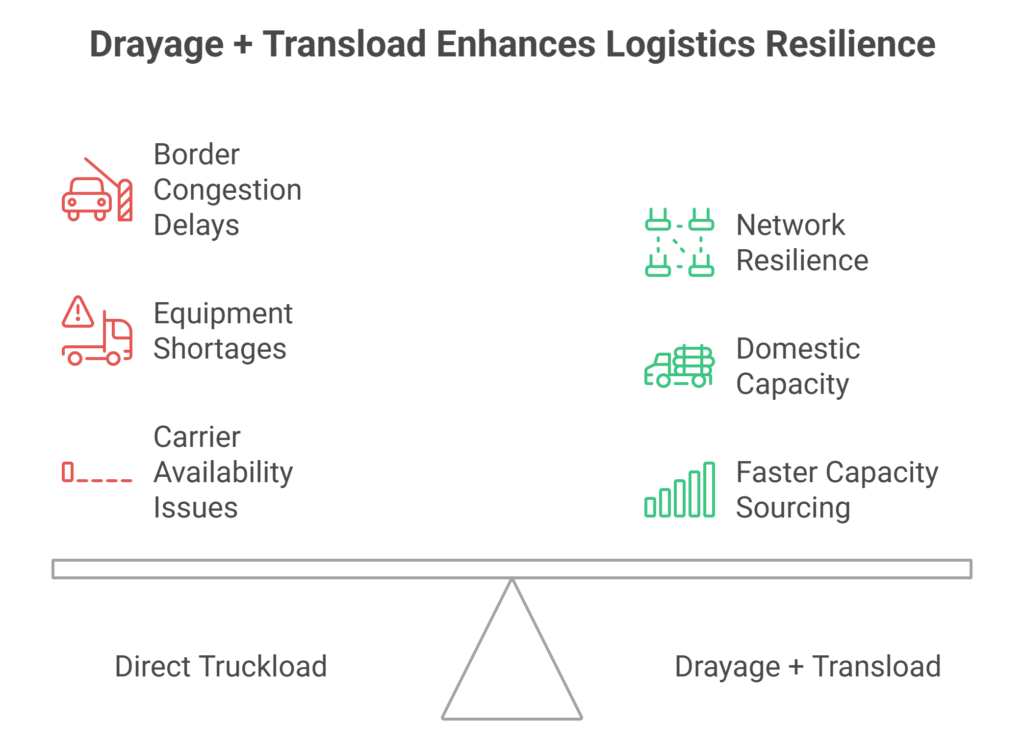
That may sound counterintuitive. After all, fewer touches usually mean less risk. But in many cross border logistics operations, insisting on direct truckload can actually create delays when border congestion, equipment shortages, or carrier availability become bottlenecks.
This is where drayage services combined with transloading become a strategic operating model rather than simply an alternative transportation option.
Instead of waiting for one truck to complete the entire move, freight crosses the border in a container or trailer, is transferred at a strategically located warehouse, and continues inland using domestic equipment that’s already positioned for the next leg of the journey.
The advantage isn’t just flexibility, it’s network resilience.
A brokerage can often source domestic capacity faster than waiting for a cross-border truck to become available, reducing downtime and keeping delivery commitments intact.
When Drayage + Transload Makes Sense
Consider this approach when:
- Border wait times are becoming unpredictable.
- Domestic capacity is stronger than cross-border capacity.
- Freight must be redistributed to multiple destinations.
- Inventory needs to reach customers quickly after crossing.
- Seasonal demand is putting pressure on specific border markets.
The tradeoff, of course, is additional freight handling. For fragile or highly specialized cargo, that extra touch may not be appropriate. But for many palletized consumer goods, retail products, or packaged industrial freight, the operational flexibility outweighs the added handling.
Real-World Lane Example: A shipper moving packaged consumer products from Saltillo to Dallas began experiencing inconsistent delivery performance during seasonal capacity swings. Rather than continuing to search for scarce cross-border truckload capacity, the brokerage shifted to a drayage-plus-transload model. Freight crossed the border as planned, was transloaded into domestic trailers near the border, and reached customers with more consistent appointment performance despite similar overall transit times.
The shipment didn’t move faster, it moved more predictably.
“The best routing strategy isn’t always the one with the fewest touches. It’s the one with the fewest opportunities for disruption.”
Could one of your recurring truckload lanes become more reliable by separating the border movement from the inland delivery?
When Drayage Plus Intermodal Protects Cost
If drayage plus transload is often about protecting service, drayage plus intermodal shipping is usually about protecting long-term transportation costs.
This operating model works particularly well when freight travels long distances after crossing the border. Instead of relying entirely on long-haul truckload, the shipment moves by drayage trucking to a rail terminal, travels the longest portion by rail, and completes the final miles with another drayage move.
The result isn’t necessarily the fastest shipment. It’s often the most consistent one.
As truckload pricing continues to firm, many brokers are reevaluating long-haul lanes that historically stayed on the highway. According to industry forecasts, intermodal pricing is expected to increase only modestly through the remainder of 2026, while truckload costs on some Mexico corridors continue to face greater upward pressure due to tighter capacity and higher operating expenses [Uber Freight, 2026].
That gap is encouraging experienced brokers to revisit mode selection—not because truckload has stopped working, but because customers increasingly value predictable transportation costs.
Drayage + Intermodal Works Best When:
- Freight travels more than 700–800 miles after crossing the border.
- Delivery schedules allow one or two additional transit days.
- Weekly shipment volumes are consistent.
- Customers prioritize budget stability over maximum speed.
- The destination is well connected to inland rail infrastructure.
Choosing this model isn’t about replacing trucks with trains.It’s about using each mode where it performs best.
Truckload handles flexibility.Rail handles distance. Drayage services connect the two.
That’s how experienced brokers build stronger cross border logistics strategies instead of relying on a single transportation solution.
“Intermodal isn’t competing with truckload. It’s helping truckload solve the lanes where consistency matters more than speed.”
Which of your long-haul cross-border lanes could benefit from greater cost stability, even if transit increased by one day?
When the Wrong Mode Choice Creates Avoidable Service Risk
Most transportation problems don’t begin with bad execution. They begin with a bad assumption.
One of the most common mistakes brokers and shippers make is treating every shipment as if it has the same priorities. In reality, every load has its own balance of cost, transit time, handling requirements, customer expectations, and operational risk.
Choosing the wrong mode can create problems that no amount of carrier management can fully solve.
For example:
- Using direct truckload for a lane that would benefit from transloading can reduce flexibility when border capacity tightens.
- Moving highly time-sensitive freight via intermodal may introduce unnecessary transit delays.
- Selecting LTL vs FTL based only on price can increase handling and damage risk for certain shipments.
- Ignoring available drayage services may create avoidable congestion around ports, rail ramps, or border facilities.
These aren’t execution failures. They’re planning failures.
Common Mode Selection Mistakes
| Mistake | Likely Result |
| Prioritizing lowest rate over operating fit | Higher total transportation costs |
| Choosing truckload for every shipment | Missed opportunities for efficiency |
| Ignoring inland rail options | Reduced long-term cost stability |
| Selecting LTL for freight that should move FTL | More handling and greater service risk |
| Evaluating modes after problems occur | Reactive instead of proactive operations |
The strongest transportation strategies begin long before freight is tendered.
Experienced brokers evaluate the lane, customer expectations, freight characteristics, and available network options before recommending a solution. That’s what transforms transportation from a transactional service into a competitive advantage.
“The wrong transportation mode can cost far more than a higher freight rate. It can cost customer confidence.”
Are you choosing transportation modes based on habit, or based on what each shipment actually needs?
A Shipper Checklist for Choosing the Right Path
One of the biggest misconceptions in transportation is that choosing the right mode starts with comparing rates. In reality, it starts with understanding the shipment.
Experienced brokers don’t begin by asking, “Can we move this?” They ask, “What’s the best way to move this based on the customer’s priorities?” That conversation often uncovers opportunities to improve service, reduce costs, or build more resilience into the supply chain.
Before deciding between direct truckload, drayage services, or intermodal shipping, shippers should ask:
- Is delivery speed more important than cost stability?
- Does this shipment move regularly or only occasionally?
- Could one additional transit day create meaningful savings?
- Is the freight suitable for transloading or rail?
- Will the shipment move through a congested border crossing or inland terminal?
- Are there backup routing options if capacity changes unexpectedly?
- Has my brokerage explained why one mode is better than another?
The answers to these questions often determine the best operating model long before the shipment is tendered.
The best routing decision isn’t always the least expensive one.It’s the one that consistently meets the customer’s operational goals.
“The strongest transportation strategy begins with understanding the shipment, not comparing freight rates.”
Wondering which shipping solution fits your freight best? Explore SPI’s shipping services and move with confidence. SPI’s shipping services
How Experienced SPI Agents Use Multiple Mode Options to Protect Customer Books
The best freight brokers don’t build customer relationships around a single transportation mode. They build them around solving problems.
That’s becoming increasingly important as cross border logistics grows more complex. Customers expect brokers to recommend the most effective solution, not simply the most familiar one.
This is where experienced SPI agents have an advantage.
Instead of relying solely on truckload capacity, SPI’s network allows agents to evaluate multiple transportation strategies based on the customer’s freight, lane characteristics, and service expectations. Whether the shipment stays truckload, benefits from drayage services, or shifts to intermodal shipping, agents have access to operational support that helps them deliver solutions with confidence.
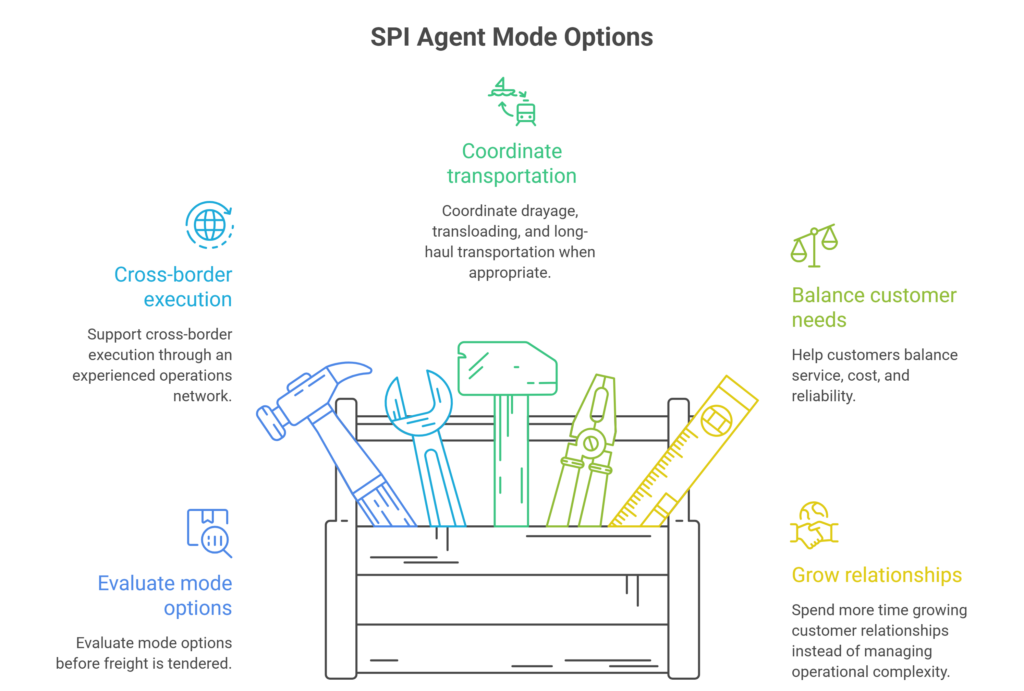
Rather than forcing every shipment into one model, SPI helps agents:
- Evaluate mode options before freight is tendered.
- Support cross-border execution through an experienced operations network.
- Coordinate drayage, transloading, and long-haul transportation when appropriate.
- Help customers balance service, cost, and reliability.
- Spend more time growing customer relationships instead of managing operational complexity.
That support becomes especially valuable during tightening freight markets, when mode selection can have a direct impact on customer satisfaction and long-term profitability.
“The broker who can explain three transportation options instead of one becomes much harder for a customer to replace.”
Ready to offer customers more than one freight solution? See what successful SPI agents do differently. what successful freight agents do differently
Frequently Asked Questions(FAQs)
1. When should I choose drayage instead of direct truckload?
Drayage isn’t a replacement for truckload, it’s a supporting service. It’s often the right choice when freight needs to move between a border crossing, port, rail terminal, or warehouse before continuing to its final destination.
2. Is intermodal shipping slower than truckload?
Generally, yes. However, for long-haul, recurring freight with flexible delivery windows, intermodal shipping often provides more predictable transportation costs and greater capacity stability, making it a strong strategic option.
3. How do brokers decide which transportation mode is best?
Experienced brokers evaluate several factors, including transit requirements, shipment size, handling needs, route distance, border conditions, and customer priorities. The goal is to recommend the operating model that best balances cost, service, and reliability, not simply the lowest rate.
One Border. Multiple Solutions. One Smart Strategy.
The conversation around cross border logistics has changed. It is no longer enough to know how to move freight across the border. Brokers and shippers need to know which operating model creates the best outcome for each shipment.
Direct truckload remains the right answer for many moves, but it isn’t the only answer. As border activity, inland rail networks, and customer expectations continue to evolve, successful transportation strategies increasingly combine truckload, drayage services, transloading, and intermodal shipping where each adds the most value.
The brokers creating long-term customer relationships aren’t waiting for service failures to rethink a lane. They’re evaluating routing decisions before problems occur, giving customers more flexibility, stronger reliability, and greater confidence in every shipment.
In this market, the competitive advantage isn’t simply having access to capacity, it’s knowing how to use it.
If your freight includes import, border, or rail-connected lanes, could your customers benefit from more than one transportation strategy? Learn how SPI helps independent agents deliver smarter cross-border solutions with the support to grow confidently.
References
American Association of Railroads. (2026). Weekly Rail Traffic Report. Retrieved from https://www.aar.org
Port of Los Angeles. (2026). Port Optimizer and Monthly Cargo Statistics. Retrieved from https://www.portoflosangeles.org
CPKC. (2026). CPKC Opens New Inland Port in Laredo. Retrieved from https://www.cpkcr.com
DAT Freight & Analytics. (2026). Freight Market Trends and Lane Analytics. Retrieved from https://www.dat.com
FreightWaves. (2026). Freight Market News and Supply Chain Analysis. Retrieved from https://www.freightwaves.com