
What is freight forwarding? Freight forwarding is the work of planning and arranging the movement of goods for a shipper, most often across international borders. It covers booking transportation and handling the documents and steps that go with it, such as customs paperwork, consolidation and storage.
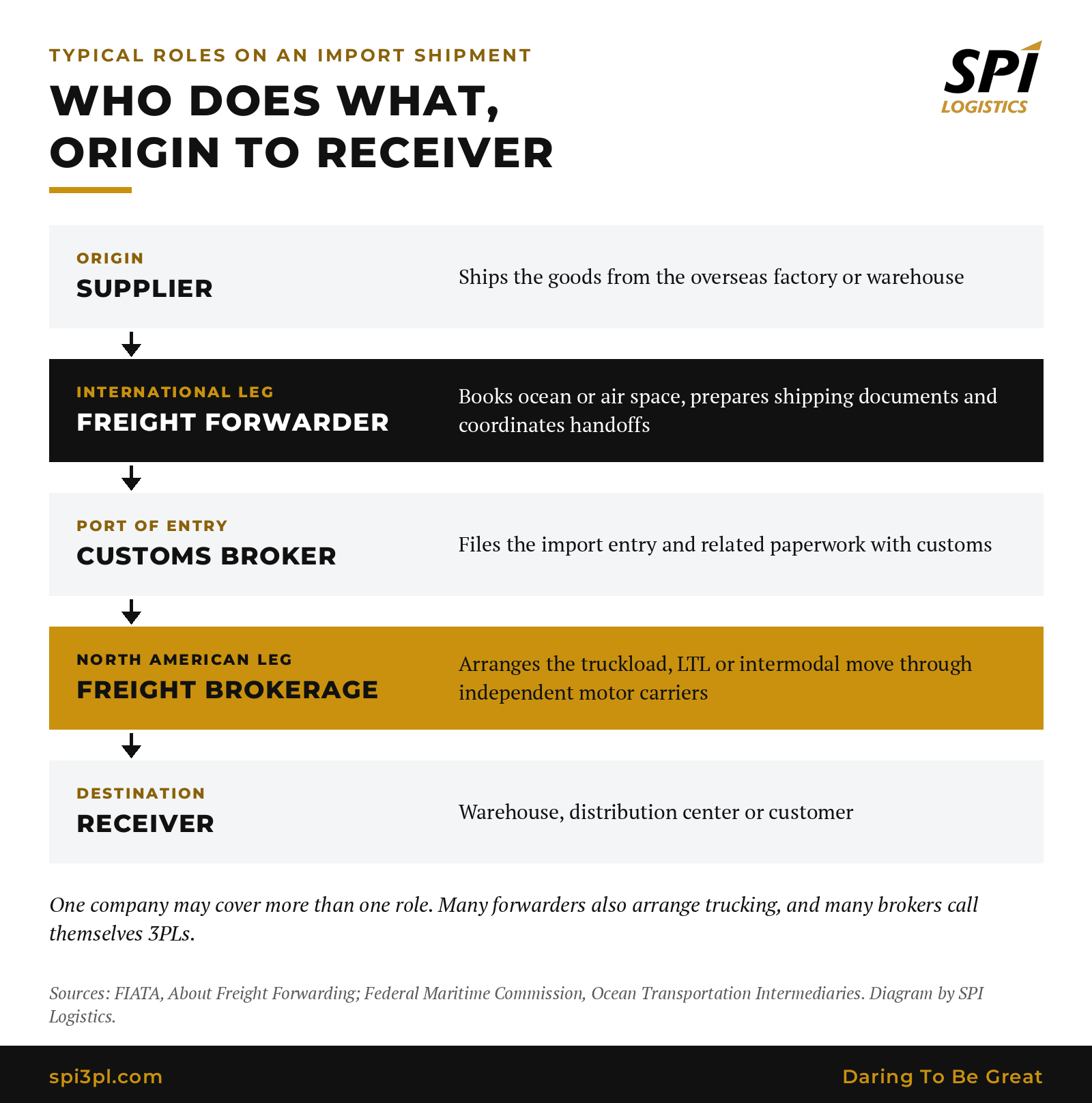
Freight forwarder meaning: A freight forwarder is the company that does that work. It books space with ocean, air, rail and truck carriers on the shipper’s behalf, prepares the shipping documents and coordinates each handoff from origin to destination.
This guide explains what freight forwarders do, how they compare with freight brokers and 3PLs, how forwarding fits into international shipping, and where a freight brokerage like SPI fits in.
“A freight forwarder connects the pieces of an international shipment. A freight broker connects a shipper with a carrier for the road leg.”
What Is Freight Forwarding?
FIATA, the international federation of freight forwarders associations, describes freight forwarding as services “relating to the carriage… consolidation, storage, handling, packing or distribution of goods,” along with related advisory services such as customs matters and documentation. [FIATA, About Freight Forwarding]
FIATA also puts it more simply: freight forwarding is about making international trade easier. The forwarder is the party that makes sure goods move from origin to destination at the right place, at the right time and at an economical cost. [FIATA, About Freight Forwarding]
In practice, a forwarder may never own a ship, plane or truck. It works with transport providers in every mode, compares routes and costs, and designs a plan that balances cost, speed and reliability.
“Freight forwarding is less about moving the box and more about orchestrating everyone who touches it.”
Are your shipments crossing an ocean, a land border or neither?
Freight Forwarder Meaning: What a Forwarder Does
A freight forwarder acts on behalf of the shipper. The exact services vary by company, but most forwarders handle some or all of the following:
- Booking space with ocean carriers, airlines, railroads and trucking providers
- Documentation such as bills of lading, commercial invoices and export paperwork
- Customs coordination, often working with a licensed customs broker at the border or port of entry
- Consolidation, combining smaller shipments into a full container or air shipment
- Storage and handling at origin or destination warehouses
- Rate negotiation and route planning across modes
In the United States, ocean freight forwarders are regulated by the Federal Maritime Commission. The FMC describes an ocean freight forwarder as a U.S. company that arranges cargo movement to an international destination, books space for shipments on behalf of shippers, and prepares and processes the documentation for those shipments. Ocean freight forwarders must hold an FMC license. [Federal Maritime Commission]
The FMC also licenses non-vessel-operating common carriers (NVOCCs), which issue their own house bills of lading without operating the vessels. Many large forwarders hold both types of license. [Federal Maritime Commission]
New to shipping paperwork? Read our guide to shipping documents for export.
“A forwarder’s real product is a plan: the route, the paperwork and the timing that get freight across borders.”
Which part of an international move takes the most of your team’s time today?
Freight Forwarder vs. Freight Broker vs. 3PL
These three terms are often used interchangeably, but they describe different roles. Here is how they usually compare.
| Freight forwarder | Freight broker | 3PL (third-party logistics) | |
| Main job | Plans and arranges international and multimodal shipments for a shipper | Arranges transportation between a shipper and a carrier, usually by truck | Broad term for an outside company that handles part of a shipper’s logistics |
| Typical modes | Ocean, air, rail and truck | Truckload, LTL, intermodal and specialized freight | Any, depending on the provider |
| Customs and export documents | Usually coordinated as part of the service | Not usually part of the service | Depends on the provider |
| U.S. registration | FMC license for ocean freight forwarders | FMCSA broker authority | Depends on the services offered |
| Where it fits | Origin to destination across borders | The road leg, domestic or cross-border | Warehousing, fulfillment, transportation management or brokerage |
The lines blur in real life. Many forwarders also arrange trucking, many brokers call themselves 3PLs, and some large logistics companies do all three under one name.
The key question is what you need moved and where. If the freight is crossing an ocean, you need a forwarder. If it is already in North America and needs a truck or a rail container, a freight brokerage is built for that.
Comparing roles inside a brokerage too? Read freight agent vs. freight broker.
“Forwarder, broker or 3PL: the title matters less than knowing who is responsible for each leg.”
Do you know which company is arranging each leg of your current shipments?
Freight Forwarding in International Shipping
International freight adds layers that domestic freight does not: ports, terminals, customs clearance, import regulations, tariffs and time zones. That is where forwarders earn their place.
In this SPI Short, the difference is summed up in one line: “Domestic freight tests your speed. International tests your systems.”
Import volume shows how much freight flows through U.S. ports before it ever reaches a truck. The National Retail Federation’s Global Port Tracker counted 2.3 million TEU (twenty-foot equivalent units) at major U.S. container ports in August 2026 and forecasts 25.8 million TEU for the year, up 1.4% from 2025. [NRF, Oct. 8, 2026]
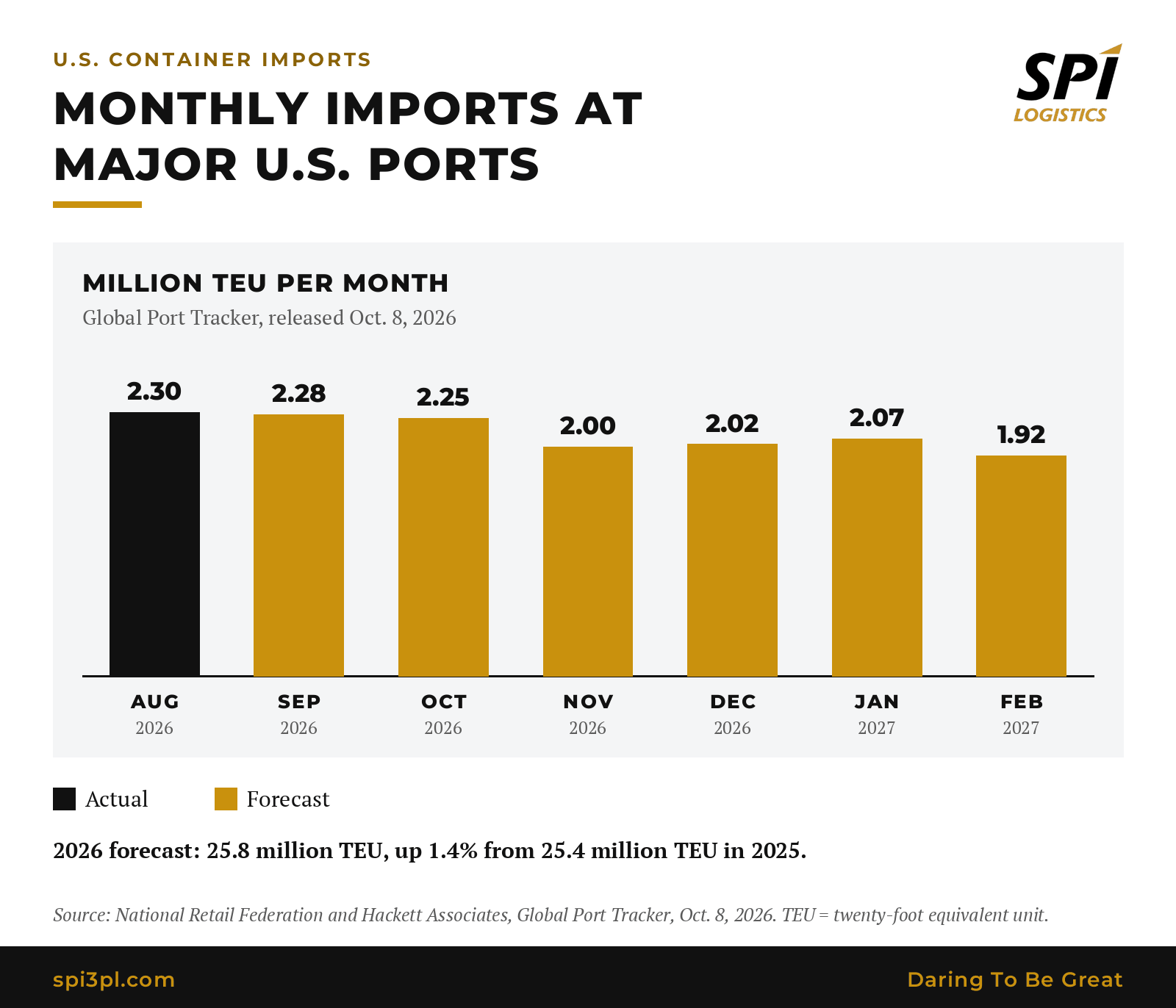
Once a container is unloaded, the shipment still has to reach a warehouse, a distribution center or a customer. That domestic leg often moves by drayage, intermodal, truckload or LTL, and it is often arranged by a freight brokerage rather than the forwarder.
Want the bigger picture? Read international vs. domestic freight.
“The ocean leg gets the freight to the country. The road and rail legs get it to the customer.”
Who arranges the move from the port to your door today?
Common Freight Forwarding Terms
- Freight forwarder: A company that plans and arranges the movement of goods for a shipper, usually internationally.
- Ocean freight forwarder (OFF): In the U.S., an FMC-licensed company that books space and handles documentation for export shipments.
- NVOCC: A non-vessel-operating common carrier that issues its own house bill of lading but does not operate vessels.
- Customs broker: A licensed party that files import entries and related paperwork with customs authorities.
- Consolidation: Combining several smaller shipments into one container or load.
- TEU: Twenty-foot equivalent unit, the standard measure for container volume. See 20 ft and 40 ft container dimensions.
- Drayage: The short truck move of a container between a port or rail ramp and a nearby facility.
- Bill of lading: The shipping document that describes the freight and the terms of carriage.
“Knowing the vocabulary is the fastest way to ask better questions of every partner on a shipment.”
How to Choose a Freight Forwarder
If your shipments cross an ocean or need air freight, a short checklist helps you compare forwarders.
1. Lane and Industry Experience
Ask which origins, destinations and product types the forwarder handles most often.
2. Network Coverage
Find out who handles your freight at origin and destination, whether the forwarder’s own offices or partner agents.
3. Licensing
For U.S. ocean shipments, confirm the forwarder’s FMC license status.
4. Clear Pricing
Ask for a breakdown of ocean or air freight, origin and destination charges, and any accessorial fees.
5. Communication and Visibility
Ask how you will get updates, who your contact is, and how handoffs to the domestic leg are managed.
“The best forwarder for you is the one that knows your lanes and tells you what is happening before you ask.”
What would you most want to improve about your current international shipping?
Where SPI Fits: North American Freight After the Border
SPI Logistics is a freight brokerage, not a freight forwarder. SPI arranges the transportation of freight across the USA and Canada through independent motor carriers.
For shippers, that means support with the road and rail legs of a supply chain: truckload, LTL, heavy haul and specialized, and intermodal, including domestic and cross-border moves between the USA and Canada.
If your international freight is handled by a forwarder, SPI can be the partner that arranges the North American move once the freight is ready to go by truck or rail.
Moving freight across the border? Read the cross-border freight execution checklist.
“Know your forwarder for the ocean. Know your brokerage for the road.”
Is the North American leg of your supply chain getting the same attention as the international leg?
Frequently Asked Questions (FAQs)
1. What is freight forwarding in simple terms?
Freight forwarding is arranging the movement of goods for a shipper, usually across borders. The forwarder books transportation, prepares documents and coordinates each step from origin to destination.
2. What is the meaning of a freight forwarder?
A freight forwarder is a company that plans and arranges shipments on a shipper’s behalf. It works with ocean, air, rail and truck carriers and handles the paperwork that goes with the shipment.
3. Is a freight forwarder the same as a freight broker?
No. A freight forwarder usually manages international and multimodal shipments, including documents and customs coordination. A freight broker arranges transportation between a shipper and a carrier, most often by truck. In the U.S., ocean freight forwarders are licensed by the FMC and freight brokers hold FMCSA broker authority.
4. What is the difference between a freight forwarder and a 3PL?
A 3PL is a broad term for any outside company that handles part of a shipper’s logistics, such as warehousing, fulfillment, transportation management or brokerage. A freight forwarder is one specific type of logistics provider focused on arranging international shipments.
5. What is the difference between a shipper and a freight forwarder?
The shipper owns or sells the goods and needs them moved. The freight forwarder is hired by the shipper to arrange that movement.
6. What is the difference between logistics and freight forwarding?
Logistics covers the whole flow of goods, including storage, inventory and transportation. Freight forwarding is one part of logistics, focused on arranging the transportation and documents for a shipment.
Need the North American Leg Covered?
Freight forwarders bring international shipments together. Once your freight is in North America, it still needs the right truck or rail container at the right time.
With 75+ North American offices and 45+ years in business, SPI arranges truckload, LTL, intermodal and specialized freight across the USA and Canada through independent motor carriers.
Shipping freight in the USA or Canada? Explore SPI’s shipping services or contact SPI to talk about your next shipment.
References
FIATA. (n.d.). About Freight Forwarding. Retrieved from
https://fiata.org/about-freight-forwarding/
Federal Maritime Commission. (n.d.). Ocean Transportation Intermediaries. Retrieved from
https://www.fmc.gov/resources-services/ocean-transportation-intermediaries/
National Retail Federation. (2026, October 8). Import Cargo’s Extended Peak Season Wrapping Up. Retrieved from
https://nrf.com/media-center/press-releases/import-cargo-s-extended-peak-season-wrapping-up