A border shipment rarely goes wrong because someone suddenly forgot that borders exist. More often, the problem started hours, or even days earlier.
A document wasn’t ready. The carrier arrived before the warehouse could load. A delivery appointment left no room for border variability. The freight was assigned to a mode that looked cheap but created too many handoffs.
That matters more in August 2026 because cross border freight is moving through a market where capacity is becoming less forgiving while transportation costs remain elevated.
The Bureau of Transportation Statistics reported that U.S.-Mexico freight increased 17.1% year over year in May 2026. Meanwhile, the Port of Los Angeles handled 1,002,734 TEUs in June, showing that import activity continues to put pressure on major freight networks. [Bureau of Transportation Statistics, May 2026; Port of Los Angeles, June 2026]
At the same time, the Logistics Managers’ Index put transportation capacity at 30.8 and transportation prices at 92.4 in June, a combination that says capacity remains relatively constrained while prices remain elevated. [Logistics Managers’ Index, June 2026]
So the question isn’t whether cross border freight is complicated. It’s whether the shipment was planned well enough to handle that complexity.
Why Cross-Border Execution Matters More in August 2026
For brokers, the biggest mistake is treating cross-border freight like domestic freight with a customs stop in the middle.
It isn’t.
There are more handoffs, more documentation, more parties involved, and more opportunities for a small timing problem to become a missed delivery.
DAT’s July 9 market update also showed van spot rates remaining above contract rates, reinforcing that dependable truck capacity is carrying a premium. [DAT Freight & Analytics, July 2026]
That changes the broker’s job. When capacity is cheap and plentiful, you can sometimes recover from poor planning by finding another truck. When capacity tightens, recovery becomes expensive.
The 2026 operating reality
| Market condition | What it means |
| U.S.-Mexico freight +17.1% | More cross-border pressure |
| LA June volume: 1,002,734 TEUs | Strong import activity |
| Transportation capacity: 30.8 | Capacity remains constrained |
| Transportation prices: 92.4 | Transportation remains expensive |
| Van spot above contract | Reliable truck capacity costs more |
“When capacity gets tighter, operational mistakes become more expensive because the backup option isn’t guaranteed.”
Where would your team feel a capacity problem first if a cross-border shipment went off schedule?
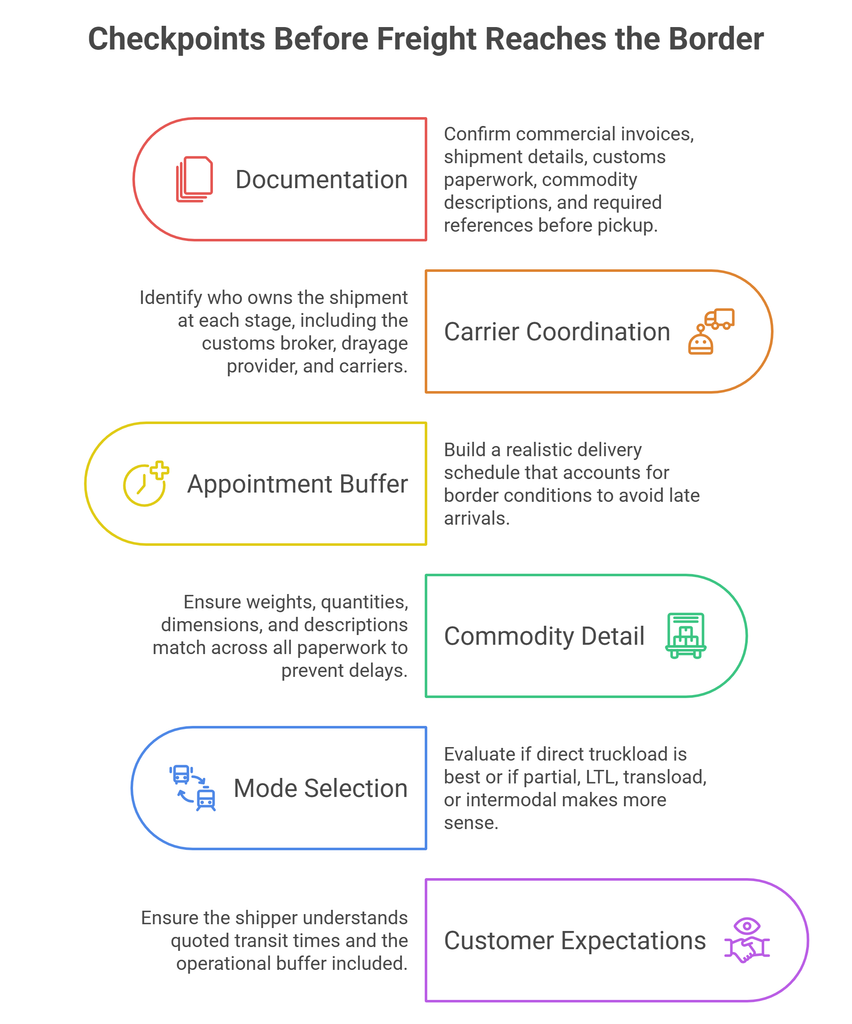
The 6 Checkpoints Before Freight Reaches the Border
A useful cross-border shipping checklist should focus on decisions that can still be fixed before the truck is committed.
1. Documentation
Confirm commercial invoices, shipment details, customs paperwork, commodity descriptions, and required references before pickup.
Don’t wait for the truck to be sitting at the border.
2. Carrier and Handoff Coordination
Everyone needs to know who owns the shipment at each stage.
That includes the originating carrier, customs broker, drayage provider, warehouse, and final-mile carrier where applicable.
3. Appointment Buffer
Don’t build a delivery schedule around perfect border conditions.
A realistic buffer can be the difference between a shipment arriving late and arriving exactly when promised.
4. Commodity Detail
Commodity descriptions, weights, quantities, dimensions, and other shipment information need to match across the paperwork.
Small inconsistencies can create disproportionately large delays.
5. Mode Selection
Before tendering, ask whether direct truckload is actually the best option, or whether partial, LTL, transload, or intermodal makes more sense.
6. Customer Expectations
Make sure the shipper understands what the quoted transit time actually assumes. A confident promise with no operational buffer isn’t good service. It’s a future apology.
“The best cross-border plan doesn’t eliminate uncertainty; it identifies where uncertainty exists before the shipment starts.”
Which of these six checkpoints is most likely to expose a problem in your current process?
Where Timing Usually Breaks First
The interesting thing about cross border freight is that the border itself isn’t always the first failure point.
A typical chain looks like this:
Pickup delay → missed handoff → customs timing shifts → border appointment changes → final delivery gets squeezed
That’s why experienced brokers look at the entire timeline rather than simply asking whether the carrier has enough hours to make the trip.
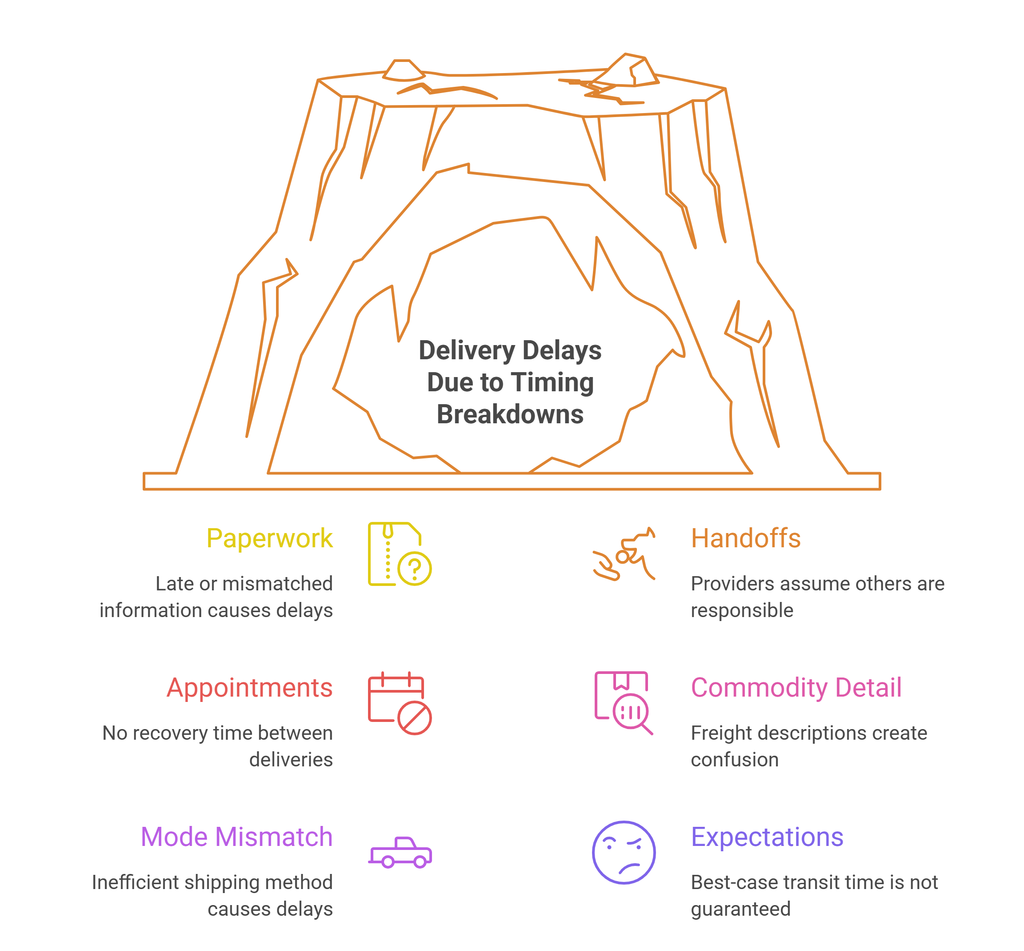
The most common pressure points are:
Paperwork: Information arrives too late or doesn’t match.
Handoffs: One provider assumes another provider is handling the next step.
Appointments: Delivery is scheduled with no recovery time.
Commodity detail: Freight descriptions or quantities create questions.
Mode mismatch: The shipment is too large for efficient LTL or too small to justify a dedicated truck.
Expectations: The customer assumes a best-case transit time is guaranteed.
A good broker doesn’t wait until the shipment is delayed to start communicating. They communicate when the plan changes.
“A two-hour problem discovered at pickup can be manageable. The same problem discovered at the border can become a two-day problem.”
Are your customers getting updates when risk appears, or only after a delivery date is already in danger?
When to Use Truckload, Partial, LTL, or Intermodal
There isn’t one perfect transportation mode for every US-Mexico freight movement.
The right answer depends on shipment size, urgency, distance, handling requirements, and the customer’s tolerance for variability.
| Mode | Best fit | Watch out for |
| Truckload | Time-sensitive, direct freight | Higher cost when capacity tightens |
| Partial | Mid-sized shipments | Requires careful capacity planning |
| LTL | Smaller palletized freight | More handling and network variability |
| Intermodal | Longer, predictable lanes | Additional drayage and handoffs |
For example, a shipment with eight oversized pallets and a flexible delivery window may deserve a partial solution rather than standard LTL. A high-value shipment with a fixed appointment may justify truckload even if the rate is higher.
This is where partial truckload vs LTL becomes a useful comparison rather than simply a pricing exercise. The mode should match the customer’s actual service requirement.
“The cheapest mode isn’t necessarily the best mode. The best mode is the one that meets the customer’s delivery requirement with the least unnecessary risk.”
Are you choosing the mode based on the shipment, or simply using the mode your customer has always used?
What Experienced Brokers Do Differently
Transactional coverage starts with:“What’s the rate?”
Experienced brokerage starts with:“What can go wrong?”
That difference becomes especially valuable in cross border freight.
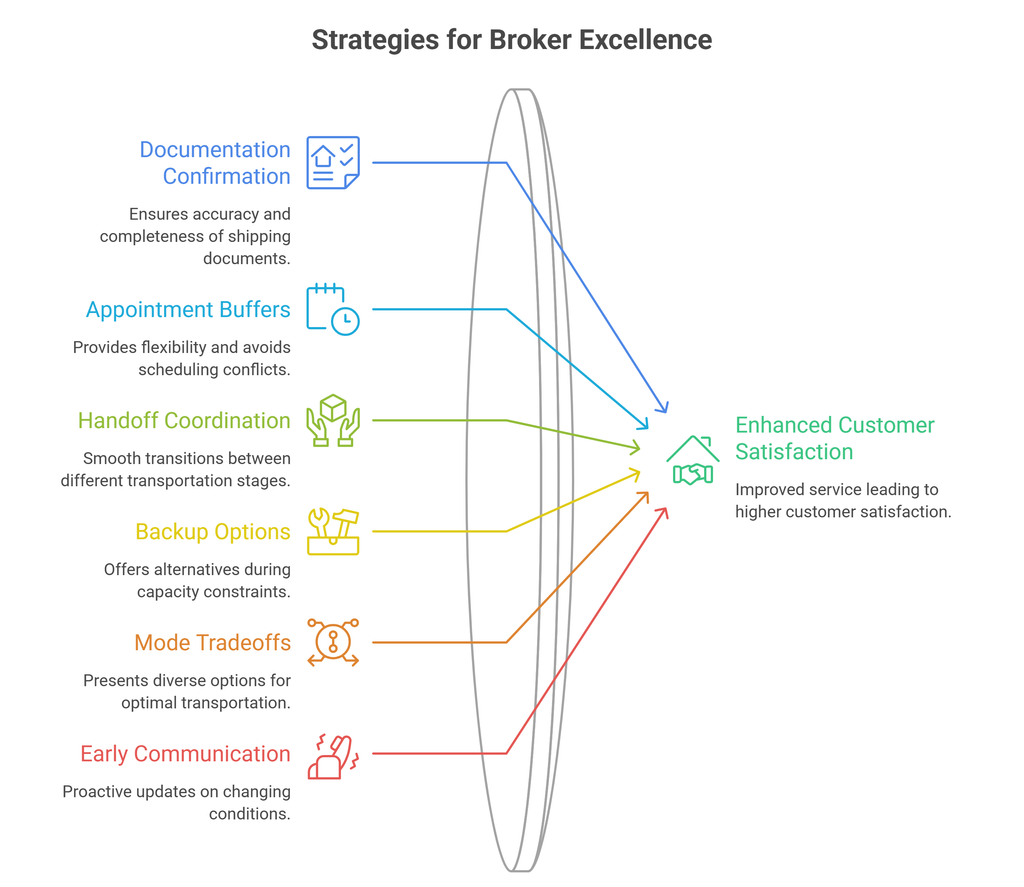
Experienced brokers tend to:
- Confirm documentation before tender.
- Build realistic appointment buffers.
- Coordinate handoffs before pickup.
- Maintain backup options when capacity is tight.
- Explain mode tradeoffs instead of presenting one quote.
- Communicate early when conditions change.
- Keep the customer focused on the total outcome, not just the linehaul rate.
That is also where operational infrastructure matters.
An independent agent shouldn’t have to personally solve every customs question, carrier issue, appointment problem, and billing exception to provide a strong customer experience.
The value of a brokerage platform is having the people, systems, carrier relationships, and back-office support to keep the shipment moving while the agent stays focused on the customer.
“Customers don’t necessarily need a broker who can predict every delay. They need one who has a plan when the delay happens.”
Want to see what experienced freight agents do differently? Explore how stronger processes and customer-focused support can help you manage freight more confidently.
What Brokers and Shippers Should Lock Down Before Pickup
Before the truck rolls, both sides should be able to answer these questions:
- Are all shipment and customs documents complete and accurate?
- Has the carrier confirmed the pickup time and location?
- Are all customs contacts and responsibilities clearly confirmed?
- Does everyone know who is responsible for each handoff?
- Is the delivery appointment realistic given border transit variability?
- Is there a backup plan if the carrier or border schedule changes?
- Does the selected mode actually fit the shipment’s size, urgency, and service requirements?
If several answers are no,the shipment isn’t ready, even if the truck is. That simple distinction can prevent a lot of border freight delays.
For shippers, this is also a useful way to evaluate cross border freight services. Don’t just ask a brokerage whether it can move freight across the border. Ask how it prepares the shipment before it gets there.
Want a more reliable approach to planning and executing your shipments? Explore SPI’s shipping services and see how the right support can help reduce avoidable delays.
Remove the Risk Before Your Freight Reaches the Border
The strongest cross border freight strategy in 2026 isn’t about finding a magical way around border delays. It’s about removing the avoidable ones.
Documentation needs to be ready. Handoffs need owners. Appointments need realistic buffers. Mode selection needs to reflect the shipment. And customers need to understand what the timeline actually depends on.
For brokers, that operational discipline becomes a competitive advantage. For shippers, it’s a way to distinguish a brokerage that simply covers freight from one that actually manages it.
If you’re a shipper, consider requesting a lane review of your current U.S.-Mexico network to identify where documentation, mode choice, or handoffs may be creating avoidable risk.
If you already own the customer but need deeper cross-border execution support, talk to SPI about the agent platform.
Frequently Asked Questions (FAQs)
1. What should brokers verify before moving cross-border freight?
At minimum, verify documentation, carrier details, pickup and delivery appointments, customs contacts, handoff responsibilities, commodity information, and the transportation mode.
2. How can shippers reduce border freight delays?
Start before pickup. A clear cross-border shipping checklist, accurate documentation, realistic appointment buffers, and proactive communication can eliminate many preventable delays.
3. Should every U.S.-Mexico shipment use truckload?
No. Depending on distance, shipment size, timing, and service requirements, truckload, partial, LTL, transload, or intermodal may be the better option.
References
Bureau of Transportation Statistics. (2026). Freight Facts and Figures: U.S.-Mexico Freight Statistics. Retrieved from
https://www.bts.gov
Port of Los Angeles. (2026). June 2026 Port Statistics. Retrieved from
https://www.portoflosangeles.org
Logistics Managers’ Index. (2026). June 2026 Logistics Managers’ Index Report. Retrieved from
https://www.the-lmi.com
DAT Freight & Analytics. (2026). Truckload Market and Rate Trends – July 2026. Retrieved from
https://www.dat.com