Most freight decisions still start with a surprisingly simple question: “How much does the quote cost?”
That is exactly where things can go wrong.
In a tightening market, the cheapest quote isn’t necessarily the cheapest shipment. A low LTL rate can come with extra handling and a longer transit window. A full truckload can leave half a trailer empty. And partial truckload can sit in the middle as the option nobody considers until the first two choices stop making sense.
That middle ground matters more in 2026 because freight costs are rising faster than shipment volumes.
The June 2026 Cass Freight Index showed shipments down 4.1% year over year, while expenditures increased 11.2% and the Cass Truckload Linehaul Index rose 5.5%. [Cass Information Systems, June 2026] DAT also reported that June van spot rates moved above contract rates for the first time since February 2022, a sign that truckload capacity is becoming more expensive to secure. [DAT Freight & Analytics, June 2026]
In other words, freight demand doesn’t have to explode for transportation decisions to get harder. The market can stay relatively soft while the cost of moving the freight rises.
For brokers, that makes mode selection a margin issue. For shippers, it makes choosing the right service level a budget issue.
The question isn’t simply whether to use LTL or truckload anymore. It is: What is the right transportation product for this shipment?
What Changed in the 2026 Market?
The 2026 freight market is creating an uncomfortable mismatch between shipment activity and transportation costs.
Cass reported that shipments declined 4.1% year over year in June, but expenditures increased 11.2%. Meanwhile, linehaul costs rose 5.5%. [Cass Information Systems, June 2026]
That’s the kind of market where a shipper can say, “We’re not shipping more,” while the transportation team says, “Why is everything costing more?”
Both observations can be correct. The problem becomes more obvious when you look at truckload pricing. DAT reported that June van spot rates moved above contract rates for the first time since February 2022. [DAT Freight & Analytics, June 2026]
That creates pressure on brokers to find capacity without simply passing every increase to the customer.
What the numbers mean operationally
| Market Signal | What It Means for Brokers | What It Means for Shippers |
| Shipments down 4.1% | Demand isn’t the whole story | Volume alone won’t predict cost |
| Expenditures up 11.2% | Margin needs more attention | Budgets face pressure |
| Linehaul up 5.5% | Truckload decisions matter more | Mode selection matters more |
| Spot above contract | Capacity is becoming expensive | Premium capacity may cost more |
This is where partial truckload becomes interesting.
It isn’t automatically the cheapest option. But when a shipment is too large or awkward for LTL and too small for a dedicated truck, it can prevent the shipper from paying for capacity they don’t actually need.
“When freight costs rise faster than shipment volumes, the smartest savings often come from changing the transportation decision, not simply negotiating the same rate harder.”
Are your customers actually choosing the right mode, or are they simply repeating the mode they’ve always used?
When LTL Is Still the Right Answer
Let’s not make the mistake of turning this into a sales pitch for partials.
LTL still has a very important job.
If a shipment is relatively small, doesn’t require dedicated equipment, and can tolerate normal terminal handling and transit variability, LTL can be exactly what the shipper needs.
The problem is defaulting to LTL when the shipment has outgrown it.
LTL works particularly well when:
- The shipment contains only a few pallets.
- Freight volume is relatively low.
- Delivery isn’t highly time-sensitive.
- The origin and destination are well served by established LTL networks.
- The shipper doesn’t need exclusive trailer space.
- The freight can tolerate additional handling.
This is where established nationwide LTL carriers can provide broad network coverage that makes sense for smaller shipments.
But the quote shouldn’t be evaluated on price alone.
A $900 LTL shipment may look better than a $1,400 partial, until the shipper discovers that the LTL shipment has additional handling, a longer transit window, or a higher exposure to terminal delays.
LTL makes sense when:
| Shipment Characteristic | LTL Fit |
| 1–6 pallets | Strong |
| Small total footprint | Strong |
| Flexible delivery | Strong |
| Low handling sensitivity | Strong |
| Tight appointment | Weaker |
| Larger shipment volume | Consider partial |
| High-value/fragile freight | Compare alternatives |
The goal isn’t to eliminate LTL. It’s to stop treating LTL as the automatic answer for anything that isn’t a full truckload.
“LTL is efficient when the shipment fits the network. The trouble starts when the freight is forced into that network simply because it technically qualifies.”
At what point does an LTL shipment become expensive enough in handling, transit, or risk, to justify another option?
When Partial Beats LTL
This is where the conversation gets more interesting. A partial truckload shipment generally sits between traditional LTL and full truckload in terms of size and capacity requirements.
Think of it this way:The freight is too much for a comfortable LTL move, but not enough to justify paying for an entire truck.
That middle ground can be especially valuable when truckload rates are elevated.
A partial can make sense when:
- The shipment occupies a meaningful portion of a trailer.
- The freight is too large for efficient LTL handling.
- The shipper wants fewer touches.
- Transit reliability matters more than standard LTL service.
- A full truck would leave substantial unused capacity.
- The shipment has enough density to justify dedicated space without requiring the whole trailer.
The key is not simply shipment weight. Cube matters.
A 7,000-pound shipment that occupies most of a trailer can behave very differently from a dense 7,000-pound palletized shipment.
That’s why experienced brokers look at dimensions, pallet count, density, loading requirements, origin, destination, and appointment requirements before deciding.
The three-way comparison
| Factor | LTL | Partial Truckload | Full Truckload |
| Small shipment | Excellent | Poor | Poor |
| Mid-sized shipment | Possible | Excellent | Possible |
| Trailer utilization | Shared | Shared/partial | Dedicated |
| Handling | More | Usually less | Minimal |
| Flexibility | High | Moderate | High |
| Dedicated capacity | No | Partial | Yes |
| Best use | Small freight | Mid-sized freight | Large/full shipments |
This is also where pallet shipping quotes become useful. Instead of asking, “What’s the cheapest way to ship these pallets?” The better question is: “What transportation model gives these pallets the right balance of cost, handling, capacity, and service?”
“Partial truckload wins when the shipper needs more control than LTL provides but doesn’t need to buy an entire truck.”
How often are your customers paying for a full trailer when their freight only needs part of one?
When Full Truckload Is the Smarter Move
Sometimes the answer really is simple: Book the truck.
Trying to force a shipment into partial or LTL just because the quote looks lower can create unnecessary risk.
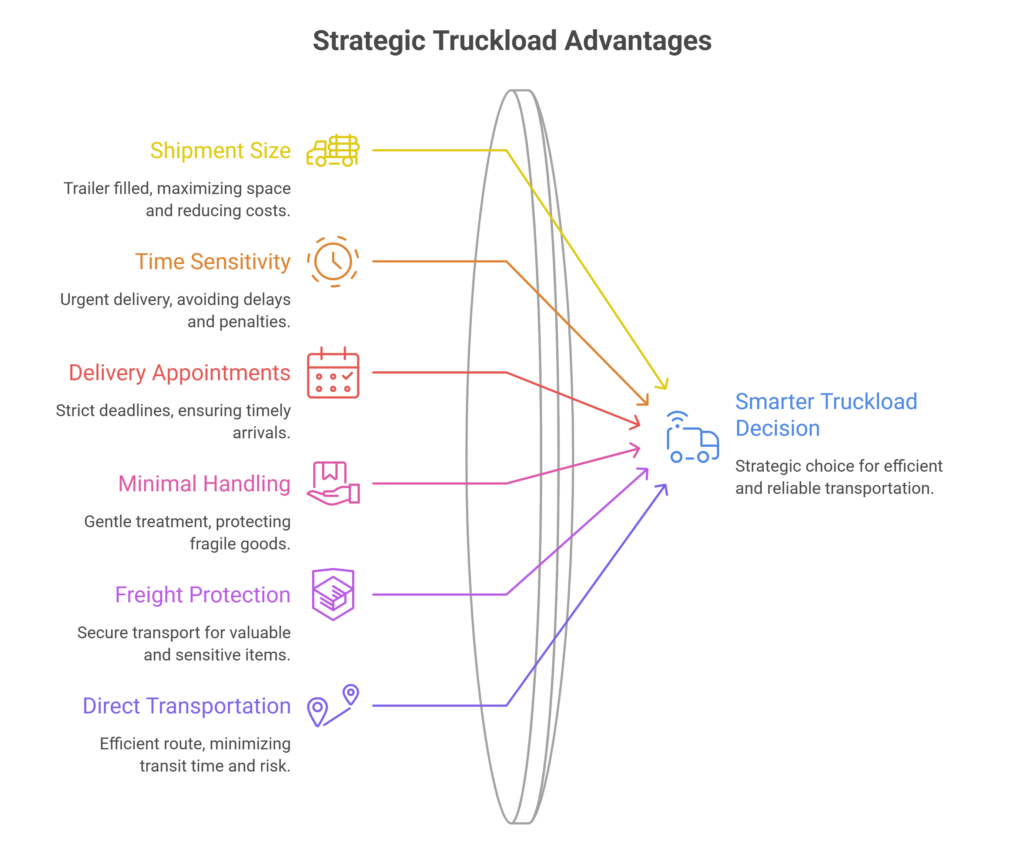
Full truckload usually wins when:
- The shipment fills most of the trailer.
- The freight is time-sensitive.
- There is a strict delivery appointment.
- The customer wants minimal handling.
- Freight is fragile, high-value, or sensitive.
- The shipper needs direct point-to-point transportation.
- The cost of a service failure is significant.
Consider a manufacturer shipping components to a production facility.
If the shipment arrives late and production stops, saving $500 on transportation isn’t exactly a victory.
A simple rule
If the customer is primarily buying speed, control, and predictability, truckload can justify its premium.
If they’re primarily buying capacity at the lowest reasonable cost, partial or LTL may deserve a closer look.
“The cheapest transportation option is not the one with the lowest rate; it’s the one that produces the lowest total cost for the customer’s operation.”
Are your rate comparisons accounting for the financial impact of a missed appointment or damaged shipment?
A 5-Question Broker Decision Framework
Before recommending a mode, experienced brokers can reduce the guesswork with five questions.
1. How much space does the shipment actually need?
Weight alone isn’t enough. Look at pallet count, dimensions, stackability, and total cube.
2. How sensitive is the delivery window?
If the customer says “anytime this week,” you have options. If they say “Tuesday by 10 a.m.,” those options shrink quickly.
3. How much handling can the freight tolerate?
Fragile or high-value freight may justify fewer touches even if the transportation rate is higher.
4. What is the real cost of the shipment?
Compare more than the base quote:
- Fuel and accessorials
- Handling
- Transit
- Appointment requirements
- Potential reclassifications
- Claims exposure
- Delivery failure costs
5. What does the customer actually value?
This final question is often skipped.
Some customers want the absolute lowest transportation cost. Others want predictability. Others want flexibility.
The broker’s job is to figure out which one matters most.
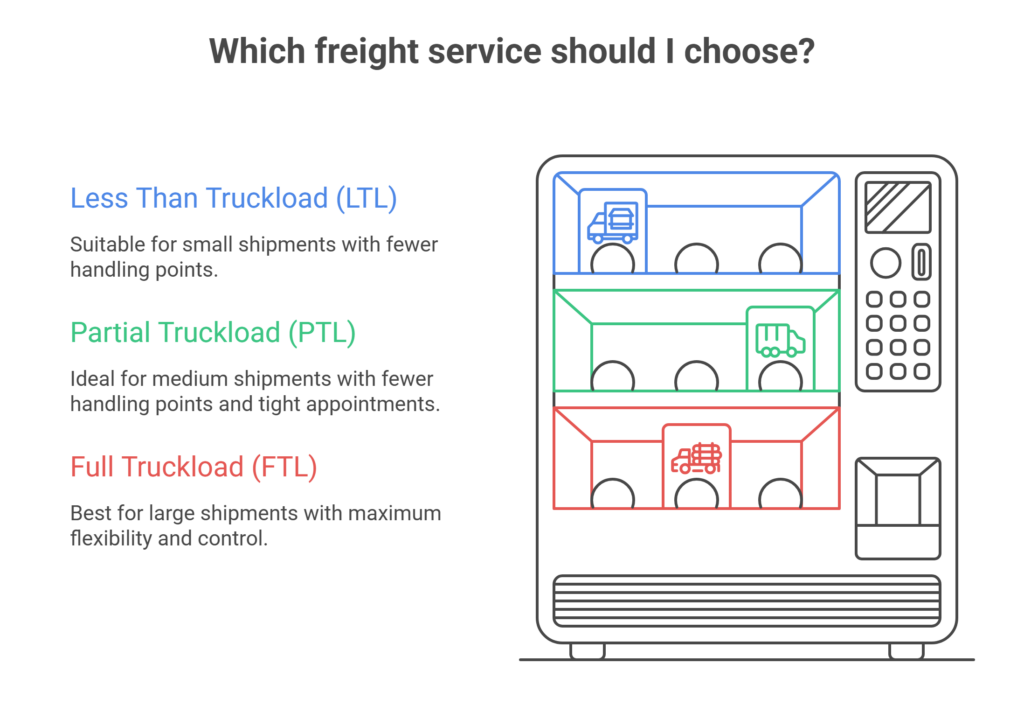
The decision framework
| Question | LTL | Partial | FTL |
| Small shipment? | ✓ | ||
| Medium shipment? | ✓ | ||
| Large/full shipment? | ✓ | ||
| Fewer handling points? | ✓ | ✓ | |
| Tight appointment? | ✓ | ✓ | |
| Maximum flexibility/control? | ✓ |
“A broker earns trust when they can explain why a customer should choose a mode, not just tell them what the rate is.”
Want to make smarter mode decisions for your customers? See how successful freight agents approach strategy, service, and margin differently.
Three Shipment Scenarios
The easiest way to understand the difference is to put the options into real situations.
Scenario 1: Six Pallets, Flexible Delivery
A distributor needs to move six standard pallets from Chicago to Atlanta. The shipment isn’t urgent and can arrive within a reasonable delivery window.
Likely answer: LTL.
There’s little reason to pay for dedicated trailer space.
Scenario 2: Twelve Large Pallets, Tight-ish Delivery
A manufacturer needs to move twelve oversized pallets from Dallas to Nashville. The freight doesn’t fill a trailer, but it’s large enough that multiple LTL handling points create unnecessary risk.
Likely answer: Partial truckload.
This is where partial truckload vs LTL becomes a meaningful comparison.
The partial option may provide better handling control without requiring the shipper to purchase a full truck.
Scenario 3: 26 Pallets, Dedicated Appointment
A supplier needs to move 26 pallets from Atlanta to Houston for a fixed receiving appointment.
Likely answer: Full truckload.
At this point, trying to save money through LTL or partial could create more operational risk than value.
Scenario comparison
| Scenario | Likely Best Option | Why |
| 6 pallets, flexible | LTL | Efficient shared network |
| 12 oversized pallets | Partial | More control without full truck |
| 26 pallets, fixed appointment | FTL | Dedicated capacity and direct service |
These aren’t rigid rules. They’re starting points. A good broker still checks current partial truckload rates, available capacity, lane conditions, and the customer’s actual requirements before making the recommendation.
“The shipment doesn’t choose the mode by weight alone. The lane, service requirement, freight profile, and customer’s tolerance for risk all matter.”
Which of your current shipments would change modes if you evaluated them from scratch today?
What Shippers Usually Miss When Choosing by Quote Alone
A transportation quote is a number. A transportation decision is a business calculation.
That distinction is easy to forget when procurement teams are comparing three quotes in a spreadsheet.
The problem is that spreadsheets often don’t show:
- Number of freight touches.
- Probability of delay.
- Appointment flexibility.
- Claims exposure.
- Transit consistency.
- Driver or equipment availability.
- Customer impact if delivery fails.
This is particularly important when comparing partial truckload vs LTL.
A partial quote may look higher than LTL but offer fewer handling points. An LTL quote may look cheaper but carry more uncertainty for a shipment that doesn’t fit neatly into the network.
The same applies to full truckload. A dedicated truck may cost more upfront, but if it eliminates a costly missed appointment, the economics can change completely.
What the quote doesn’t tell you
| Quote Shows | Quote May Not Show |
| Base transportation price | Total operational cost |
| Fuel | Handling exposure |
| Accessorials | Delay risk |
| Transit estimate | Service consistency |
| Capacity | Cost of failure |
That’s why brokers should treat pallet shipping quotes as inputs, not final answers.
The strongest brokers aren’t simply quote machines. They’re decision-makers who can translate transportation choices into business outcomes.
“When customers compare transportation entirely on price, brokers need to make the invisible costs visible.”
Want to give shippers more than just another quote? Explore SPI’s shipping services and build solutions around the customer’s actual needs.
Frequently Asked Questions(FAQs)
1. When should I use partial truckload instead of LTL?
Partial truckload is worth considering when a shipment is too large or handling-sensitive for an efficient LTL move but doesn’t require an entire truck. Shipment dimensions, pallet count, delivery requirements, and lane capacity should all be considered.
2. Is partial truckload always cheaper than full truckload?
No. Partial truckload rates vary significantly by lane, shipment characteristics, and available capacity. The value is often in paying for the capacity you actually need rather than automatically buying an entire trailer.
3. How do I decide between LTL and full truckload?
Start with shipment size, cube, delivery requirements, handling sensitivity, and the cost of a service failure. Then compare the total operational cost, not just the quoted transportation rate. This is the core of partial truckload vs LTL decision-making as well.
Turn the Middle Ground Into a Freight Advantage
The 2026 market is making one thing increasingly clear: there is no prize for choosing the transportation mode by habit.
LTL still makes sense for smaller, flexible shipments. Full truckload remains the right answer when speed, control, and dedicated capacity matter. But partial truckload deserves more attention when freight sits in the uncomfortable middle, that is, too large for efficient LTL, but not large enough to justify an entire truck.
For experienced brokers, that middle ground can become a real competitive advantage. Instead of giving customers one quote and hoping it works, brokers can show them why each option makes sense, what the tradeoffs are, and where the risk sits. That’s how pallet shipping quotes turn into actual transportation strategies.
And in a market where expenditures are rising faster than shipment volumes, better mode selection isn’t just about saving the shipper money. It’s about protecting the broker’s margin while giving the customer a reason to trust the recommendation.
If you already manage customer freight but want better support for mode strategy, margin protection, and back-office execution, talk to SPI about joining the agent network.
References
Cass Information Systems. (2026). Cass Freight Index Report – June 2026. Retrieved from https://www.cassinfo.com
DAT Freight & Analytics. (2026). June 2026 Truckload Market and Rate Trends. Retrieved from https://www.dat.com
Transportation Intermediaries Association. (2026). Freight Brokerage and Transportation Industry Resources. Retrieved from https://www.tianet.org
FreightWaves. (2026). Truckload Market and Freight Industry Analysis. Retrieved from https://www.freightwaves.com
DAT Freight & Analytics. (2026). Freight Rate and Lane Analytics. Retrieved from https://www.dat.com