Small carriers love saying they don’t need brokers. Until:
- a customer suddenly stops shipping,
- fuel jumps 40 cents in a week,
- detention isn’t paid,
- or a truck sits empty for two days while the bills keep rolling in.
Then brokers start looking a lot less like middlemen and a lot more like survival tools.
The relationship between small carriers and brokers has always been complicated. Some carriers believe brokers take too much margin. Others feel direct shipper freight is the only path to profitability. But in the current freight market, where volatility, fraud, payment delays, and lane instability are all increasing, many small carriers are realizing something important:
Running trucks and running a freight network are two very different businesses. And that’s where brokers still matter.
Why Many Small Carriers Say They Don’t Need Brokers
For years, many owner-operators and small fleets have viewed brokers as an unnecessary layer between themselves and shippers (FreightCaviar, n.d.).
The logic makes sense on paper:
- Direct customers mean higher margins
- Fewer intermediaries create faster communication
- Brokers are often blamed for rate compression
- Some carriers believe they can manage sales independently
In strong freight cycles, especially during boom periods, many carriers successfully moved away from brokers temporarily because capacity was tight and shippers were desperate for trucks (FreightWaves, n.d.).
But in our experience, what works during an overheated market often falls apart during normalization.
One carrier may land a direct customer and feel broker-proof for six months. Then freight volumes slow, lanes become inconsistent, and suddenly that one customer controls nearly all their revenue.
That’s when diversification becomes a necessity, not a luxury.
“Many small carriers don’t realize brokers aren’t just freight providers. The best brokers are risk reducers, relationship managers, and business stabilizers.”
If one customer disappeared tomorrow, how stable would your operation really be?
Direct Freight Sounds Great… Until the Market Changes
There’s nothing wrong with direct freight. The problem is depending entirely on it.
Small carriers often underestimate how much operational pressure comes with managing direct shipper relationships:
- Sales outreach
- Rate negotiations
- Invoicing
- Collections
- Customer service
- Lane forecasting
- Capacity planning
That’s a lot to manage while also operating trucks daily.
In our experience, many small fleets eventually discover that driving freight is easier than constantly sourcing it.
For example, imagine a three-truck carrier that secures a direct manufacturing account moving loads between Indiana and Texas. For eight months, things look stable. Then production slows unexpectedly. Weekly volume drops by 40%, and suddenly the carrier has idle equipment with fixed expenses still accumulating.
Without broker relationships already in place, replacing that freight becomes extremely difficult.
According to the Owner-Operator Independent Drivers Association (OOIDA), fluctuating freight demand remains one of the biggest financial risks facing small carriers (OOIDA, n.d.).
“Direct customers can increase profit margins, but overdependence on a small customer base creates dangerous exposure.”
Are you building a freight network, or depending on a few customers to hold everything together?
Brokers Give Small Carriers Something Extremely Valuable: Consistency
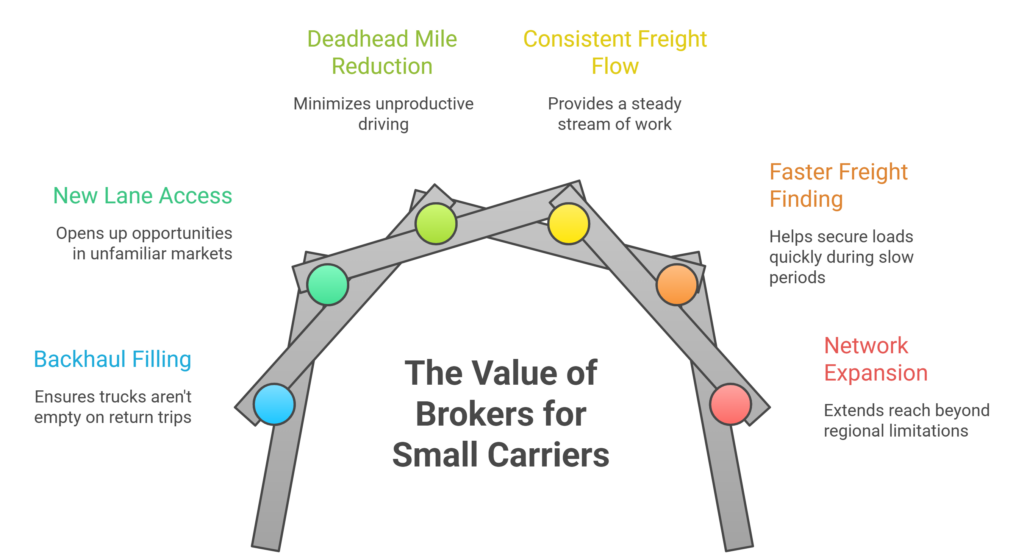
Consistency may not sound exciting. But ask any small carrier what hurts more: A slightly lower rate, or sitting empty for three days. The answer usually becomes obvious. Freight brokers help small carriers:
- Fill backhauls
- Access new lanes
- Reduce deadhead miles
- Maintain consistent freight flow
- Find freight faster during market slowdowns
- Expand outside limited regional networks
In our experience, carriers who maintain strong broker relationships often recover faster during freight downturns because they have multiple freight access points instead of relying on one shipper.
For example, a small flatbed carrier running primarily Midwest freight may suddenly experience construction slowdowns during winter months. Brokers with diversified customer networks can quickly reposition that carrier into industrial, steel, or machinery freight opportunities in other regions. That flexibility matters. Especially when cash flow is tight.
According to DAT Freight & Analytics, freight market volatility continues to create major lane imbalances that disproportionately affect smaller fleets without broad freight access (DAT Freight & Analytics, n.d.).
“The best broker relationships aren’t transactional. They create operational stability during unstable freight cycles.”
Need more consistent freight and fewer empty miles? Explore shipping solutions designed to keep carriers moving.
Case Study: How a Small Carrier Stabilized Revenue Through Broker Partnerships
Here’s a practical scenario based on common industry operating patterns.
Initial Situation:
- Five-truck dry van carrier
- Heavy dependence on one retail shipper
- Frequent empty miles after outbound deliveries
- Inconsistent weekly cash flow
What Changed (Over 120 Days):
The carrier began strategically working with multiple broker partners instead of relying almost entirely on direct freight.
The brokers helped:
- Build consistent reload opportunities
- Reduce empty repositioning miles
- Diversify freight types
- Improve lane planning
- Create access to contracted freight opportunities
Results After 4 Months:
- Deadhead miles reduced by approximately 18%
- Weekly load consistency improved significantly
- Revenue volatility decreased
- Driver utilization improved
One major operational improvement came from securing reloads before trucks even completed deliveries instead of searching manually afterward. That reduced downtime substantially.
“In uncertain markets, consistency often matters more than chasing the absolute highest rate on every load.”
Are your trucks spending more time moving freight or searching for it?
The Best Brokers Do More Than Just Find Loads
Bad brokers created a lot of bad reputations for the industry. That part is true. But strong brokers today do far more than simply post loads online.
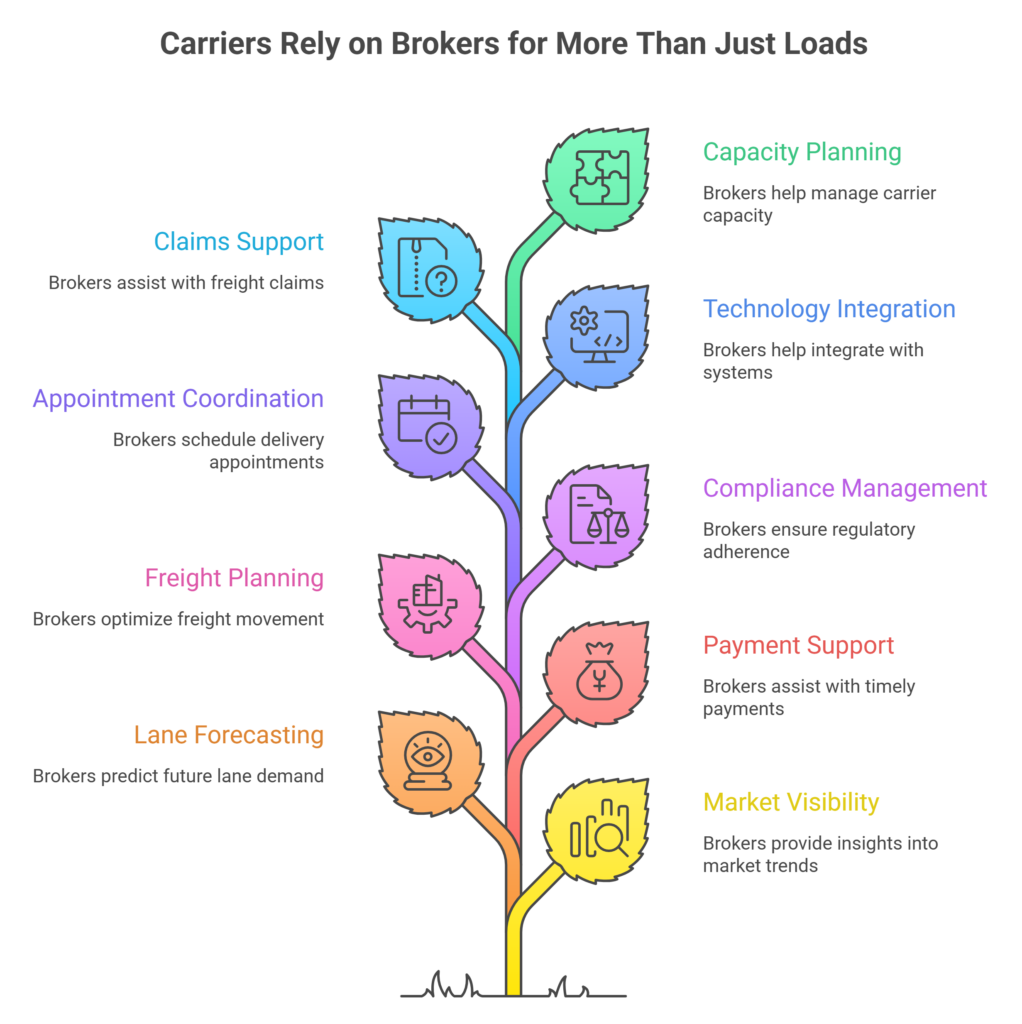
Modern brokers increasingly help carriers with:
- Market visibility
- Lane forecasting
- Payment support
- Freight planning
- Compliance management
- Appointment coordination
- Technology integration
- Claims support
- Capacity planning
In our experience, the strongest broker-carrier relationships operate more like partnerships than transactions.
For example, during severe weather disruptions or sudden capacity tightening, experienced brokers can reroute freight quickly, communicate with shippers proactively, and help carriers minimize downtime.
That operational support becomes extremely valuable during chaotic freight conditions.
According to the Transportation Intermediaries Association (TIA), brokers continue playing a critical role in improving freight efficiency and supply chain coordination across fragmented transportation networks (TIA, n.d.).
“A good broker finds freight. A great broker helps carriers operate more efficiently.”
Looking for a brokerage partner you can actually rely on during unpredictable markets? See how SPI’s carrier payment solutions help keep small carriers moving with confidence.
Technology Is Making Broker Partnerships More Valuable
The modern freight market moves too quickly for manual operations alone.
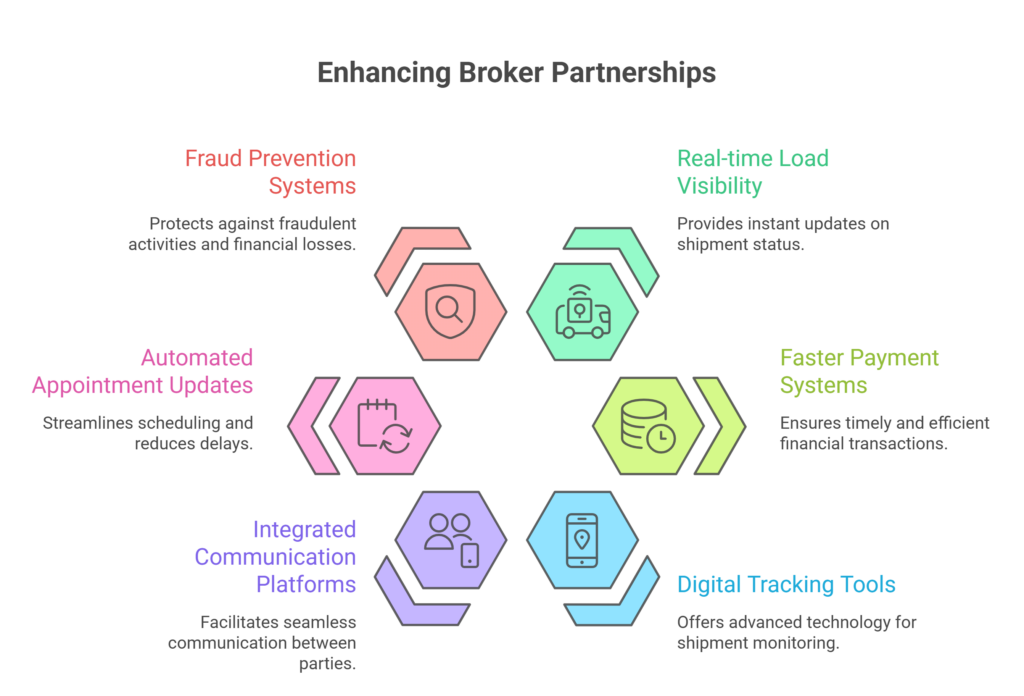
Small carriers increasingly rely on brokers who provide:
- Real-time load visibility
- Faster payment systems
- Digital tracking tools
- Integrated communication platforms
- Automated appointment updates
- Fraud prevention systems
Technology adoption is no longer optional.
For example, brokers using advanced Transportation Management Systems (TMS) can often:
- Match loads faster
- Reduce manual errors
- Improve tracking visibility
- Shorten onboarding timelines
- Speed up payment processing
In our experience, carriers working with tech-enabled brokers spend less time dealing with administrative friction and more time focusing on operations.
And honestly, nobody gets into trucking because they love paperwork.
Freight technology adoption studies show operational automation can significantly improve load coordination and communication efficiency across broker-carrier networks (Gartner, n.d.).
“Technology doesn’t replace relationships in freight. It strengthens the good ones.”
Are your current partnerships helping you operate more efficiently or creating more friction?
The Smartest Small Carriers Use Both Direct Freight and Brokers
The strongest small carriers rarely choose one or the other. They use both.
They build direct relationships where it makes sense while also maintaining broker partnerships for flexibility, coverage, and market access.
That balance creates resilience. Because freight markets change constantly:
- Customers leave
- Rates fluctuate
- Seasons shift
- Lanes soften
- Capacity tightens
And carriers who rely entirely on one strategy often struggle when the market changes direction.
The carriers growing sustainably in 2026 are usually the ones building adaptable networks, not rigid business models.
“The goal isn’t avoiding brokers. The goal is building a stronger, more flexible business.”
Is your current strategy built for today’s market or for the market you wish still existed?
Frequently Asked Questions (FAQs)
1.Why do small carriers still work with brokers?
Brokers help carriers access consistent freight, reduce deadhead miles, diversify lanes, and stabilize revenue during changing market conditions.
2.Are direct shipper relationships better than brokers?
Direct freight can improve margins, but relying entirely on a small number of direct customers increases operational and financial risk.
3.How do brokers help carriers during slow freight markets?
Brokers provide access to broader freight networks, alternative lanes, and faster freight opportunities when direct customer volume declines.
Build Stability, Not Just Independence
Small carriers have every reason to want independence. Higher margins, direct customer relationships, and more control over operations all sound ideal on paper. And during strong freight markets, many carriers successfully operate with minimal broker involvement for a period of time.
But freight markets rarely stay predictable for long. Volume shifts. Customers disappear. Fuel prices rise. Lanes soften. Equipment sits longer than expected. That’s usually when the value of strong broker relationships becomes much more obvious.
The reality is that modern freight is too dynamic for most small carriers to rely on a single approach forever. The smartest operations understand that brokers are not just load providers. The right brokers help stabilize freight flow, improve planning, reduce downtime, and create operational support when markets become unpredictable.
At the end of the day, success in trucking is not just about finding the highest-paying load this week. It’s about building a business that can survive changing conditions next month, next quarter, and next year.
Ready to build stronger freight partnerships and create more stability for your operation? Contact us to learn how we can help support your long-term growth.
References
DAT Freight & Analytics. (n.d.). Freight market trends and lane analytics. Retrieved from
https://www.dat.com
FreightCaviar. (n.d.). Small carriers need brokers. Retrieved from https://www.freightcaviar.com/small-carriers-need-brokers/
FreightWaves. (n.d.). Freight market analysis and carrier trends. Retrieved from https://www.freightwaves.com
Gartner. (n.d.). Transportation technology and logistics automation insights.Retrieved from
https://www.gartner.com
Owner-Operator Independent Drivers Association (OOIDA). (n.d.). Small carrier operational challenges. Retrieved from https://www.ooida.com
Transportation Intermediaries Association (TIA). (n.d.). Freight brokerage industry insights and best practices. Retrieved from https://www.tianet.org