Every year, DOT Blitz Week shows up like a pop quiz the freight industry swears it studied for, but somehow still panics about anyway.
Suddenly:
- drivers are triple-checking logbooks,
- carriers are hunting for missing inspection stickers,
- and brokers are quietly asking themselves, “Wait… are all our carrier files updated?”
Welcome to DOT Blitz Week.
Officially known as the International Roadcheck, DOT Blitz Week is one of the largest commercial vehicle inspection events in North America, organized annually by the Commercial Vehicle Safety Alliance (CVSA, n.d.). For 72 hours, inspectors across the U.S., Canada, and Mexico conduct thousands of inspections focused on safety, compliance, and operational standards.
And every year, the same thing happens: the carriers and brokers who prepared early treat it like a routine process… while everyone else treats it like an emergency.
What Is DOT Blitz Week and Why Does It Matter?
DOT Blitz Week is essentially a large-scale safety enforcement initiative targeting commercial vehicles and drivers (Federal Motor Carrier Safety Administration [FMCSA], n.d.).
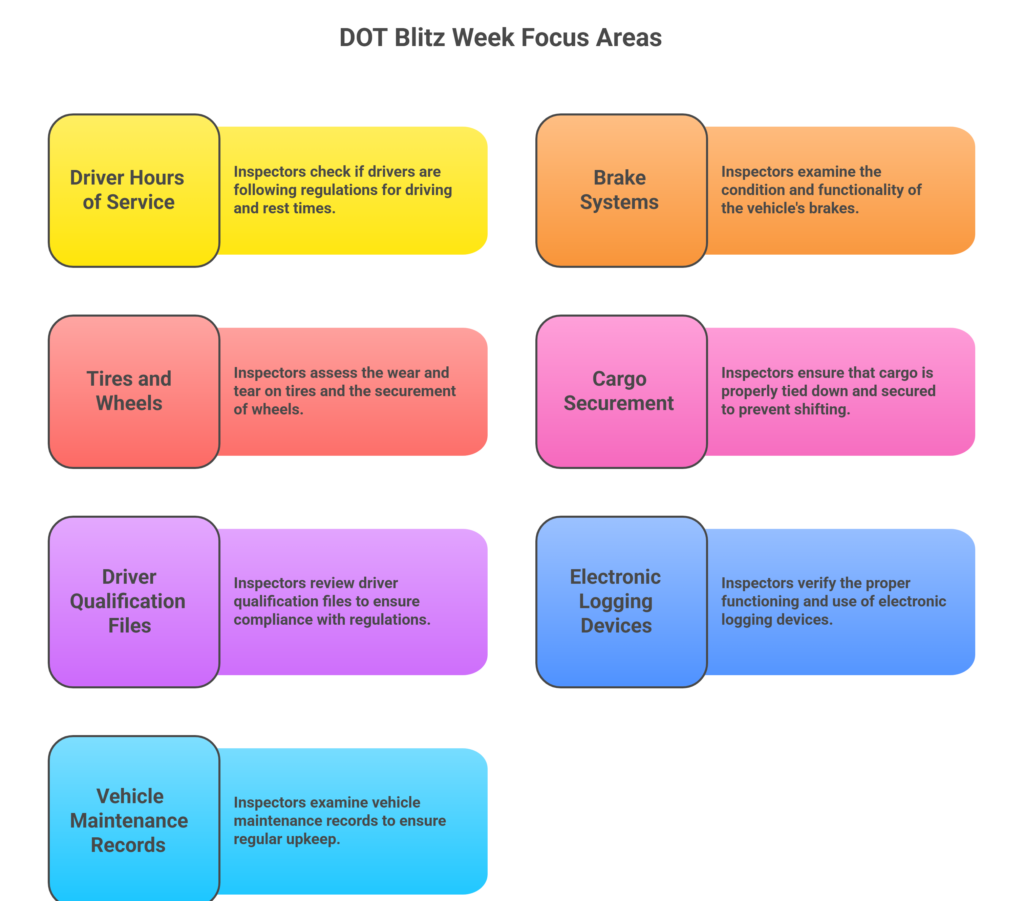
Inspectors typically focus on:
- Driver Hours of Service (HOS)
- Brake systems
- Tires and wheels
- Cargo securement
- Driver qualification files
- Electronic Logging Devices (ELDs)
- Vehicle maintenance records
Each year also includes a special enforcement focus. Some years prioritize brakes. Others focus heavily on driver records, lighting systems, or cargo securement (CVSA, n.d.).
In our experience, many carriers mistakenly think DOT Blitz Week is only about roadside inspections. In reality, it affects operations far beyond the scale house.
Delayed freight, tighter capacity, missed appointments, and compliance-related shutdowns can ripple across entire freight networks during the week.
For brokers, even one carrier getting placed out of service mid-load can quickly turn into a service disaster.
“DOT Blitz Week doesn’t create operational weaknesses, it exposes the ones already there.”
If your operation faced a surprise inspection tomorrow, would you feel confident or nervous?
Why Carriers Stress About Blitz Week Every Year
Let’s be honest:
few things increase driver anxiety faster than seeing multiple DOT officers lined up near a weigh station.
Especially during Blitz Week.
In our experience, smaller carriers and owner-operators often feel the most pressure because they usually have fewer compliance resources internally.
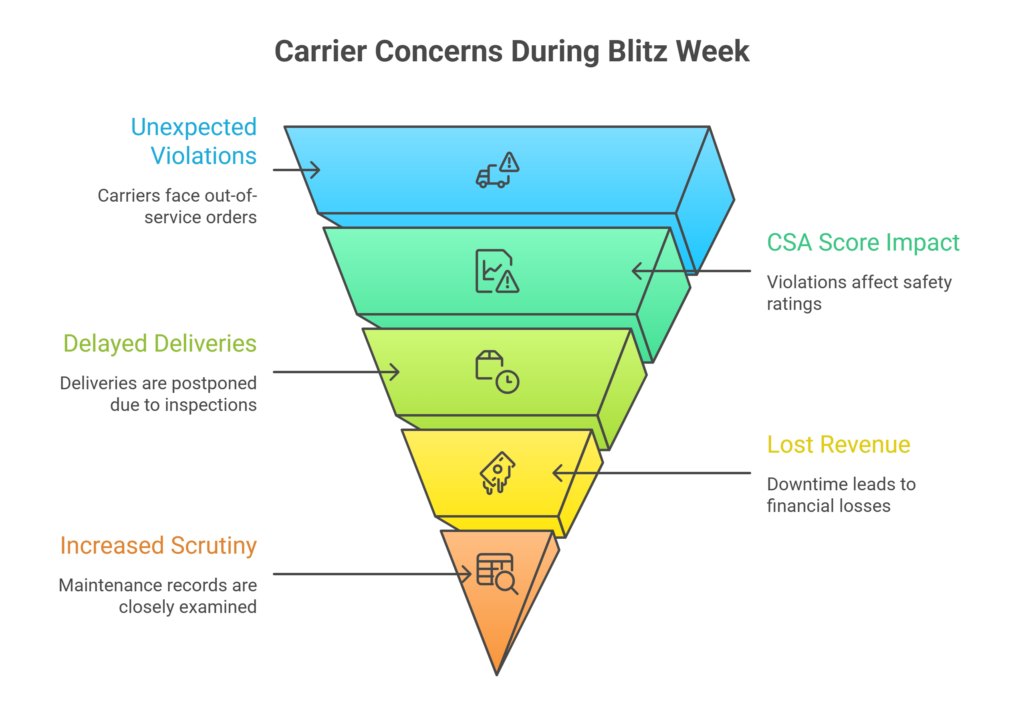
The biggest carrier concerns include:
- Unexpected out-of-service violations
- CSA score impacts
- Delayed deliveries
- Lost revenue from downtime
- Increased scrutiny on maintenance records
- Driver logbook violations
According to FMCSA inspection data, brake violations, tire defects, and lighting violations consistently rank among the most common inspection issues every year (FMCSA, n.d.).
What makes Blitz Week stressful isn’t usually catastrophic failures, it’s preventable details:
- cracked lights,
- loose hoses,
- expired medical cards,
- missing paperwork,
- or poorly secured freight.
For example, a carrier may run thousands of safe miles all year but still lose an entire day because of documentation gaps discovered during inspection.That downtime adds up quickly.
“Most Blitz Week violations aren’t caused by major failures. They’re caused by small things operators assumed nobody would notice.”
Worried about cash flow during inspection delays and downtime? See how SPI helps carriers stay moving with reliable payment solutions.
What Brokers Often Forget About DOT Blitz Week
Many brokers assume Blitz Week is mainly a carrier problem.
It’s not.
In our experience, brokers who ignore compliance during Blitz Week usually end up managing avoidable operational chaos:
- missed appointments,
- rescheduled deliveries,
- frustrated customers,
- and sudden capacity shortages.
When inspections increase, capacity naturally tightens because:
- some carriers avoid certain routes,
- some trucks get delayed,
- and others are temporarily placed out of service.
That means brokers need to prepare operationally, not just reactively.
Smart broker preparation often includes:
- Verifying carrier compliance before dispatch
- Building extra lead time into transit schedules
- Communicating proactively with customers
- Monitoring high-risk lanes closely
- Preparing backup carrier options
For example, during a previous enforcement week, a broker handling produce freight experienced multiple delays after two scheduled carriers were pulled into extended inspections. The brokerage avoided delivery failures only because backup carrier relationships had already been arranged before the week started.
Preparation matters. Especially when timing-sensitive freight is involved.
“The brokers who survive Blitz Week smoothly are usually the ones planning for disruptions before they happen.”
Does your operation have contingency plans, or just optimistic scheduling?
Case Study: How Preparation Reduced Inspection Delays
Here’s a practical operational scenario based on common freight patterns during enforcement weeks.
Initial Situation:
- Regional carrier operating 22 trucks
- Frequent roadside inspection delays during prior DOT enforcement periods
- Multiple customer complaints tied to late deliveries
- Limited internal compliance review process
What Changed (Over 60 Days Before Blitz Week):
The carrier implemented a structured preparation process:
- Conducted pre-Blitz maintenance audits
- Reviewed driver qualification files weekly
- Standardized document checklists
- Held internal safety walkthroughs with drivers
- Increased broker communication regarding transit timing
Results During Blitz Week:
- Fewer inspection-related delays
- No out-of-service violations reported
- Improved delivery consistency
- Reduced driver stress during inspections
One operations manager noted that simply organizing paperwork more consistently reduced inspection time significantly because drivers weren’t scrambling to locate missing records roadside.
Sometimes operational improvement isn’t glamorous.
It’s just organized.
“Preparation before Blitz Week often determines whether inspections become routine or disruptive.”
Are your compliance systems proactive, or only activated when enforcement increases?
Technology Is Becoming a Major Compliance Advantage
Technology is quietly changing how carriers and brokers handle compliance preparation.
In our experience, companies leveraging modern systems often respond faster and more accurately during enforcement periods.
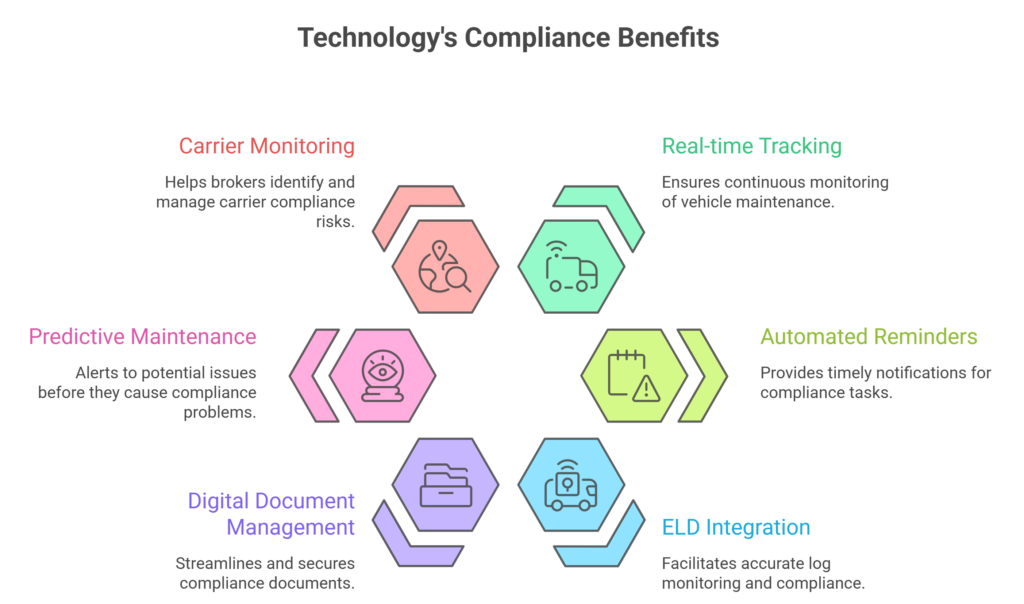
Key technology advantages include:
- Real-time maintenance tracking
- Automated compliance reminders
- ELD integration and log monitoring
- Digital document management
- Predictive maintenance alerts
- Carrier monitoring tools for brokers
For brokers specifically, carrier monitoring platforms help identify:
- Insurance lapses
- Authority changes
- Safety score issues
- Inspection history trends
That visibility reduces the risk of onboarding problematic carriers during high-enforcement periods.
According to Gartner logistics technology research, companies using automated compliance workflows typically reduce administrative delays and improve operational visibility during peak enforcement periods (Gartner, n.d.).
And honestly, nobody wants to discover an expired medical certificate while the truck is already parked roadside.
“Compliance technology doesn’t eliminate risk, but it dramatically reduces preventable mistakes.”
Still relying on manual processes during high-pressure compliance weeks? See how freight technology helps operations stay ahead of disruptions.
Blitz Week Usually Reveals Long-Term Operational Habits
One important reality about DOT Blitz Week:
it rarely exposes completely new problems.
It usually exposes existing habits.
Strong fleets tend to perform consistently because:
- maintenance routines already exist,
- paperwork is organized,
- drivers are trained regularly,
- and compliance isn’t treated as a once-a-year panic exercise.
In our experience, the operations struggling most during Blitz Week are often the ones trying to “catch up” days before inspections begin.
That approach almost never works smoothly.
The carriers and brokers who handle Blitz Week best are usually the ones treating compliance as part of daily operations, not seasonal preparation.
Because enforcement week eventually ends. But operational discipline matters year-round.
“Blitz Week preparation should start long before Blitz Week is announced.”
Does your operation build compliance into daily routines, or treat it as a temporary project?
Frequently Asked Questions (FAQs)
1.What is DOT Blitz Week?
DOT Blitz Week, also known as the International Roadcheck, is a large-scale commercial vehicle inspection initiative conducted annually across North America by the CVSA.
2. What do inspectors focus on during Blitz Week?
Inspectors commonly review brakes, tires, lighting systems, Hours of Service compliance, cargo securement, and driver documentation.
3. Why should freight brokers care about DOT Blitz Week?
Inspection delays, carrier out-of-service violations, and tighter capacity can directly impact shipment schedules, customer satisfaction, and operational reliability.
DOT Blitz Week Exposes Operational Weaknesses
DOT Blitz Week has a funny way of exposing the difference between operations that are prepared and operations that are hoping for the best.
For carriers, it’s a reminder that compliance is not just paperwork. It directly affects uptime, revenue, and customer trust. For brokers, it’s proof that carrier vetting and contingency planning matter far more than many realize during normal freight cycles.
In our experience, the companies that navigate Blitz Week successfully are rarely doing anything dramatic. They’re simply consistent. Their trucks are maintained. Their records are organized. Their communication is proactive. And their systems are already in place long before enforcement week begins.
Because the truth is, Blitz Week is not really about one week. It’s about the operational habits companies build during the other fifty-one.
Ready to strengthen your compliance processes and build a more resilient freight operation? Contact us to learn how we can help you stay prepared year-round.
References
Commercial Vehicle Safety Alliance (CVSA) – International Roadcheck inspection program and enforcement focus information.
Federal Motor Carrier Safety Administration (FMCSA) – Commercial vehicle inspection data, compliance standards, and safety regulations.
Gartner Supply Chain Research – Logistics technology and compliance workflow research.
FreightWaves – Freight market insights and carrier operational trends.