

Freight broker salary is one of the most searched questions in this industry, and one of the hardest to answer with a single number.
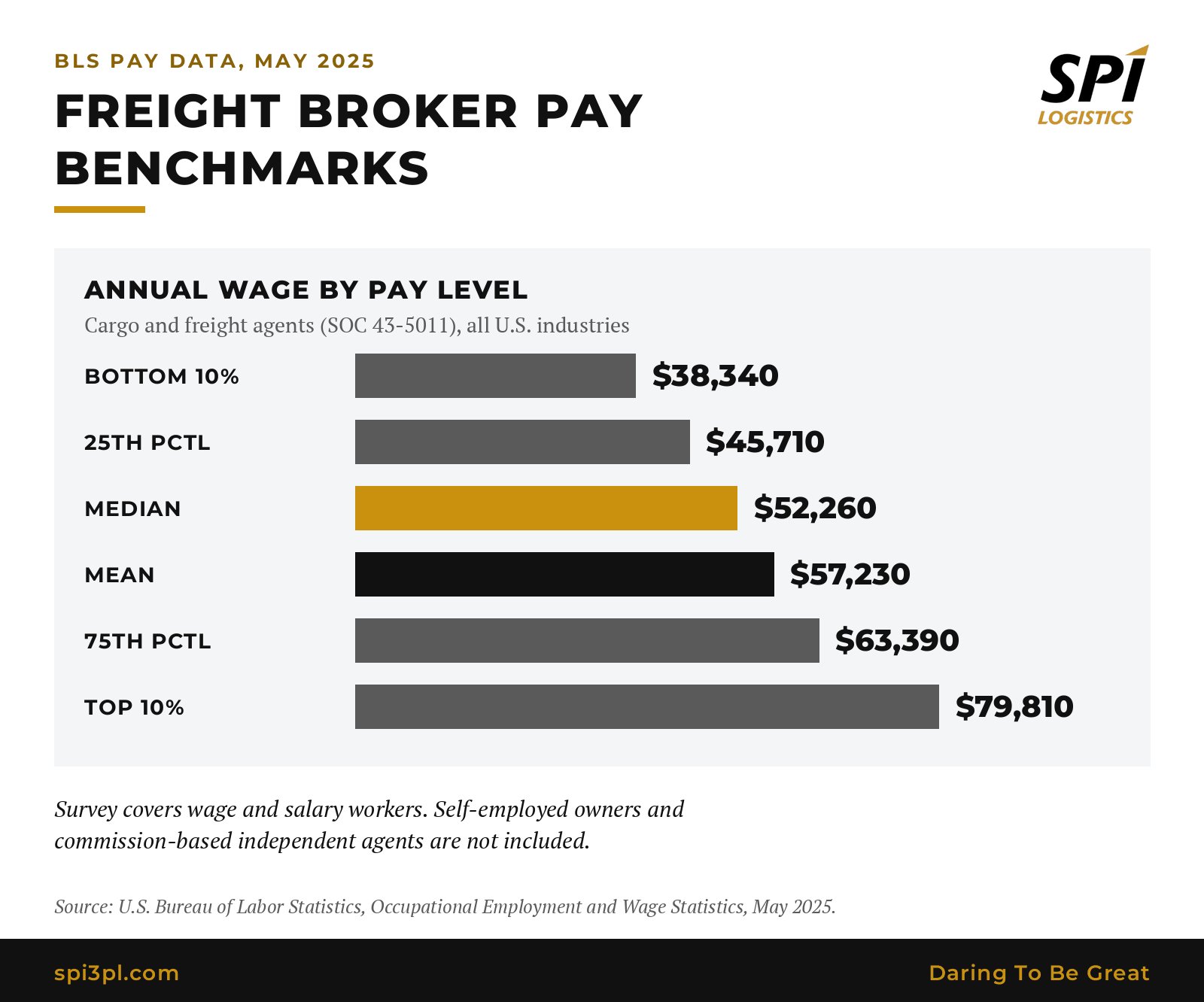
The closest federal benchmark is the U.S. Bureau of Labor Statistics category for cargo and freight agents. In May 2025, the median annual wage was $52,260 and the top 10% earned more than $79,810. [BLS, May 2025]
That number describes salaried employees. It does not include self-employed brokerage owners or independent agents paid on commission, which is where many experienced brokers sit.
For them, income starts with the gross margin on each load, then depends on how many loads they book and who pays for the overhead.
This guide covers both: current pay data for employed brokers, clearly labeled example math for owners and agents, and what the 2026 market is doing to margins.
If you already run a book of business, the sections on the three pay models and the $1M book will be the most useful.
“A salary is a number. A freight income is a formula: margin, volume and the model you work under.”
What Is the Average Freight Broker Salary in 2026?
BLS does not publish a separate category for freight brokers. Cargo and freight agents (SOC 43-5011) is the closest occupation it tracks, and it covers people who arrange and route shipments.
The May 2025 survey counted 97,670 jobs in this occupation, with a mean annual wage of $57,230. [BLS, May 2025]
Cargo and Freight Agent Pay, May 2025 (Closest BLS Match)
| Pay level | Annual wage |
| Bottom 10% | $38,340 or less |
| 25th percentile | $45,710 |
| Median | $52,260 |
| 75th percentile | $63,390 |
| Top 10% | $79,810 or more |
| Mean (average) | $57,230 |
Inside the freight transportation arrangement industry, where brokerages are classified, the median for this occupation was $54,730. [BLS, May 2025]
Demand for the role is still growing. BLS projects employment of cargo and freight agents to grow 6.2% from 2025 to 2035. [BLS Employment Projections, 2025 to 2035]
Use these figures as a floor for salaried roles, not a ceiling for the industry. Survey data covers employees, so commission-based agents and owners are outside it.
“The BLS median tells you what a salaried role pays. It does not tell you what a book of business is worth.”
Are you comparing your income to a salary benchmark or to the margin your book produces?
How Freight Brokers Get Paid: Margin First, Salary Second
A freight brokerage earns the difference between what a shipper pays and what the independent motor carrier is paid for the load. That difference is the gross margin.
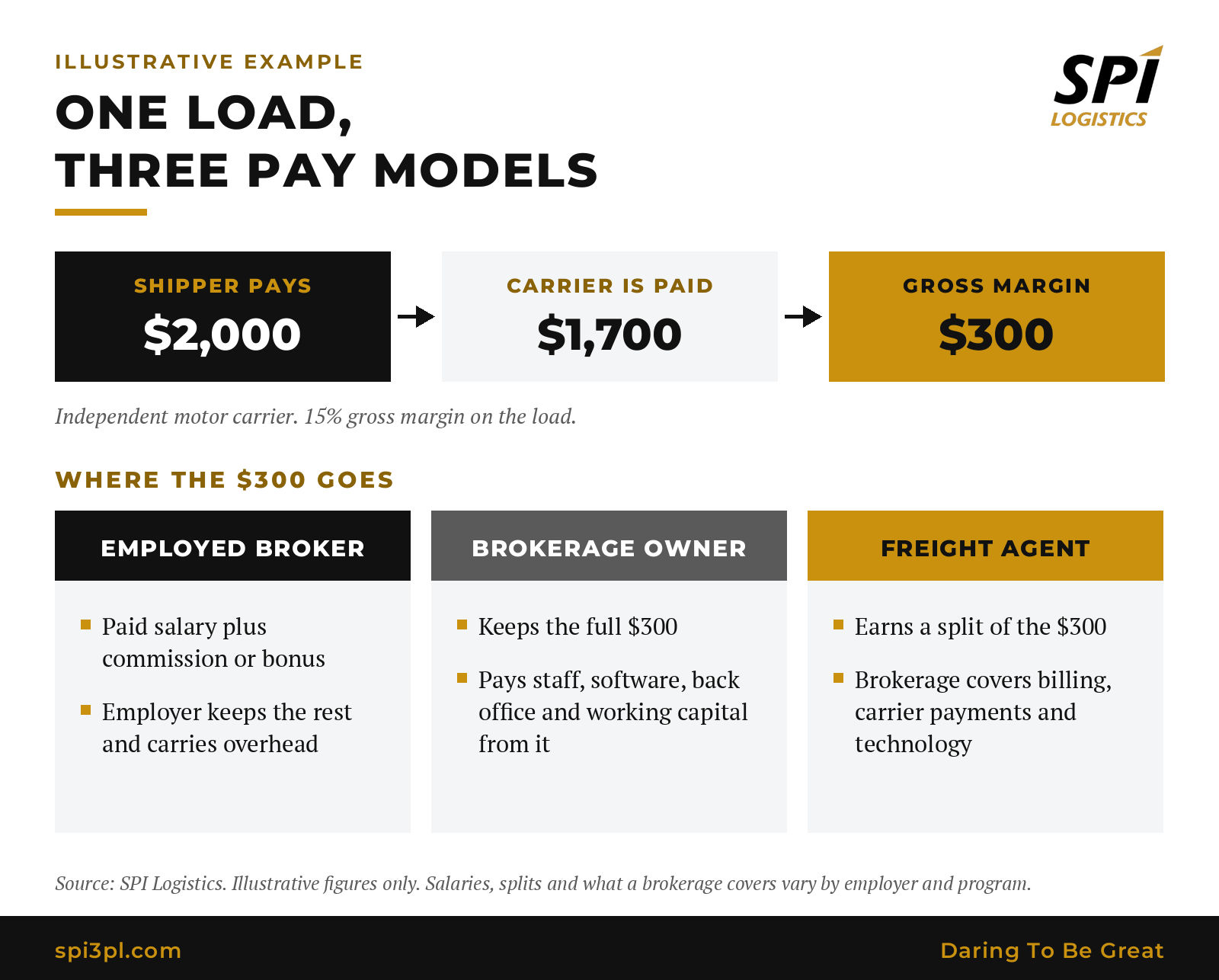
Here is a simple example. A shipper pays $2,000, the carrier is paid $1,700, and $300 is left as gross margin. That is a 15% margin on the load.
Every pay model is built from that $300. An employed broker earns a salary plus a commission set by the employer. An owner keeps the full margin and pays all the costs. An agent earns a split of the margin while the brokerage covers the back office.
A Public Benchmark for Margin Per Load
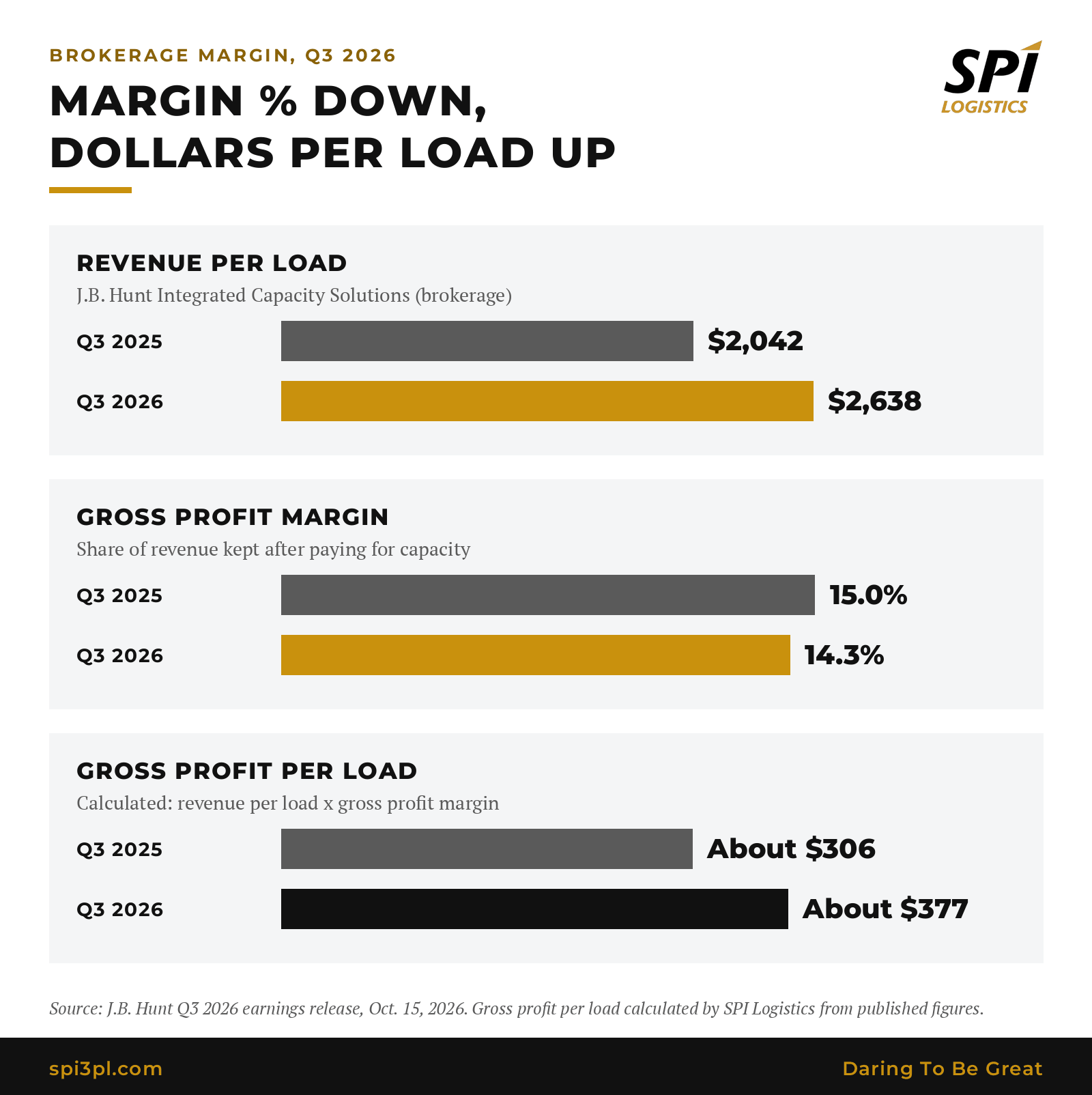
J.B. Hunt publishes load and margin data for its brokerage segment, Integrated Capacity Solutions. In the third quarter of 2026, revenue per load was $2,638 and the gross profit margin was 14.3%. A year earlier, those figures were $2,042 and 15.0%. [J.B. Hunt, Oct. 15, 2026]
| J.B. Hunt brokerage (ICS) | Q3 2025 | Q3 2026 |
| Revenue per load | $2,042 | $2,638 |
| Gross profit margin | 15.0% | 14.3% |
| Gross profit per load (calculated) | About $306 | About $377 |
| Loads in the quarter | 135,309 | 164,462 |
The margin percentage slipped, but the dollars earned per load rose because rates rose. Gross profit per load is SPI’s calculation from the published revenue per load and margin.
Want the full breakdown of splits and payouts? Read how freight broker commission works.
“Brokers are paid on the spread. Watch the dollars per load, not just the percentage.”
Do you know your average gross margin per load for the last 90 days?
Freight Broker Earnings Per Load, Month and Year
The table below uses the same $300 average gross margin from the example above. It is illustrative math, not a typical or promised result.
Illustrative Gross Margin by Weekly Load Count
| Loads per week | Per week | Per month | Per year |
| 5 | $1,500 | $6,500 | $78,000 |
| 10 | $3,000 | $13,000 | $156,000 |
| 20 | $6,000 | $26,000 | $312,000 |
Assumes a $300 average gross margin per load and 52 weeks. Monthly figures use 52 weeks divided by 12.
These are gross margin figures. What lands in your pocket depends on your pay model, your split or salary, your costs and your taxes.
Ten loads a week at an average shipper rate of $2,000 is about $1.04 million in annual revenue. That is roughly what the industry calls a $1M book.
“Ten good loads a week, every week, is the difference between a job and a book of business.”
How many loads a week does your current book produce, and how steady is that number?
Three Pay Models: Employed Broker, Brokerage Owner and Freight Agent
Employed Broker (W-2)
An employed broker works for a brokerage and is usually paid a base salary plus commission or bonus. The BLS figures above describe this group best.
The employer carries the overhead and the working capital. In exchange, the broker keeps a smaller share of the margin and usually does not own the customer relationships.
Brokerage Owner (Own Authority)
An owner holds the operating authority and keeps 100% of the gross margin. The owner also pays for staff, software, credit and collections, compliance and the cash that funds carrier payments before shippers pay.
In this SPI Short, the speaker says, “the cost to operate is exponentially more expensive than people realize.” He adds that many people think brokerage is just “answer the phone, make some calls.”
Freight Agent (Commission Split)
A freight agent books freight under a brokerage’s authority and earns a split of the gross margin on each load. The brokerage provides the back office, technology and financial backing.
Splits, payment timing and what the brokerage covers vary by program, so compare them side by side before you sign anything.
The Three Pay Models Side by Side
| Factor | Employed broker | Brokerage owner | Freight agent |
| How you are paid | Salary plus commission or bonus | Full gross margin, minus all costs | Split of gross margin |
| Who carries overhead | Employer | You | Brokerage |
| Working capital | Employer | You | Brokerage |
| Customer relationships | Usually the employer’s | Yours | Depends on the agent agreement |
| Income ceiling | Set by the pay plan | Highest, with the most cost | Grows with your book |
Thinking about moving from salary to commission? Read from W-2 employee to 1099 freight agent.
“The model you choose decides who pays for the overhead, and that decides how much of the margin you keep.”
Which model are you in today, and is it still the right one for your book?
What a $1M Book Earns: Owner vs. Agent Math
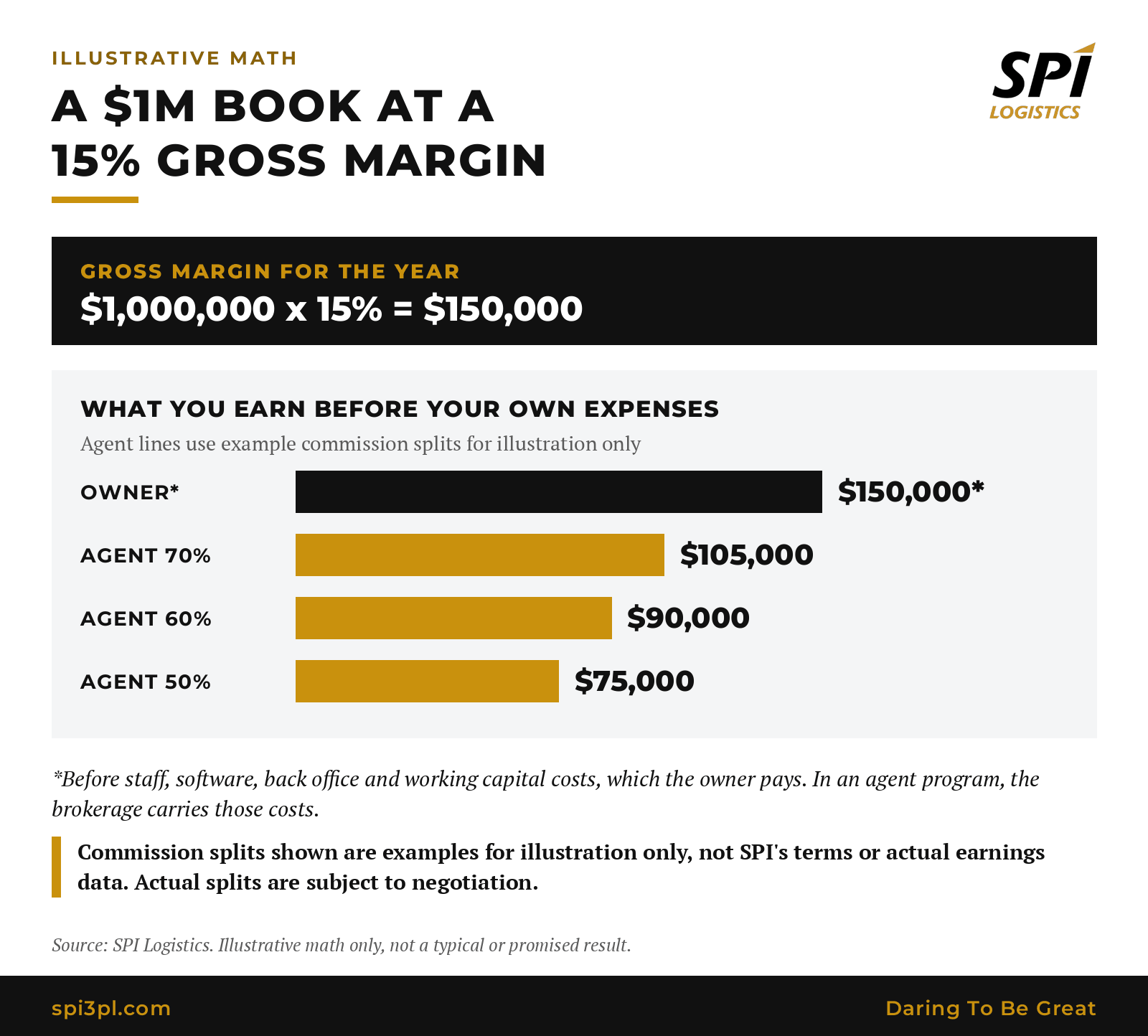
For an established broker, the useful number is what your own book produces. Take a $1M book at a 15% average gross margin. That is $150,000 in gross margin for the year.
Illustrative Math for a $1M Book
| Scenario | Gross margin | What you earn before your own expenses |
| Owner, own authority | $150,000 | $150,000, minus staff, software, back office and working capital costs |
| Agent, example 50% split | $150,000 | $75,000 |
| Agent, example 60% split | $150,000 | $90,000 |
| Agent, example 70% split | $150,000 | $105,000 |
Commission splits shown are examples for illustration only, not SPI’s terms or actual earnings data. Actual splits are subject to negotiation.
The owner line looks largest, but every cost of running the company comes out of it. The agent lines are smaller, but the brokerage carries billing, carrier payments, technology and working capital.
Margin pressure matters here too. If the average margin on that book slips from 15% to 14.3%, the J.B. Hunt rate for Q3 2026, gross margin drops from $150,000 to $143,000.
In this SPI Short, the speaker describes owners who are “wearing multiple hats” and “working 16 hours a day most days,” and says many “didn’t know that the agent route was even really an option.”
Weighing the switch? Compare freight agent vs. freight broker for an owner with a $1M book.
“For a $1M book, the real comparison is not the split. It is the split against everything you pay to run the company.”
What does your book cost you to run each year, in dollars and in hours?
6 Factors That Drive Freight Broker Income
Whatever the model, the same six factors separate average earners from brokers with a strong book.
1. Customer Retention
Long-term shippers with recurring lanes create predictable freight and steady income.
2. Margin Discipline
Quoting with current market data protects the spread when buy rates move faster than contracts.
3. Freight Mix
Specialized freight such as flatbed, temperature-controlled or cross-border shipments can support stronger margins when you know the lanes.
4. Load Volume
More profitable loads per week multiply every other factor on this list.
5. Market Knowledge
Understanding capacity, seasonality and lane pricing helps you quote with confidence.
6. Time Spent Selling
Hours spent on billing and collections are hours not spent with customers.
Growth often starts inside accounts you already have. In this SPI Short, the speaker explains how expanding the relationship within your existing account base, and “finding other key players that are making decisions on transportation,” creates new opportunities.
As he puts it: “It’s all relationships.”
Want more of your week for selling? See how SPI’s freight brokerage back office support works.
Which of these six factors has the most room to grow in your book?
Freight Market Trends Affecting Broker Earnings in 2026
Market conditions shape every margin conversation, and 2026 has been a tight year for capacity.
DAT reports spot rates, excluding fuel, about a third above last year: 35% for van, 33% for reefer and 29% for flatbed. Truck posts on DAT One are 21% to 27% below a year ago. [DAT via AJOT, Oct. 19, 2026]
FreightWaves reports the national tender rejection rate holding near 13.9%, and expects a market that stays tighter for longer, into 2027. [FreightWaves, Oct. 17, 2026]
Higher rates can raise gross margin dollars per load. They also raise the cash needed to pay carriers before shippers pay, which is a bigger issue for owners than for agents.
Want more market context? Read our freight market update on tightening capacity.
“A tight market rewards brokers who quote with current data and have support behind them.”
Are your customer rates keeping up with what capacity costs today?
Entry-Level Freight Broker Salary and How Pay Grows
New brokers usually start on salary plus commission while they learn pricing, sales and the market. The lower BLS percentiles, $38,340 at the 10th and $45,710 at the 25th, are a reasonable reference for starting roles. [BLS, May 2025]
Freight Broker vs. Dispatcher Salary
| Occupation (BLS, May 2025) | Median annual wage |
| Cargo and freight agents | $52,260 |
| Dispatchers, except police, fire and ambulance | $50,340 |
Median pay for the two roles is close. The difference is upside: broker and agent income can grow with margin and volume, while dispatch pay is usually tied to a wage. [BLS, May 2025]
Just getting started? Read free vs. paid freight broker training to see what actually helps.
What would it take for your book to cover your income on commission alone?
Frequently Asked Questions (FAQs)
1. What is the average freight broker salary?
For salaried roles, the closest BLS benchmark is cargo and freight agents, with a median annual wage of $52,260 and a mean of $57,230 in May 2025. Owners and commission-based agents are not included in that data.
2. Do freight brokers get paid per load?
Income is built per load. The gross margin on each load is the difference between the shipper rate and the carrier payment, and it is kept by an owner, split with an agent, or paid out as commission to an employee.
3. How much do freight brokers make a week?
It depends on loads and margin. As illustrative math, 10 loads a week at a $300 average gross margin produces $3,000 a week in gross margin, before any split, costs or taxes.
4. Can freight brokers make six figures?
Some do, especially owners and agents with a steady book. Income depends on margin, volume and the pay model, so there is no guaranteed level.
5. Do freight agents earn more than employed brokers?
Agents usually keep a larger share of the margin than employees, but their income depends entirely on the freight they book. Compare splits, payment timing and back office coverage before you decide.
Build Your Income Around the Right Model
Freight broker salary is only the starting point. Your real income comes from the margin on each load, the size of your book and the model you choose.
If you already have customers, the question is how much of that margin you keep and how much of your week goes to selling.
If you have a book of business and want to keep selling without running the company, see how independent brokers join SPI as agents.
Have questions about how SPI works with agents? Talk to SPI and learn how our transportation network of 75+ North American offices supports your book.
References
U.S. Bureau of Labor Statistics. (2026). Occupational Employment and Wages, May 2025: 43-5011 Cargo and Freight Agents. Retrieved from
https://www.bls.gov/oes/current/oes435011.htm
U.S. Bureau of Labor Statistics. (2026). Occupational Employment and Wages, May 2025: 43-5032 Dispatchers, Except Police, Fire, and Ambulance. Retrieved from
https://www.bls.gov/oes/current/oes435032.htm
U.S. Bureau of Labor Statistics. (2026). Employment Projections, National Employment Matrix: 43-5011 Cargo and Freight Agents, 2025 and projected 2035. Retrieved from
https://data.bls.gov/projections/nationalMatrix?ioType=o&queryParams=43-5011
J.B. Hunt Transport Services. (2026, October 15). Third Quarter 2026 Earnings Release. Retrieved from
https://www.jbhunt.com/content/dam/jbhunt/jbh/investor-relations/documents/earnings-releases/Q3_2026_Earnings_Release.pdf
American Journal of Transportation. (2026, October 19). DAT spot truckload pricing and load-to-truck ratios for Oct. 10-16, 2026 (Week 42). Retrieved from
https://www.ajot.com/news/dat-spot-truckload-pricing-and-load-to-truck-ratios-for-oct-1016-2026-week-42
FreightWaves. (2026, October 17). No signs of truckload capacity recovering. Retrieved from
https://www.freightwaves.com/news/no-signs-of-truckload-capacity-recovering