
For most freight professionals, spot rates and court rulings don’t usually belong in the same conversation.
One happens in the market. The other happens in a courtroom.
Yet over the past several months, many brokers, carriers, and shippers have noticed something unusual: as concerns surrounding broker liability have grown, spot rates in certain markets have begun moving higher as well.
Coincidence? Not entirely.
While freight rates are always influenced by supply, demand, fuel costs, seasonality, and capacity availability, changes in legal risk can create operational shifts that eventually affect pricing throughout the transportation network (FreightWaves, n.d.).
The recent broker liability discussions have caused many brokerages to reevaluate carrier selection processes, risk management standards, insurance requirements, and compliance procedures. Those changes may improve long-term safety and operational quality, but they can also reduce available capacity and increase operating costs in the short term (Transportation Intermediaries Association [TIA], n.d.).
As a result, many industry participants are asking an important question: Why are spot rates rising after a legal decision that wasn’t directly about pricing?
Let’s break it down.
The Broker Liability Decision Changed More Than Legal Conversations
The most immediate impact of the liability discussions has been operational rather than legal.
In our experience, when risk exposure increases, brokerages tend to become more selective about the carriers they work with.
Historically, many brokers focused primarily on:
- Active operating authority
- Insurance verification
- Basic safety compliance
- Capacity availability
Today, many are expanding their review processes to include:
- Carrier performance history
- Safety trends
- Identity verification
- Insurance monitoring
- Fraud screening
- Operational consistency reviews
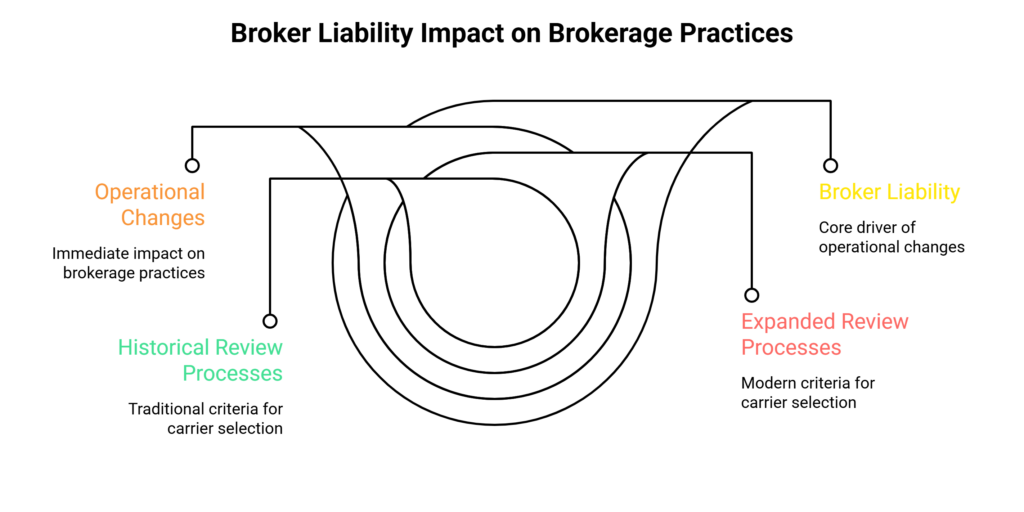
While these additional steps improve risk management, they also narrow the pool of carriers that qualify for freight.
When fewer carriers are eligible for the same shipment opportunities, capacity effectively tightens. And whenever capacity tightens, rates often rise.
For example, a brokerage that previously approved 100 carriers for a specific lane may now approve only 75 after implementing stricter vetting standards. The freight still needs to move, but there are fewer trucks competing for those loads.
That shift alone can put upward pressure on pricing.
“The ruling did not directly increase freight rates. It changed operational behavior, which indirectly affects capacity and pricing.”
If your brokerage tightened carrier qualification standards tomorrow, how much of your current carrier network would still qualify?
Stricter Carrier Vetting Can Reduce Available Capacity
One of the most overlooked effects of increased liability concerns is capacity reduction.
Many carriers that were previously accepted by brokerages may now face additional scrutiny.
Common areas receiving greater attention include:
- Safety scores
- Insurance history
- Inspection records
- Authority longevity
- Fraud indicators
- Documentation quality
In our experience, carriers with strong compliance records generally adapt well to these requirements. However, carriers operating with inconsistent documentation or borderline safety metrics may find themselves receiving fewer load opportunities.
This can remove portions of available truck capacity from the spot market.
Consider a hypothetical example:
A brokerage handling 500 loads per week introduces enhanced carrier qualification procedures following increased liability concerns.
After reviewing its carrier network:
- 12% of carriers require additional documentation
- 8% are temporarily suspended pending review
- 5% fail qualification standards entirely
The result is fewer available trucks competing for freight.
Basic economics then takes over.
Less available capacity often leads to higher spot pricing.
According to freight market analysts, capacity tightening remains one of the strongest drivers of short-term spot rate increases (DAT Freight & Analytics, n.d.).
“Every carrier removed from a network slightly changes the supply-demand equation.”
Looking for a brokerage that thoroughly vets carriers without slowing freight down? See how SPI balances carrier compliance, reliability, and performance.
Insurance and Compliance Costs Are Increasing
Another factor influencing rates is cost.
Brokerages facing greater liability exposure often invest more heavily in:
- Compliance personnel
- Legal review processes
- Insurance coverage
- Carrier monitoring systems
- Documentation management
- Technology platforms
Those investments improve operational protection, but they are not free.
Similarly, carriers are increasingly investing in:
- Safety programs
- Driver training
- Compliance management
- Risk mitigation initiatives
- Documentation systems
When operating costs increase across the supply chain, freight pricing eventually reflects those costs.
For example, imagine a brokerage implementing:
- Automated carrier monitoring
- Enhanced insurance verification
- Additional compliance reviews
If those systems increase operating expenses by 10–15%, maintaining profitability may require adjustments elsewhere in the business.
The same principle applies throughout transportation.
According to industry insurance analysts, transportation liability concerns have contributed to rising risk-management costs across multiple segments of the freight industry (TIA, n.d.).
“Compliance investments often protect long-term profitability, but they can increase short-term operating costs.”
Are rising compliance costs simply an expense, or an investment in long-term stability?
Case Study: How Enhanced Vetting Affected Lane Pricing
Consider a hypothetical brokerage operating a high-volume dry van lane between major manufacturing markets.
Before Enhanced Vetting
- Average weekly loads: 220
- Approved carriers: 185
- Average spot rate: $2.18 per mile
- Minimal secondary verification procedures
Operational Changes Implemented
Following increased industry focus on liability exposure, the brokerage introduced:
- Identity verification requirements
- Automated insurance monitoring
- Safety score reviews
- Carrier performance tracking
- Enhanced onboarding procedures
After 90 Days
- Approved carriers: 151
- Higher carrier qualification standards
- Increased consistency in carrier performance
- Reduced onboarding risk exposure
- Average spot rate: $2.31 per mile
While rates increased modestly, service reliability improved and operational risk decreased.
An operations manager involved in the review process noted:
“We realized that reducing risk sometimes meant accepting a smaller carrier pool. The tradeoff was stronger service consistency and greater confidence in carrier selection.”
This example illustrates why pricing discussions cannot be separated from operational risk management.
Sometimes higher rates reflect higher-quality capacity.
“Not all rate increases are driven by market volatility. Some are driven by deliberate operational decisions.”
Would you accept slightly higher rates in exchange for stronger carrier quality and lower risk exposure?
Technology Is Playing a Bigger Role in Pricing Decisions
The broker liability conversation is also accelerating technology adoption.
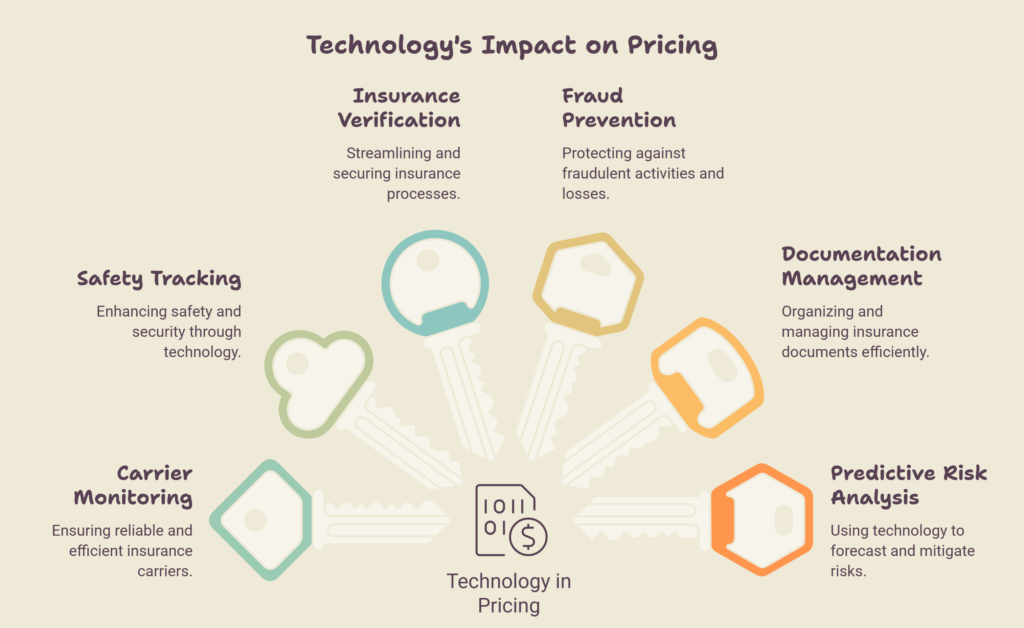
Modern brokerages increasingly rely on technology platforms for:
- Carrier monitoring
- Safety tracking
- Insurance verification
- Fraud prevention
- Documentation management
- Predictive risk analysis
In our experience, technology helps brokerages make more informed carrier selection decisions while maintaining operational efficiency.
For example:
- Automated monitoring identifies authority changes instantly
- Insurance alerts reduce coverage gaps
- Safety score tracking improves carrier selection accuracy
- Integrated TMS systems improve documentation consistency
Technology also influences pricing.
When brokerages gain better visibility into carrier quality and risk exposure, they often become more selective about where freight is awarded.
That selectivity can affect market capacity and ultimately influence rates.
According to Gartner supply chain research, organizations implementing automated compliance and risk-management systems often improve operational visibility while reducing manual oversight requirements (Gartner, n.d.).
“The future of freight pricing will be shaped not only by capacity, but by the quality of the data behind carrier selection decisions.”
Want better visibility into freight pricing and market trends? Explore how technology helps brokers make smarter, faster decisions.
The Market Is Adjusting to a New Operating Environment
The most important takeaway is that the freight market is adapting.
The liability discussions did not suddenly create higher rates overnight.
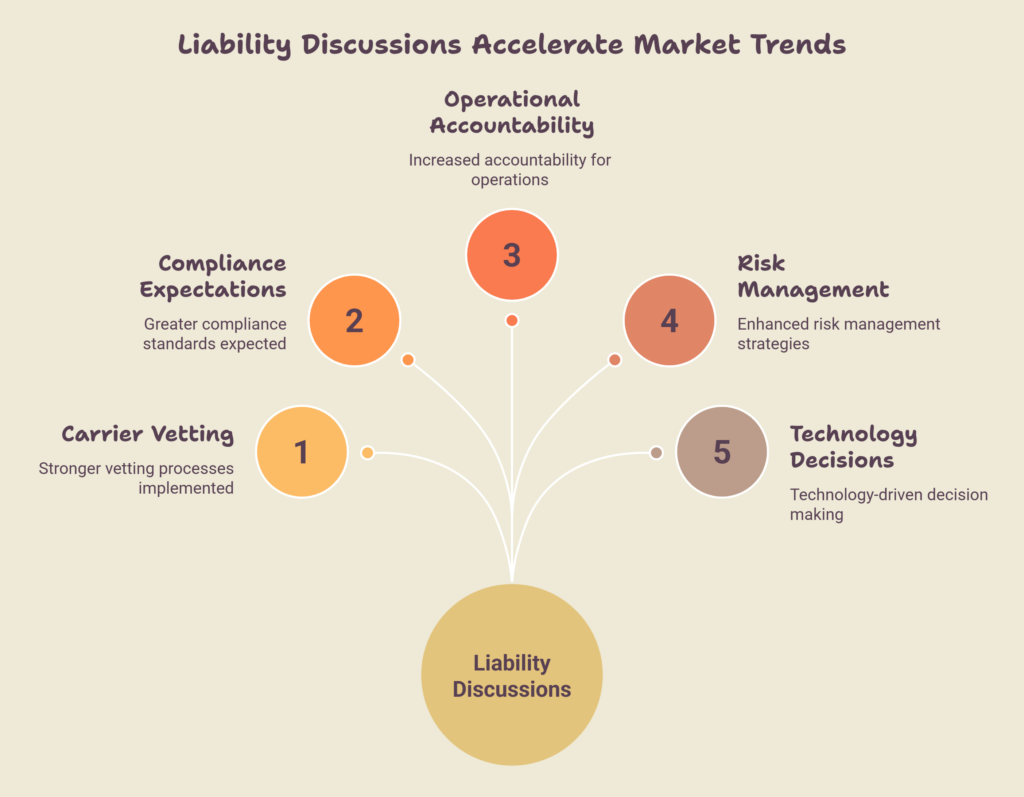
Instead, they accelerated trends that were already developing:
- Stronger carrier vetting
- Greater compliance expectations
- Increased operational accountability
- Enhanced risk management
- Technology-driven decision making
In our experience, brokerages that adapt early often position themselves more effectively than those waiting for regulations, customers, or insurers to force change.
Markets naturally respond when operating requirements evolve.
And right now, many freight networks are recalibrating around a higher standard of accountability.
That adjustment may create short-term pricing pressure, but it could also lead to stronger long-term operational stability across the industry.
“The market is not just paying for transportation anymore. Increasingly, it is paying for verified, compliant, and dependable transportation.”
Are higher spot rates a temporary reaction, or a reflection of a permanently higher standard for carrier selection?
Frequently Asked Questions
1. Why are spot rates increasing after the broker liability decision?
The decision itself did not directly raise rates. However, stricter carrier vetting, increased compliance requirements, and reduced available capacity can contribute to upward pricing pressure in certain markets (FreightWaves, n.d.).
2. Does stronger carrier vetting always lead to higher rates?
Not necessarily. Market conditions, freight demand, and capacity all influence pricing. However, reducing the available carrier pool can sometimes increase competition for qualified capacity.
3. How can brokers manage rising spot rates?
Brokers can improve carrier relationships, invest in compliance technology, strengthen carrier networks, and use data-driven pricing tools to make more informed decisions.
The Market Is Changing. Is Your Brokerage Ready?
The relationship between broker liability and spot rates is not as simple as cause and effect.
What we’re seeing is a market adjusting to new expectations around risk, accountability, and carrier selection.
As brokerages strengthen vetting standards, invest in compliance systems, and become more selective about the carriers they work with, capacity dynamics naturally begin to shift. Those shifts can influence pricing, especially in competitive freight markets.
In our experience, the companies that navigate these changes most effectively are the ones that view compliance and operational discipline as strategic advantages rather than administrative burdens.
The freight industry has always adapted to changing market conditions. This is simply another chapter in that evolution.
The question isn’t whether the market will adjust. The question is whether your operation is adjusting with it.
Ready to build a stronger, more resilient brokerage for the changing freight market? Contact us to learn how we can help you stay ahead of the curve.
References
FreightWaves. (n.d.). Freight market analysis and broker liability coverage. Retrieved from https://www.freightwaves.com
Transportation Intermediaries Association (TIA). (n.d.). Broker compliance and risk management resources. Retrieved from https://www.tianet.org
DAT Freight & Analytics. (n.d.). Freight market trends and spot rate analysis. Retrieved from https://www.dat.com
Federal Motor Carrier Safety Administration (FMCSA). (n.d.). Carrier safety and compliance guidance. Retrieved from https://www.fmcsa.dot.gov
Gartner. (n.d.). Supply chain technology and risk management research. Retrieved from https://www.gartner.com/en/supply-chain