
If the freight market had a personality, it would be unpredictable at best. Rates go up. Then down. Then sideways just to keep things interesting.
In uncertain times, the difference between struggling brokers and successful ones isn’t luck, it’s how they adapt.
Because uncertainty doesn’t remove opportunity. It just hides it better.
Uncertainty Exposes Weak Systems (and Rewards Strong Ones)
Market volatility has a way of revealing what’s working and what’s not.
In our experience, brokerages that rely on reactive decision-making tend to struggle when conditions shift. Those with structured systems tend to adjust faster.
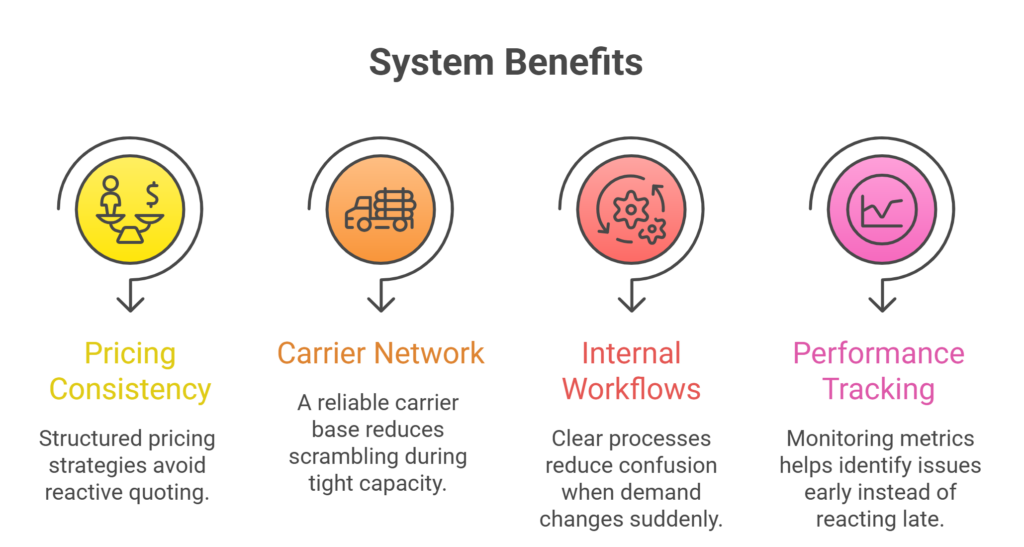
Key areas where systems make the biggest difference:
- Pricing consistency: Brokers with structured pricing strategies avoid emotional or reactive quoting, even when the market fluctuates (DAT Freight & Analytics, n.d.)
- Carrier network stability: A reliable, pre-vetted carrier base reduces last-minute scrambling during tight capacity periods
- Internal workflows: Clear processes reduce confusion when volume or demand suddenly changes
- Performance tracking: Monitoring key metrics helps identify issues early instead of reacting too late (Gartner, n.d.)
For example, during a sudden rate drop, a brokerage with no pricing framework may start undercutting aggressively, hurting margins. One with defined pricing guidelines adjusts strategically instead.
“Uncertainty doesn’t break strong operations, it exposes weak ones.”
If the market shifts tomorrow, would your current systems hold up or fall apart?
The Brokers Who Win Focus on the Right Freight (Not Just More Freight)
When markets get uncertain, the instinct is to chase more loads.
In our experience, that’s usually the wrong move. Top-performing brokers shift their focus toward better freight, not just higher volume.
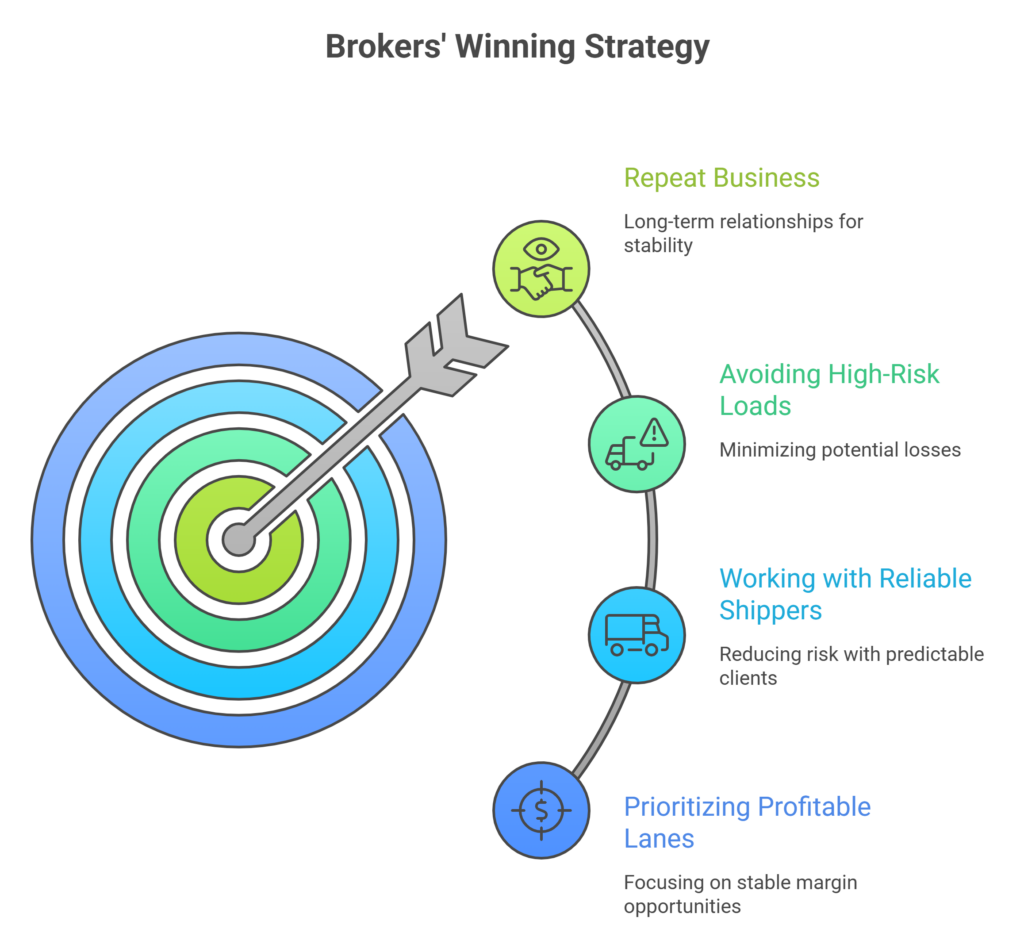
This includes:
- Prioritizing profitable lanes: Identifying which lanes consistently deliver stable margins
- Working with reliable shippers: Reducing risk by focusing on customers with predictable freight patterns (Journal of Commerce, n.d.)
- Avoiding high-risk loads: Steering clear of shipments that frequently cause delays, disputes, or losses
- Building repeat business: Focusing on long-term relationships instead of one-off opportunities
For instance, one brokerage we analyzed reduced overall load volume by about 15% during a volatile period,but improved profitability by focusing only on consistent, high-quality freight. Less chaos. Better results.
“Growth in uncertain markets isn’t about doing more, it’s about doing the right things consistently.”
Are you focusing on the right freight, or just more freight? Learn what successful agents do differently to stay profitable.
Case Study: How One Brokerage Stabilized Margins in a Volatile Market
Here’s a practical scenario based on common industry patterns.
Initial Situation:
- Heavy reliance on spot market loads
- Frequent margin swings due to rate volatility
- Limited repeat business from customers
What Changed (Over 90 Days):
In our experience, the brokerage implemented a focused strategy:
- Shifted toward repeat lanes with known pricing behavior
- Strengthened carrier relationships for consistency
- Introduced weekly performance reviews for pricing and margins
- Reduced exposure to unpredictable, one-off loads
Results After 90 Days:
- Margin volatility reduced significantly
- Repeat business increased by ~35%
- Operational efficiency improved due to fewer disruptions
One key adjustment was simple: instead of reacting to market swings daily, they made measured, data-backed decisions weekly. That shift alone reduced overcorrection.
“Stability in uncertain markets comes from controlled decision-making, not constant reaction.”
How often are you adjusting your strategy, and is it based on data or pressure?
Communication Becomes a Competitive Advantage
When everything is uncertain, communication becomes more valuable.
In our experience, brokers who communicate clearly and proactively stand out immediately, especially when things don’t go as planned.
Strong communication includes:
- Setting realistic expectations: Avoiding overpromising during volatile conditions
- Providing proactive updates: Informing customers before they ask
- Explaining market conditions: Helping shippers understand rate changes or delays (FreightWaves, n.d.)
- Being transparent about challenges: Building trust instead of hiding issues
For example, telling a shipper, “Capacity is tightening this week. We recommend adjusting timelines,” positions you as a partner, not just a service provider. And in uncertain markets, trust is currency.
“In volatile markets, the best communicators often outperform the lowest bidders.”
Do your customers hear from you only when there’s a problem or before it happens?
Technology Helps You See What Others Miss
Uncertainty creates noise. Technology helps filter it.
In our experience, brokers who leverage data and tools effectively make better decisions under pressure.
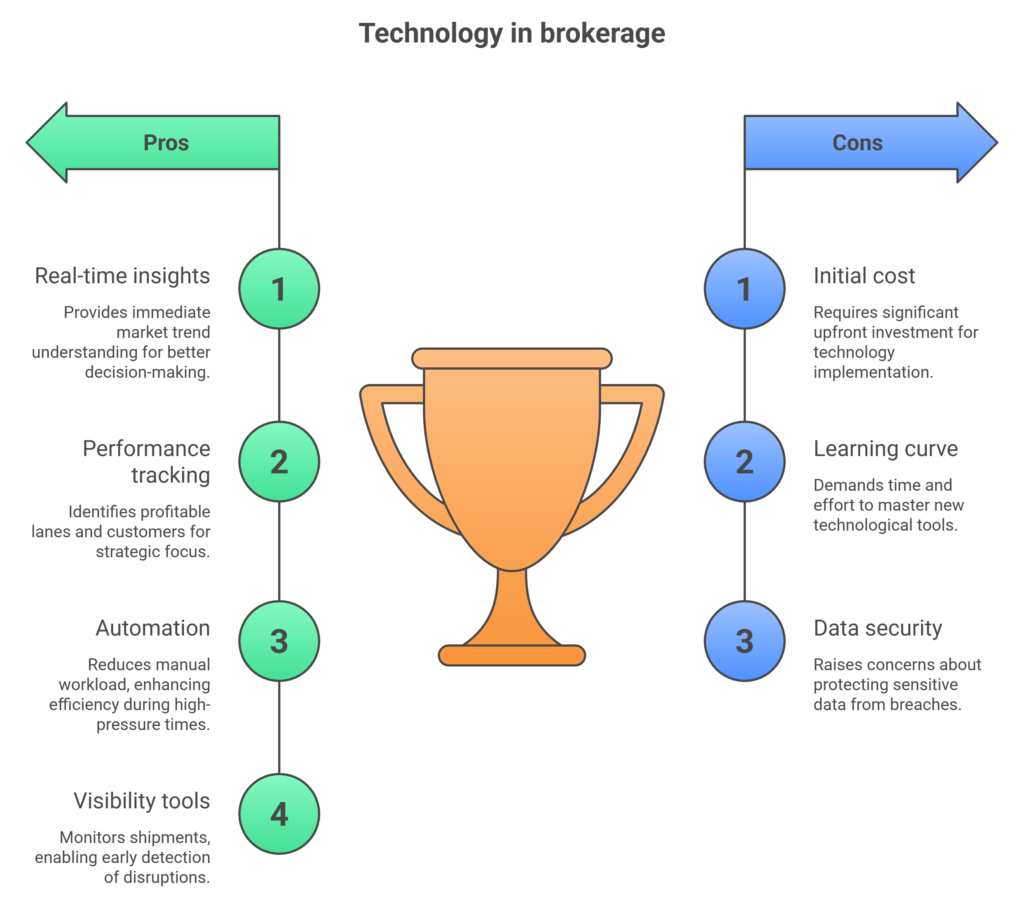
Key advantages of technology include:
- Real-time pricing insights: Understanding market trends quickly (DAT Freight & Analytics, n.d.)
- Performance tracking: Identifying which lanes and customers are truly profitable
- Automation: Reducing manual workload during high-pressure periods
- Visibility tools: Monitoring shipments and identifying disruptions early
For example, a broker using real-time rate data can avoid underpricing during sudden market shifts, protecting margins.
Without data, decisions become guesswork. With data, they become a strategy.
“The more uncertain the market, the more valuable accurate data becomes.”
Are you using the right tools to spot opportunities others miss? See how freight technology can sharpen your edge.
Flexibility Wins, But Only When It’s Controlled
Flexibility is essential in uncertain markets.
But in our experience, uncontrolled flexibility leads to inconsistency, which creates more problems than it solves.
Smart flexibility looks like:
- Adjusting strategies without abandoning structure
- Adapting pricing based on data, not emotion
- Exploring new lanes while maintaining core operations
- Scaling activity up or down without disrupting workflows
For instance, expanding into a new lane during a downturn can create opportunity, but only if it’s backed by research and planning.
Flexibility should be intentional, not reactive.
“The goal isn’t to react faster, it’s to adapt smarter.”
Is your flexibility strategic or just a response to pressure?
Frequently Asked Question (FAQs)
1. How can brokers handle market uncertainty effectively?
By focusing on strong systems, using data-driven decision-making, and maintaining consistent communication with customers and carriers.
2.Should brokers focus on volume during uncertain markets?
Not necessarily. Prioritizing profitable and reliable freight often leads to better long-term results than chasing higher volume.
3. What role does technology play in uncertain markets?
Technology provides visibility, improves decision-making, and helps brokers respond strategically rather than reactively.
Control What You Can. Win in Any Market.
Uncertain markets aren’t new in freight, but they always feel new when you’re in them.
The brokers who navigate them successfully aren’t guessing. They’re relying on systems, relationships, and data.
In our experience, the difference comes down to control. Control over pricing. Control over processes. Control over decisions.
Because while you can’t control the market, you can control how you respond to it. And in freight, that’s often the difference between surviving and scaling.
Ready to take control of your brokerage and navigate uncertainty with confidence? Contact us to learn how we can help you build systems that scale in any market.
References
DAT Freight & Analytics. (n.d.). Freight market data and pricing insights. Retrieved from https://www.dat.com
FreightWaves. (n.d.). Freight market trends and analysis. Retrieved from https://www.freightwaves.com
Gartner. (n.d.). Supply chain and logistics performance insights. Retrieved from
https://www.gartner.com
Journal of Commerce. (n.d.). Freight and logistics market analysis.Retrieved from
https://www.joc.com