Remote work is no longer a trend in logistics, it’s a competitive advantage. From virtual freight agent jobs to fully distributed broker teams, companies that master hiring, onboarding, and training remotely are scaling faster, reducing overhead, and accessing global talent.
This guide breaks down the best practices for recruiting, onboarding, and training remote freight agents or employees, with real-world strategies you can actually implement.
Recruiting the Right Talent for a Remote Logistics Workforce
Successful remote teams start with intentional hiring. A strong logistics remote workforce strategy focuses on skill alignment, accountability, and cultural fit, not just experience (Society for Human Resource Management [SHRM], n.d.).
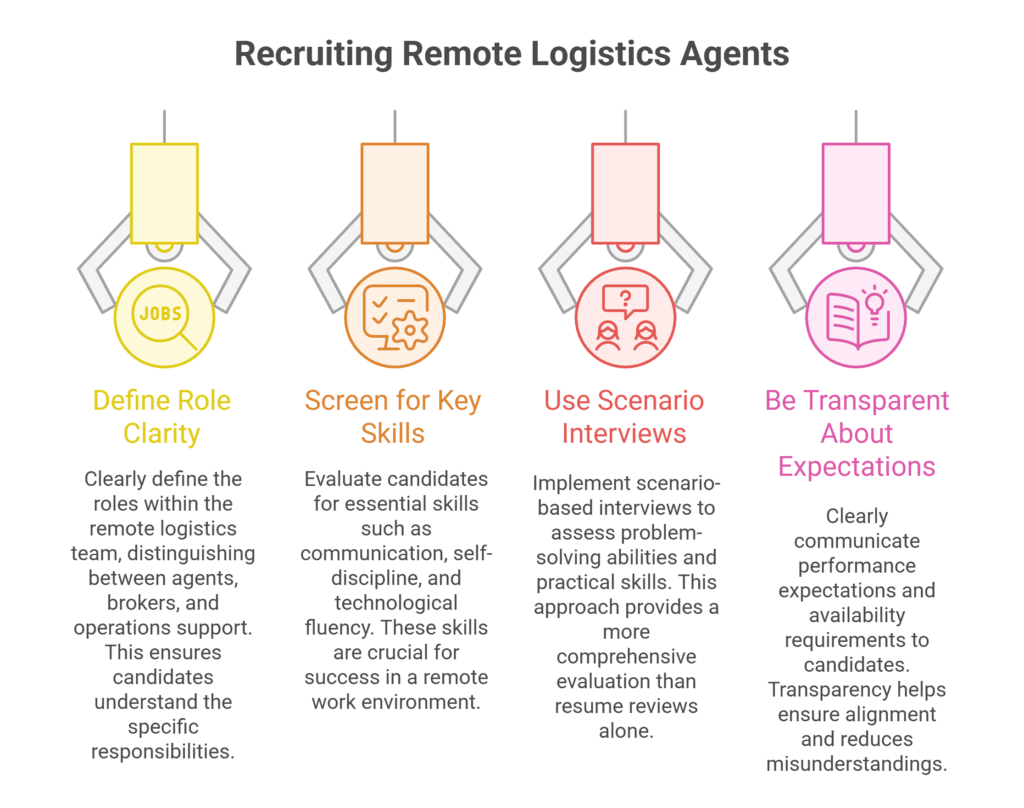
Best Practices for Recruiting Remote Logistics Agents
- Define role clarity early (agent vs broker vs ops support)(SHRM, n.d.)
- Screen for communication, self-discipline, and tech fluency
- Use scenario-based interviews instead of resume-only reviews
- Be transparent about expectations for performance and availability
When recruiting remote logistics agents, prioritize candidates who have worked independently, handled digital workflows, or completed freight broker training online.
Where to Find Strong Candidates
- Industry-specific job boards for virtual freight agent jobs
- LinkedIn and freight-focused communities
- Referrals from existing agents
- Internal promotions into remote roles
Companies that invest in remote freight company hiring strategies tend to see better retention and faster ramp-up (Gartner, n.d.).
“The best remote freight hires aren’t always the most experienced, they’re the most coachable, communicative, and systems-oriented.”
What traits do you prioritize most when hiring remote freight agents; experience or adaptability?
Structuring an Effective Virtual Onboarding Experience
Once hired, the biggest risk is losing momentum. Poor onboarding leads to confusion, disengagement, and early turnover. A strong virtual onboarding process for logistics companies creates confidence and clarity from day one (Gartner, n.d.).
Key Elements of Onboarding Remote Workers in Logistics
Effective onboarding isn’t about dumping information in week one. When onboarding remote workers in logistics, the goal is to reduce uncertainty, accelerate confidence, and help new hires understand how their role fits into the freight operation.
1. Centralized SOPs and Process Documentation
Remote hires can’t tap someone on the shoulder, so documentation must be:
- Easy to access (single source of truth)
- Clearly written with visuals, flowcharts, or short videos
- Updated regularly as processes evolve
Strong SOPs support a scalable freight broker onboarding process by standardizing how loads are booked, tracked, billed, and resolved (Training Industry, n.d.).
2. Clear Performance Benchmarks for the First 30–60–90 Days
Remote employees perform better when expectations are visible and measurable.
- First 30 days: Tool familiarity, shadowing, and basic task execution
- 60 days: Independent load handling or customer communication
- 90 days: Performance metrics tied to revenue, service levels, or efficiency
These benchmarks reinforce accountability and support a long-term logistics remote workforce strategy.
3. Live Walkthroughs of TMS, CRM, and Communication Tools
Recorded videos are helpful, but live walkthroughs matter more.
- Demonstrate real workflows, not generic features
- Show how systems connect across departments
- Encourage questions in real time
This is especially critical for teams learning how to train freight brokers remotely, where systems are the backbone of daily operations.
4. Assigned Mentors or Onboarding Buddies
A mentor provides:
- Context beyond documentation
- Faster problem-solving
- Cultural alignment with the team

This human layer reduces early-stage friction and improves retention in remote freight agent training programs (Training Industry, n.d.).
“Remote onboarding succeeds when systems provide structure and people provide context.”
Struggling to onboard remote freight agents efficiently? Explore our freight broker solutions to discover proven onboarding systems and tools that help logistics teams ramp faster and stay aligned.
What Great Logistics Employee Onboarding Looks Like
High-performing teams treat onboarding as a process, not an event. Great logistics employee onboarding blends preparation, communication, and continuous feedback.
1. Pre-Onboarding Access to Tools and Accounts
Before day one, new hires should have:
- Email and system credentials
- Access to SOPs and training libraries
- A clear onboarding schedule
This sets a professional tone and strengthens the virtual onboarding process for logistics companies.
2. Structured Daily or Weekly Check-Ins
Remote employees need rhythm and connection.
- Daily check-ins during week one
- Weekly coaching sessions during the first month
- Clear agendas for each call
These check-ins support alignment and improve remote logistics team management.
3. Training Milestones Tied to Real Tasks
Training sticks when it’s applied immediately.
- Shadow a live load, then manage one
- Observe negotiations, then practice pricing
- Review claims, then handle a minor issue
This task-based approach accelerates learning for virtual freight agent jobs and reinforces operational confidence.
4. Feedback Loops During the First Month
Early feedback prevents bad habits.
- Short performance reviews at 2 and 4 weeks
- Open discussion of challenges and blockers
- Adjust training based on performance gaps
These feedback loops are essential for companies refining how to manage remote freight agents at scale.
“Great onboarding doesn’t overwhelm new hires, it gives them clarity, momentum, and early wins.“
How often should managers provide feedback during a remote employee’s first 30 days?
Training, Managing, and Scaling Remote Freight Agents
Training doesn’t stop after onboarding. In remote environments, learning must be continuous, measurable, and closely tied to real freight activity. This is especially true when figuring out how to train freight brokers remotely, where performance, compliance, and communication all happen without a shared office (Training Industry, n.d.).
A scalable logistics remote workforce strategy treats training as an operational system, not a one-time event.
How to Train Freight Brokers Remotely
Remote training works best when it’s structured, repeatable, and outcome-driven.
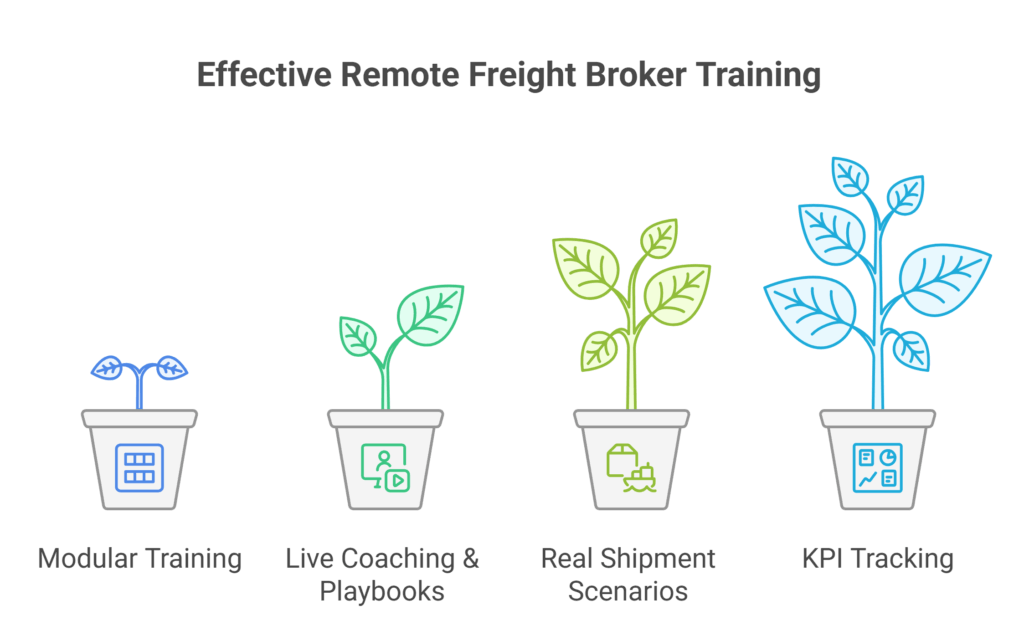
1. Use Modular Training Instead of Long Sessions
Long, one-time sessions lead to low retention. Modular training breaks learning into focused, digestible units.
- Short modules (15–30 minutes) per topic
- One concept per session (pricing, carrier vetting, claims, etc.)
- Easy to revisit as reference material
This approach is foundational for companies improving remote freight agent training at scale (American Society for Training and Development, n.d.).
2. Combine Live Coaching With Recorded Playbooks
Recorded content creates consistency, while live coaching adds context.
- SOP videos for standard workflows
- Live calls for Q&A, nuance, and judgment-based decisions
- Playbooks for lanes, customers, and negotiation frameworks
Blending both methods strengthens any freight broker training online initiative.
3. Reinforce Learning With Real Shipment Scenarios
Training sticks when brokers apply it immediately.
- Review real loads (good and bad outcomes)
- Walk through rate breakdowns and margin decisions
- Analyze service failures and recovery steps
This is one of the most effective ways to master how to train freight brokers remotely without overwhelming new hires.
4. Track Progress With KPIs, Not Just Attendance
Presence doesn’t equal performance. Measure what actually matters:
- Loads booked and covered (ASTD, n.d.)
- Margin consistency
- On-time delivery rates
- Communication quality
KPIs turn training into a business driver and align with long-term remote logistics team management goals.
Remote Freight Agent Training Best Practices
Once training is live, consistency and feedback keep performance high.
Weekly Coaching Calls
Regular coaching creates alignment and momentum.
- Review wins, losses, and challenges
- Address skill gaps early
- Reinforce best practices
These calls are essential for maintaining quality across virtual freight agent jobs.
Role-Play Negotiations and Problem Scenarios
Simulation builds confidence without risking real shipments.
- Rate negotiations with shippers and carriers
- Handling service failures or delays
- Managing difficult customer conversations
Role-play is a proven method in the freight agent best practices playbook.
Shared Dashboards for Visibility and Accountability
Transparency drives better behavior.
- Live performance dashboards
- Margin and service metrics
- Pipeline visibility
Shared data strengthens trust and simplifies how to manage remote freight agents effectively (ASTD, n.d.).
Clear Escalation Paths for Issues
Remote agents must know when and how to ask for help.
- Defined thresholds for escalation
- Clear contacts for ops, compliance, or management
- Documented resolution steps
This reduces risk and supports sustainable remote logistics team management.
“Strong remote teams scale faster when agents know what to own, what to escalate, and how success is measured.”
Need support managing and scaling your remote freight agents? See how expert back-office support can streamline training, improve oversight, and keep your brokerage running smoothly.
Frequently Asked Questions (FAQs)
1. How do I train freight brokers remotely without losing quality?
Use structured modules, live coaching, and real shipment scenarios. Companies that focus on how to train freight brokers remotely combine internal playbooks with proven freight broker training online programs.
2. What’s the biggest mistake in onboarding remote logistics employees?
Rushing the process. Weak logistics employee onboarding leads to confusion and early turnover. A clear virtual onboarding process for logistics companies prevents this.
3. Are virtual freight agent jobs sustainable long-term?
Yes. With the right logistics remote workforce strategy, virtual teams often outperform in-house teams due to flexibility and access to wider talent pools.
Building Remote Freight Teams That Actually Perform
Remote work in logistics is here to stay. Companies that invest in smart hiring, structured onboarding, and continuous training will dominate the next phase of freight operations.
By improving recruiting remote logistics agents, strengthening onboarding remote workers in logistics, and refining remote freight agent training, you build a team that’s productive, resilient, and scalable.The question isn’t whether remote freight teams work, it’s whether your systems are ready to support them.
Ready to build a high-performing remote freight team? Contact us to streamline your hiring, onboarding, and operational systems for long-term growth.
References
American Society for Training and Development. (n.d.). Remote training best practices. Retrieved from Discover more
Gartner. (n.d.). Employee onboarding and workforce development. Retrieved from Discover more
Society for Human Resource Management. (n.d.). Remote hiring and onboarding strategies. Retrieved from Discover more
Training Industry. (n.d.). Virtual onboarding and learning programs. Retrieved from Discover more