

Your First 90 Days as an SPI Freight Agent
A realistic look at the model, the support, and how fast you’re up and running.
Talk to SPI
What to Expect in Your First 90 Days as an SPI Freight Agent
Joining a new freight agent program isn’t about learning how to move freight. It’s about understanding a new operating model, the level of support behind it, and how quickly you can move from onboarding to booking customer loads and growing your book of business.
This page is written for experienced freight agents and independent brokers evaluating whether SPI Logistics is the right long-term platform for their operation. Rather than marketing promises, it outlines what most agents realistically experience in their first 90 days at SPI: what SPI provides, what remains fully in your control, and how momentum typically builds.
Before Day One: Setting the Right Expectations
SPI is built for experienced operators who want independence without operational drag. Agents who succeed at SPI typically aren’t looking for leads, dispatchers, or micromanagement. They’re looking for a platform that removes friction—accounting, compliance, settlements so that they can focus on customers, carriers, and growth.
Who Thrives at SPI
SPI tends to be a strong fit for agents who:
- Already manage customer relationships and pricing
- Want to reduce administrative and compliance overhead
- Prefer full ownership of margins, lanes, and growth decisions
- Value transparent accounting and predictable settlements
- Are thinking beyond “today’s loads” toward a scalable operation
What SPI Provides
SPI provides proven freight broker back-office solutions, including:
- Accounting and settlements
- Compliance and carrier onboarding support
- A proven TMS and operational infrastructure
- A scalable platform for independent agents
What SPI is Not
Independence is central to the SPI model, so we don’t:
- Provide freight or guaranteed leads
- Act as a dispatcher or sales organization
- Control how you run your book of business
Days 1–30: Onboarding & Setup
The first 30 days are about stability, confidence, and setting you up for success.
1) Administrative & Compliance Setup
Your initial focus is aligning your operation with SPI’s infrastructure:
- Beginning carrier onboarding within SPI’s systems
- Completing agent onboarding and agreements
- Aligning compliance and insurance requirements
2) Systems & Technology Access
Agents receive access to SPI’s operational stack, including:
- TMS setup and training
- Accounting and settlement workflows
- Visibility into load, carrier, and financial data
3) What Success Looks Like in Days 1–30
By the end of the first month, most successful agents have:
- Fully active systems
- Carriers onboarded and ready
- Clear lanes and customers prepared for execution
Some agents book freight immediately. Others prioritize setup to avoid disruption later. Both approaches can work.
Days 31–60: First Loads, Systems, and Momentum
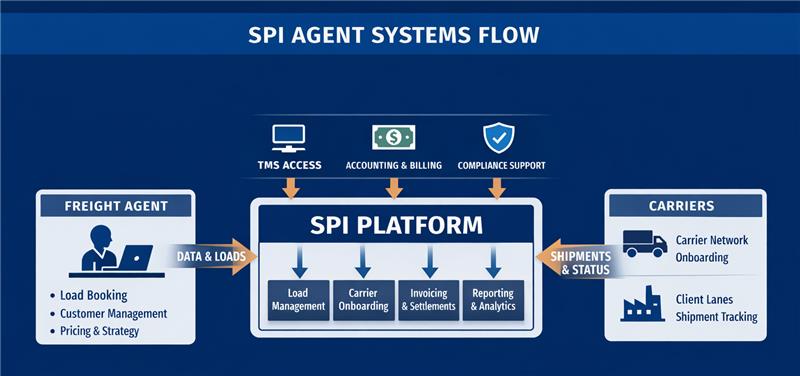
This is where SPI’s infrastructure begins to replace prior manual processes. As freight moves through SPI systems, agents typically notice the biggest shift here, not in sales effort, but in confidence. Accounting becomes predictable. Settlements become reliable. Compliance stops being a daily concern.
Booking Freight & Executing Loads
Agents begin:
- Transitioning existing customers where applicable
- Running live freight through SPI systems
- Using SPI’s accounting processes for invoicing and settlements
Support You’ll Use Most
Day-to-day value typically comes from:
- Accounting and settlement accuracy
- Compliance and carrier management
- Operational support when issues arise
What SPI Handles vs. What You Own
SPI handles the operational backbone, such as accounting, invoicing, settlements, and compliance, so that agents don’t have to build or maintain those systems themselves.
Agents retain full ownership of customer relationships, pricing strategy, margins, and growth decisions. The business remains yours, just with significantly less friction.
What Success Looks Like in Days 31–60
- First invoices paid
- Confidence in systems and processes
- Reduced admin burden compared to prior setups

Days 61–90: Optimization, Growth, and Independence
By month three, agents are no longer onboarding, they’re operating. At this stage, agents typically have clearer visibility into profitability, tighter carrier performance, and fewer administrative distractions. Growth becomes a matter of opportunity, not infrastructure.

Refining Your Operation
This phase is about tightening:
- Carrier mix and lane performance
- Margin visibility and profitability
- Internal processes using SPI reporting
Scaling Without Adding Overhead
SPI’s model allows agents to grow freight volume without building:
- Internal accounting teams
- Compliance departments
- Custom technology stacks


Independent, Not Alone
Agents remain fully independent while benefiting from:
- Mature systems
- Experienced support teams
- A platform built for long-term growth
Common Questions from
That depends on your existing book, carrier readiness, and how aggressively you want to transition. Some agents book in week one. Others take a more deliberate approach to avoid operational risk. Both paths are common, and supported.
In practice, the most-used support is a full suite of the latest freight-broker terchnology, accounting accuracy, compliance management, and operational problem-solving when issues arise (not sales oversight).
SPI doesn’t provide leads, dispatch freight, or control how you run your business. If you’re looking for autonomy with support, not direction, this is typically a strength.
How SPI Compares to Other Agent Models

Compared to high-control or asset-based models, SPI offers:
- Greater autonomy
- Lower operational overhead
- Transparent accounting
Compared to minimal-support networks, SPI provides:
- Deeper back-office infrastructure
- Scalable systems
- Long-term operational stability
Is SPI the Right Fit?
If you’re an experienced freight agent evaluating your next platform, a conversation with SPI can help determine fit, without pressure or assumptions. Fill in the form below and we’ll be in touch.
"*" indicates required fields