
Remote teams unlock flexibility and global talent, but when something breaks, escalates, or goes wrong fast, distance can amplify chaos. Whether it’s a system outage, security incident, client escalation, or internal conflict, managing emergencies with remote employees requires structure, speed, and calm leadership (Gartner, n.d.).
Here are effective, battle-tested strategies for handling urgent issues remotely designed to help leaders stay in control, protect productivity, and keep teams aligned under pressure.
Build a Clear Remote Crisis Response Framework
The biggest mistake in remote team crisis management is improvisation. When teams are distributed, uncertainty spreads faster than the problem itself. A clear framework removes hesitation and replaces panic with process.
A strong framework ensures that when handling urgent issues remotely, everyone knows who acts, how fast, and through which channels without waiting for instructions.
What to Put in Place
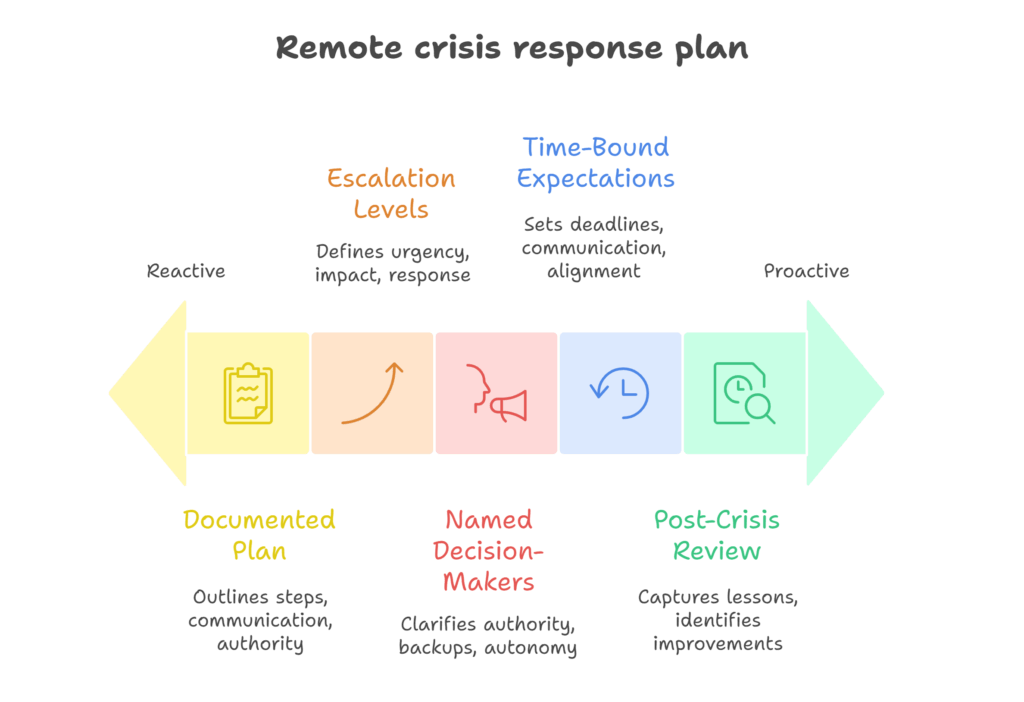
1. A Documented Remote Crisis Response Plan
Your plan should be simple, accessible, and action-oriented, not a dusty PDF no one reads.
It should clearly outline:
- What qualifies as a crisis in your organization
- Immediate first steps once an issue is identified
- Communication rules (channels, tone, frequency)
- Authority boundaries for decision-making
- Recovery and stabilization steps
This document becomes the backbone of how to handle crises in virtual teams, especially when leaders are offline or unavailable.
2. Clear Escalation Levels (Low, Medium, Critical)
Not every issue deserves the same urgency. Without escalation tiers, teams either overreact, or dangerously underreact.
Define escalation levels clearly:
- Low: Minor disruptions with minimal impact (handled by the team lead)
- Medium: Issues affecting delivery or clients (requires manager visibility)
- Critical: Security breaches, outages, reputational risk (executive-level response)
This clarity is essential when dealing with remote work disruptions, where context isn’t always visible.
3. Named Decision-Makers and Backups
Ambiguity around authority slows response time. Every crisis plan must clearly state:
- Who has final decision-making power
- Who steps in if that person is unavailable
- Which decisions can be made without approval
This is especially important for remote leadership in crisis, where time zones and availability vary.
4. Time-Bound Response Expectations
Urgency loses meaning without deadlines. Define response windows for each escalation level, such as:
- Initial acknowledgment within 10–15 minutes
- First action taken within 30 minutes
- Status updates every 30–60 minutes during active incidents
These expectations strengthen effective communication during remote crisis situations and keep teams aligned.
5. Post-Crisis Review Procedures
A crisis isn’t complete when the issue is fixed, it’s complete when the lesson is captured.
Your review process should include:
- What happened and why
- What slowed response
- What worked well
- What needs to change in the plan
This step strengthens remote team risk management and improves future virtual emergency response strategies.
“Remote crises don’t fail because teams lack talent, they fail because teams lack predefined authority and process.”
Does your remote team have a written crisis response plan, or are decisions made ad hoc when pressure hits?
Centralize Crisis Communication (No Channel Chaos)
During a crisis, scattered communication kills momentum. Crisis communication for remote teams must be centralized, visible, and intentional (Forbes, n.d.).
Best practices for effective communication during remote crisis situations:
- Designate one primary crisis channel (Slack, Teams, or similar)
- Use short, directive messages not long explanations
- Share updates on a fixed cadence (e.g., every 30 minutes)
- Document decisions in real time
Strong handling of urgent issues remotely depends on clarity more than speed.
“In virtual crises, silence creates panic, structured updates create confidence.”
Do your teams know exactly where crisis updates will appear, or do messages scatter across tools?
Use the Right Tools for Remote Crisis Management
Technology is the backbone of how to handle crises in virtual teams. Without the right stack, leaders operate blind.
Essential tools for remote crisis management include:
- Real-time messaging (Slack, Teams)
- Video escalation tools (Zoom, Meet)
- Incident tracking (Notion, Jira, ClickUp)
- Monitoring and alerts (status dashboards, uptime tools)
- Documentation hubs for rapid access
The right tools reduce downtime, improve visibility, and strengthen remote team management under pressure (Harvard Business Review, n.d.).
“Tools don’t solve crises but they dramatically reduce decision latency when seconds matter.”
Are your systems built to handle pressure in real time? Explore proven freight broker technology that helps teams respond faster, stay visible, and stay in control during critical moments.
Lead Decisively Without Micromanaging
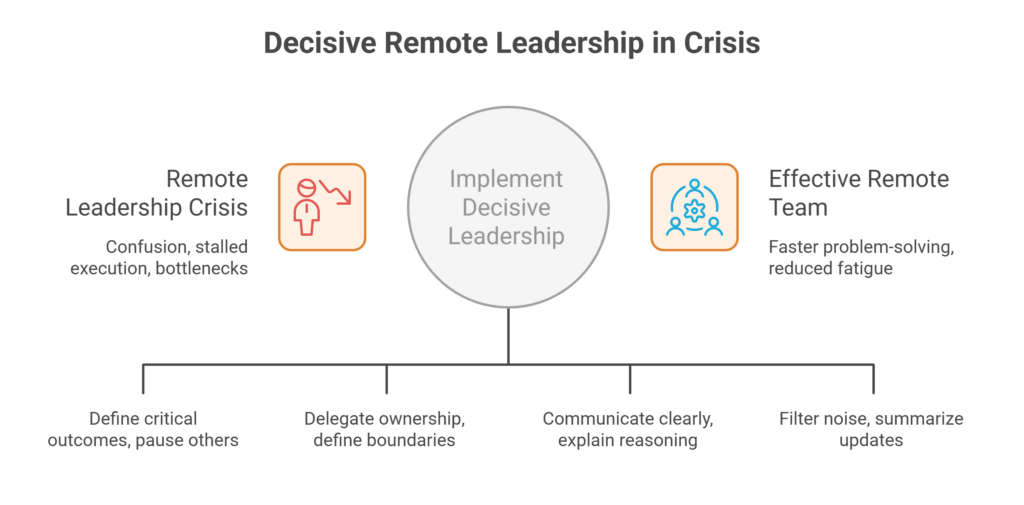
Remote leadership in crisis is a balancing act. Too little direction creates confusion and stalled execution. Too much control creates bottlenecks, slows response, and exhausts teams. The goal is decisive clarity without suffocation (Psychology Today, n.d.).
Strong leaders don’t disappear during crises, but they also don’t hover. They create momentum by removing uncertainty, not by controlling every move.
1. Set Priorities Clearly (What Matters Now)
In a crisis, everything feels urgent. Your job as a leader is to define what is actually critical, and what can wait.
Effective leaders explicitly answer:
- What is the single most important outcome right now?
- What must be paused, delayed, or ignored temporarily?
- What does “success in the next 1–2 hours” look like?
Clear prioritization anchors remote team management under pressure and prevents teams from wasting energy on low-impact tasks.
2. Empower Owners to Execute Without Constant Approval
Micromanagement kills speed, especially when teams are distributed. Once priorities are set, leaders must delegate ownership, not just tasks.
That means:
- Assigning a single owner per critical issue
- Giving permission to act without looping leadership on every step
- Defining boundaries (what they can decide vs. when to escalate)
This approach unlocks faster remote team problem-solving strategies and reduces decision fatigue at the leadership level.
3. Make Visible Decisions
Silence from leadership is often interpreted as uncertainty or avoidance. In remote settings, that perception is amplified.
Strong remote leadership in crisis means:
- Communicating decisions clearly and publicly
- Explaining why a decision was made
- Acknowledging uncertainty without stalling action
Perfect decisions are rare in crises. Progress comes from momentum, not precision.
4. Protect Team Focus by Filtering Noise
During disruptions, information overload becomes its own crisis. Messages fly, opinions multiply, and focus fractures.
Effective leaders act as information filters by:
- Limiting who communicates during active incidents
- Summarizing key updates instead of forwarding everything
- Shielding execution teams from external pressure and distractions
This discipline supports effective communication during remote crisis situations and preserves cognitive energy.
“In remote crises, teams don’t need more meetings, they need clearer decisions.”
When pressure rises, does leadership in your team empower action, or unintentionally slow it down?
Address Conflict and Emotional Stress Early
Urgency amplifies tension. Without intervention, small disagreements can explode making virtual team conflict resolution a critical crisis skill.
How to reduce friction while dealing with remote work disruptions:
- Acknowledge stress openly
- Separate facts from emotions
- Move sensitive conversations to private video calls
- Reinforce shared goals and timelines
This approach strengthens remote team risk management and keeps morale intact during uncertainty.
“Emotional misalignment, not technical failure, is what prolongs most remote crises.”
How does your team currently surface and resolve tension during high-pressure moments?
Review, Learn, and Strengthen Future Response
Crisis management doesn’t end when systems are restored or fires are put out. For high-performing organizations, resolution is just the midpoint. The real advantage comes from what happens after. Teams that improve fastest treat every incident as a structured learning loop, not a one-off disruption.
Without intentional review, the same weaknesses resurface, just under different circumstances. With review, even painful disruptions become assets that strengthen virtual emergency response strategies over time.
1. Document What Happened (While Memory Is Fresh)
The first mistake teams make is waiting too long to document a crisis. Details fade fast especially in remote environments where actions happen across tools and time zones.
Effective documentation should capture:
- Timeline of events (what happened, when, and in what order)
- Who was involved and what decisions were made
- What information was available at each stage
- What worked and what failed
This record becomes a shared source of truth and a foundation for improving how to handle crises in virtual teams.
2. Identify Decision Bottlenecks (Not Just Technical Failures)
Most post-crisis reviews focus too heavily on tools or systems. In reality, delays are often caused by decision friction, not technical limitations.
Look closely at:
- Where approvals slowed response
- Moments where ownership was unclear
- Instances where teams waited for confirmation
- Gaps in authority or escalation clarity
This analysis directly strengthens remote team management under pressure by removing invisible blockers before the next disruption.
3. Update Your Remote Crisis Response Plan
A crisis response plan is a living document. Every real incident should leave fingerprints on it.
Updates may include:
- Revised escalation thresholds
- Clearer ownership definitions
- Adjusted communication timelines
- Tool or channel changes
- New backup roles for key leaders
This step ensures your remote crisis response plan evolves with reality not assumptions.
4. Train Teams on Revised Protocols
Updating a document isn’t enough. If teams don’t internalize changes, they won’t use them when pressure hits.
Effective training doesn’t require long workshops. Instead:
- Run short scenario walkthroughs
- Practice responses in low-stakes simulations
- Reinforce expectations during regular team meetings
This builds muscle memory and improves remote team risk management long before the next disruption.
“The strongest remote teams aren’t crisis-proof, they’re crisis-trained.”
Do you conduct structured post-crisis reviews, or does the team simply move on?
Frequently Asked Questions (FAQs)
1. What is the biggest challenge in managing emergencies with remote employees?
The biggest challenge is lack of visibility. Without clear processes and tools, leaders struggle to assess urgency and coordinate action quickly.
2. How can teams improve crisis communication for remote teams?
By centralizing communication channels, setting update cadences, and assigning clear decision-makers during crises.
3. How often should a remote crisis response plan be updated?
At least quarterly, or immediately after any major incident that exposes gaps in response.
Lead Through Crises in Remote Teams
Crisis management in remote environments isn’t about reacting faster, it’s about preparing smarter. By combining structured plans, clear communication, the right tools, and confident leadership, organizations can master handling urgent issues remotely and reduce the impact of disruptions.
When teams know how to act, where to communicate, and who decides, even the most intense challenges become manageable. That’s the difference between surviving a crisis, and leading through one.
Ready for stronger, crisis-proof remote teams? Contact us to build your remote crisis management strategy.
References
Forbes. (n.d.). Managing communication during remote work disruptions. Retrieved from https://www.forbes.com
Gartner. (n.d.). Crisis management and remote workforce strategies. Retrieved from https://www.gartner.com
Harvard Business Review. (n.d.). Leadership and crisis decision-making. Retrieved from https://hbr.org
Psychology Today. (n.d.). Conflict and emotional regulation in teams. Retrieved from https://www.psychologytoday.com