Independent freight brokers operate in a fast-moving, highly competitive environment where margins are tight, regulations evolve, and relationships determine long-term success. Professional development for freight brokers is no longer optional, it is a strategic investment that directly impacts profitability, compliance, leadership effectiveness, and scalability (Transport Topics, n.d.).
From sharpening freight broker leadership and management skills to enrolling in advanced freight broker training for experienced brokers, today’s brokers have access to a wide range of learning pathways designed to support growth at every career stage. This guide explores the most impactful professional development opportunities available and how independent brokers can leverage them to stay competitive.
Leadership and Management Development for Independent Freight Brokers
Strong leadership is the foundation of a sustainable brokerage. As independent brokers scale operations, manage agents, or oversee carrier relationships, freight broker leadership and management skills become essential (Inbound Logistics, n.d.).
Key Focus Areas
- Team leadership and remote workforce management
- Operational decision-making and performance tracking
- Financial oversight and margin optimization
- Strategic planning for brokerage growth
Developing freight broker leadership and management skills helps brokers move from day-to-day load management into long-term business ownership thinking (American Trucking Associations [ATA], n.d.).
“Brokers who invest early in leadership development transition faster from transactional operators to strategic business builders.”
How are you currently developing the leadership capabilities needed to scale your brokerage beyond yourself?
Freight Broker Mentorship Programs
One of the most effective ways to grow is through freight broker mentorship programs. These programs connect independent brokers with seasoned professionals who provide real-world guidance, accountability, and strategic insight.
Benefits of Freight Broker Mentorship Programs
- Practical guidance grounded in real market cycles, including tight and loose capacity environments
- Faster problem-solving and decision-making through access to proven frameworks
- Exposure to established brokerage systems and workflows, such as carrier vetting, CRM usage, and load tracking
- Confidence-building through guided execution, not just advice
- Accountability and performance feedback, helping brokers stay disciplined and focused
Many freight broker mentorship programs place strong emphasis on high-risk, high-impact areas such as carrier onboarding, rate negotiation, fraud prevention, pricing discipline, and client retention; areas where mistakes are often expensive and difficult to reverse.
Well-structured mentorship also supports the development of long-term thinking. Brokers learn how to balance short-term margin pressure with sustainable relationships, how to evaluate opportunities strategically, and how to build repeatable processes that reduce burnout.
“Mentorship shortens the learning curve by turning someone else’s hard-earned lessons into your competitive advantage.”
Looking for expert mentorship to accelerate your brokerage growth? Explore freight broker mentorship solutions
Advanced Training for Experienced Brokers
As brokers mature, basic training no longer delivers value. Advanced freight broker training for experienced brokers is designed to deepen expertise and address complex operational challenges (Inbound Logistics, n.d.).
What Advanced Training Covers
1. Multi-lane pricing strategies
Advanced training dives deep into pricing freight across multiple lanes rather than quoting in isolation. Brokers learn how to analyze lane history, seasonality, equipment availability, fuel trends, and shipper volume commitments to build pricing models that protect margins while remaining competitive. This includes understanding lane imbalances, headhaul vs. backhaul dynamics, and how to use data to justify rate consistency across regions.
2. Contract freight negotiation
Experienced brokers are trained to negotiate long-term contracts that balance shipper expectations with carrier realities. This goes beyond spot-rate discussions and focuses on service-level agreements, escalation clauses, volume commitments, and renegotiation triggers. Contract negotiation training also emphasizes relationship management, ensuring agreements remain profitable and flexible during market shifts.
3. Carrier capacity forecasting
Advanced programs teach brokers how to anticipate capacity changes before they impact service. This includes reading market indicators, monitoring carrier behavior, understanding seasonal freight cycles, and aligning capacity planning with shipper demand forecasts. Effective carrier capacity forecasting allows brokers to secure reliable coverage, reduce last-minute premiums, and maintain service continuity.
4. Risk mitigation and claims handling
Risk-focused training prepares brokers to identify, reduce, and respond to operational threats. This includes freight claims management, cargo insurance requirements, contract liability exposure, and fraud prevention. Brokers learn how to document shipments properly, respond to claims efficiently, and implement preventative processes that minimize financial and reputational damage.
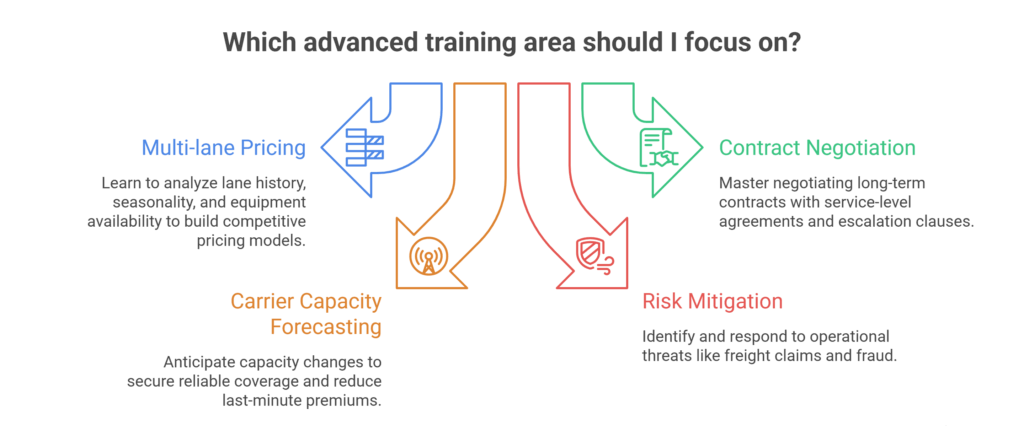
High-level programs offering advanced freight broker training for experienced brokers often include case studies, simulations, and data-driven decision models (FreightWaves, n.d.).
“Advanced education shifts brokers from reactive problem-solvers to proactive market strategists.”
Which advanced skills would most improve your ability to handle high-volume or high-risk freight?
Continuing Education and Certification Pathways
Continuing education for freight brokers ensures long-term relevance in an industry shaped by regulatory changes and technological disruption. Many brokers also explore freight broker certification options to enhance credibility (FreightWaves, n.d.).
Common Freight Broker Certification Options
1. Industry-recognized brokerage certifications
These certifications focus on the core competencies required to operate a freight brokerage professionally and credibly. They typically cover brokerage operations, ethical standards, carrier and shipper relationship management, documentation practices, and industry best practices. For independent brokers, industry-recognized brokerage certifications help establish trust with shippers, especially those working with brokers for the first time, and signal a serious, long-term commitment to the profession (ATA, n.d.).
2. Specialized compliance credentials
Specialized compliance credentials are designed to deepen a broker’s understanding of regulatory requirements and risk exposure. These credentials often focus on FMCSA rules, broker-carrier contracts, insurance and bonding obligations, cargo claims processes, and fraud prevention. Earning specialized compliance credentials supports stronger internal controls and reduces the likelihood of costly regulatory or legal issues as a brokerage grows.
3. Sales and negotiation certificates
Sales and negotiation certificates concentrate on the commercial side of brokerage success. These programs emphasize value-based selling, pricing psychology, objection handling, and long-term contract negotiation. For independent brokers, sales and negotiation certificates help improve margin consistency, strengthen shipper relationships, and move conversations away from rate-only competition toward service and reliability.
Combining continuing education for freight brokers with formal freight broker certification options signals professionalism to shippers and partners.
“Certification doesn’t replace experience, but it amplifies trust, especially with enterprise-level shippers.”
How could formal credentials strengthen your positioning with high-value clients?
Sales and Negotiation Skill Development
Revenue growth depends on effective selling and deal-making. Freight broker sales training and freight broker negotiation skills training directly impact margins and customer retention (Inbound Logistics, n.d.).
Skills Developed Through Sales and Negotiation Training
1. Value-based selling techniques
This skill trains brokers to move conversations away from price alone and toward the total value they provide. Brokers learn how to articulate service reliability, carrier quality, risk reduction, communication standards, and problem-solving capabilities in a way that resonates with shippers. Value-based selling helps brokers justify rates, reduce churn, and position themselves as strategic partners rather than interchangeable vendors.
2. Objection handling and price justification
Objection handling focuses on responding confidently to shipper concerns such as pricing pressure, service doubts, or competitive comparisons. Brokers are trained to diagnose the real objection behind a pushback, respond with data and service differentiation, and justify pricing using market context, lane performance, and operational value. Strong objection handling reduces discounting and protects margins.
3. Long-term contract negotiation
This area emphasizes negotiating agreements that balance profitability, service expectations, and flexibility. Brokers learn how to structure contracts with clear service levels, volume commitments, escalation clauses, and review periods. Long-term contract negotiation training helps brokers secure predictable revenue while maintaining the ability to adapt to market changes.
4. Relationship-driven closing strategies
Rather than transactional closes, brokers develop strategies focused on trust, consistency, and long-term alignment. This includes active listening, follow-up discipline, transparency, and setting realistic expectations. Relationship-driven closing strategies increase lifetime customer value and lead to repeat business, referrals, and stronger shipper loyalty.
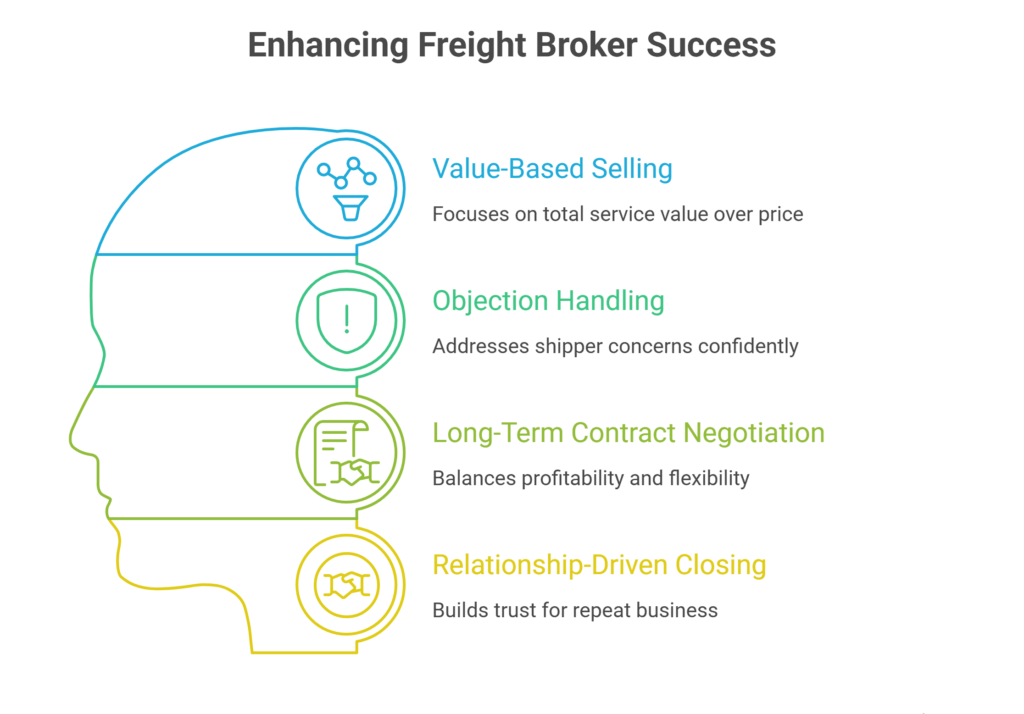
Consistent freight broker sales training paired with freight broker negotiation skills training allows brokers to compete on value rather than price alone.
“Strong negotiators don’t chase rates, they justify them.”
Want to strengthen your brokerage’s sales and negotiation process? Learn how to strengthen your brokerage’s back-office sales support
Compliance, Regulations, and Risk Management Education
Regulatory missteps can cripple independent brokers. Enrolling in a freight broker compliance and regulations course protects both reputation and revenue (ATA, n.d.).
Topics Typically Covered
1. FMCSA regulations and updates
This area focuses on understanding current and evolving FMCSA rules that govern freight brokerage operations. Brokers learn how regulatory changes affect authority status, broker responsibilities, carrier qualification, and enforcement trends. Training emphasizes staying compliant through proper monitoring, documentation, and internal audits so brokers can adapt quickly as regulations shift.
2. Broker-carrier contracts
Brokers receive detailed instruction on structuring, reviewing, and enforcing broker-carrier agreements. This includes indemnification clauses, payment terms, liability allocation, cargo claims language, and termination conditions. Strong knowledge of broker-carrier contracts helps reduce disputes, protect margins, and ensure accountability on both sides of the relationship.
3. Insurance, bonding, and liability
This topic covers the financial protection mechanisms every broker must understand. Brokers learn how surety bonds work, how insurance policies interact with claims, and where liability exposure commonly arises. Education in this area helps brokers avoid underinsured risk, manage claims responsibly, and maintain compliance with federal and shipper requirements.
4. Fraud prevention and documentation
Fraud prevention training equips brokers with tools to detect and prevent common threats such as double brokering, identity theft, and fictitious carriers. Brokers are trained on proper documentation practices, carrier verification procedures, and red-flag detection. Strong documentation processes not only reduce fraud risk but also support dispute resolution and regulatory compliance.
A comprehensive freight broker compliance and regulations course is a core component of professional development for freight brokers.
“Compliance training is not about avoiding penalties, it’s about building operational resilience.”
Are you looking for compliance and risk management solutions for your brokerage? Discover compliance and risk management solutions
Business Development and Growth Training
Scaling requires more than moving freight. Freight broker business development training focuses on long-term growth strategy (Transport Topics, n.d.).
Core Areas of Business Development Training
1. Market expansion planning
Market expansion planning trains brokers to grow deliberately rather than opportunistically. This includes evaluating new geographic regions, identifying high-demand lanes, assessing equipment availability, and understanding regional shipper behavior. Brokers learn how to analyze market data, pilot new lanes with minimal risk, and scale successful expansions without overextending operational capacity.
2. Shipper segmentation strategies
Shipper segmentation strategies focus on categorizing customers based on factors such as shipment volume, margin potential, industry vertical, service complexity, and long-term value. Brokers learn how to prioritize high-value shippers, tailor service offerings, and allocate time and resources more effectively. Proper segmentation helps reduce burnout while increasing profitability and customer retention.
3. Process automation and technology adoption
This area emphasizes using technology to streamline operations and reduce manual workload. Brokers are trained to implement and optimize tools such as TMS platforms, CRM systems, automated carrier onboarding, digital documentation, and tracking solutions. Process automation improves consistency, reduces errors, enhances visibility, and frees brokers to focus on relationship-building and strategic growth.
4. Financial forecasting and KPI management
Financial forecasting and KPI management teach brokers how to track performance and plan proactively. Training covers revenue forecasting, cost analysis, margin tracking, and cash-flow management. Brokers also learn how to define and monitor key performance indicators such as load-to-quote ratios, margin per load, customer lifetime value, and carrier performance metrics to support data-driven decision-making.
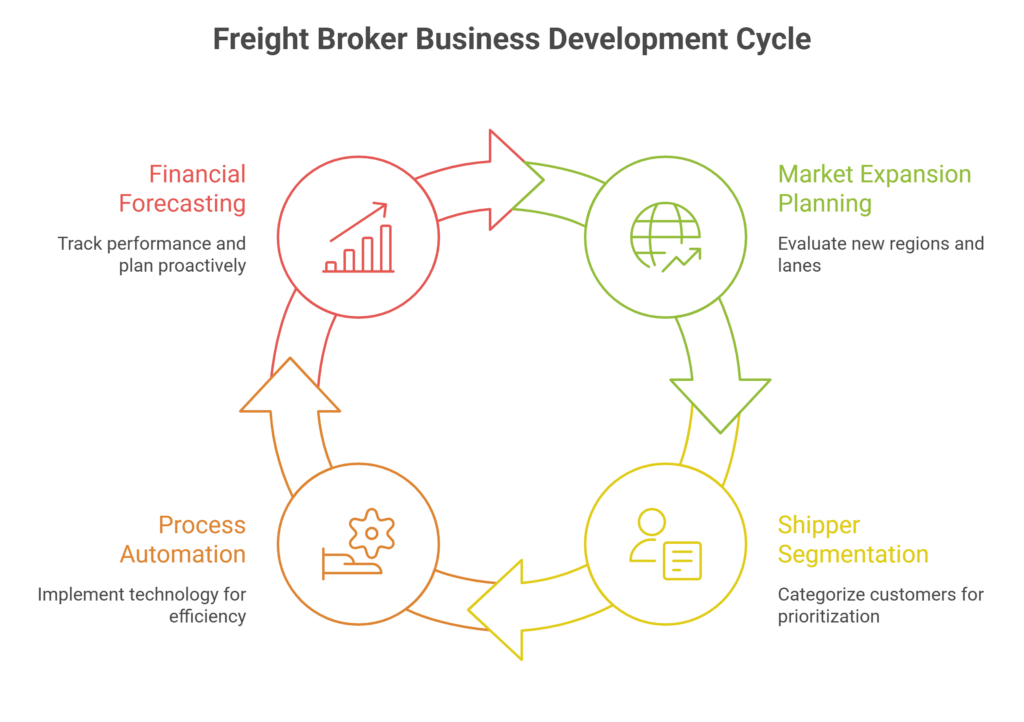
Effective freight broker business development training transforms brokers into growth-oriented entrepreneurs.
“Growth is intentional. Brokers who plan for it outperform those who react to it.”
What systems would need to change for your brokerage to grow sustainably?
Webinars, Workshops, and Industry Events
Ongoing learning doesn’t always require long-term programs. Freight broker webinars and workshops provide timely insights, while freight broker industry conferences offer deeper exposure (FreightWaves, n.d.).
Value of Live Learning Opportunities
1. Real-time market intelligence
Participating in webinars and workshops provides brokers with up-to-the-minute insights into freight trends, pricing fluctuations, and capacity issues. This knowledge allows brokers to make informed decisions quickly and capitalize on emerging opportunities.
2. Exposure to new technologies
Live learning sessions often showcase new tools, software, and logistics technologies. Brokers can explore TMS platforms, digital tracking solutions, automation tools, and other innovations that improve operational efficiency and provide a competitive edge.
3. Peer learning and collaboration
Attending industry events connects brokers with peers, mentors, and industry leaders. These interactions foster knowledge exchange, problem-solving collaboration, and sharing of best practices, enabling brokers to learn from real-world experiences and avoid common mistakes.
Regular participation in freight broker webinars and workshops and attendance at freight broker industry conferences keeps brokers aligned with industry trends.
“The brokers who show up consistently are the ones who spot opportunities first.”
Which type of live learning experience delivers the most value for you?
Networking and Professional Associations
Relationships drive opportunity. Freight broker networking and professional associations provide access to peers, carriers, and industry leaders (ATA, n.d.).
Benefits of Professional Association
1. Peer benchmarking and knowledge exchange
Active participation in professional associations allows brokers to compare performance, strategies, and operational approaches with their peers. This benchmarking helps identify areas for improvement, adopt best practices, and stay informed about industry trends.
2. Advocacy and industry representation
Professional associations often represent the interests of brokers in legislative, regulatory, and policy matters. Members benefit from collective advocacy, staying informed about changes that could affect operations, compliance, or market conditions, and gaining a voice in industry decision-making.
3. Collaboration and referral opportunities
Associations provide structured networking that facilitates collaboration on shared challenges, joint ventures, and referral partnerships. Brokers can leverage these connections to find new clients, access reliable carriers, and create mutually beneficial business opportunities.
Active involvement in freight broker networking and professional associations strengthens credibility and visibility.
“Your network often determines your net worth in freight brokerage.”
How intentionally are you building relationships within the industry today?
Online Training Programs and Digital Learning
Flexibility matters for independent brokers. Freight broker training programs delivered digitally, including online freight broker courses, allow brokers to learn at their own pace.
Advantages of Online Learning
1. On-demand access to expert instruction
Online courses allow brokers to learn from industry experts at any time, accommodating varied schedules. This flexibility ensures learning is continuous, enabling brokers to pause, revisit, or accelerate lessons as needed, which is particularly valuable for independent operators managing multiple priorities.
2. Scalable learning for teams
Digital platforms make it easy for brokerages with multiple staff or agents to access consistent training simultaneously. Brokers can roll out courses across teams, standardize processes, and ensure everyone is aligned on operational best practices, negotiation strategies, and compliance requirements.
3. Cost-effective skill development
Online learning reduces expenses related to travel, lodging, and time away from operations. Brokers gain access to high-quality instruction and resources at a fraction of the cost of in-person programs, allowing for a higher return on investment while still achieving professional development goals.
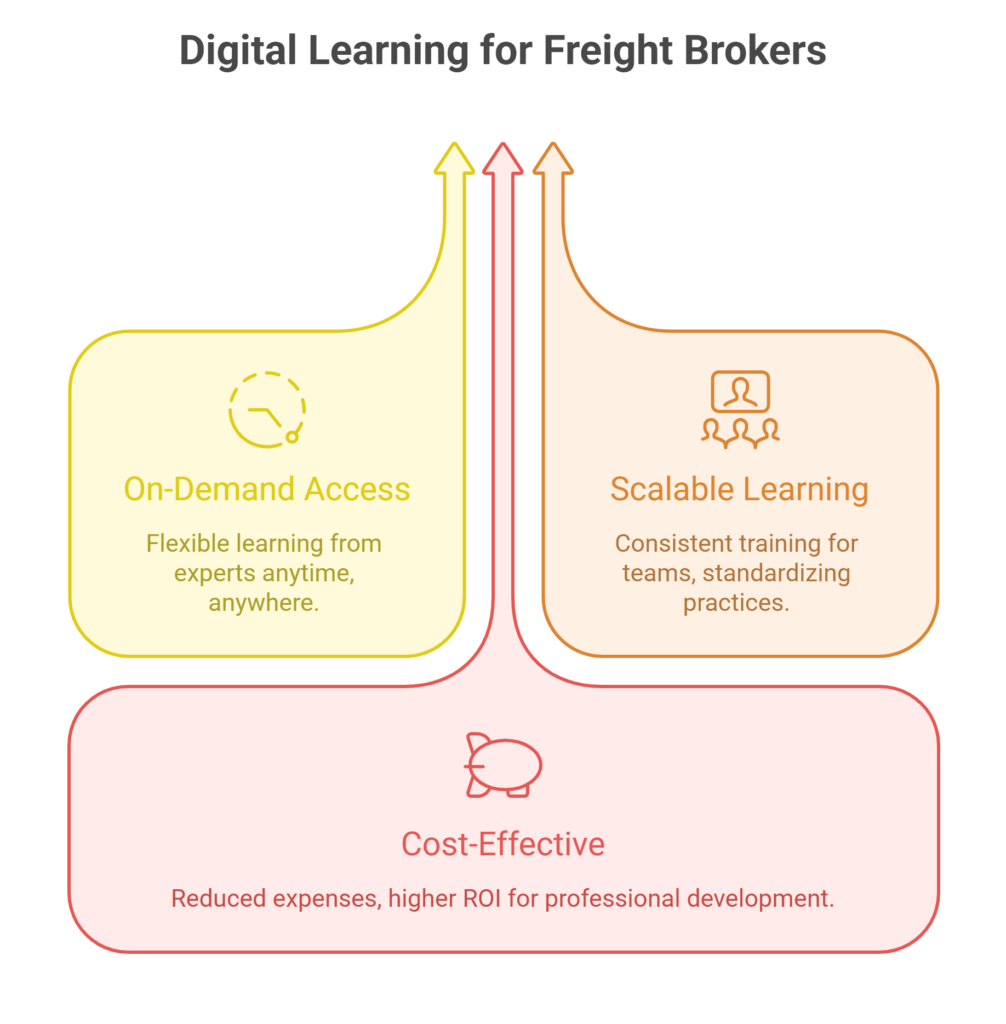
Modern freight broker training programs increasingly combine recorded content, live sessions, and community forums within online freight broker courses.
“The best online education blends flexibility with accountability.”
How could structured online learning fit into your weekly workflow?
Frequently Asked Questions (FAQs)
1. What professional development opportunities are best for new versus experienced brokers?
New brokers benefit from foundational freight broker training programs, while experienced professionals gain more from advanced freight broker training for experienced brokers and mentorship.
2. Are freight broker certifications required to succeed?
No, but freight broker certification options can enhance credibility, especially when paired with continuing education for freight brokers.
3. How often should brokers invest in professional development?
Ongoing learning through freight broker webinars and workshops, annual conferences, and periodic training ensures long-term relevance.
Build a Future-Ready Freight Brokerage
The most successful independent brokers treat learning as a continuous strategy, not a one-time event. By developing freight broker leadership and management skills, engaging in freight broker mentorship programs, and pursuing advanced freight broker training for experienced brokers, brokers position themselves for sustainable growth.
Whether through certifications, sales training, compliance education, or networking, professional development for freight brokers is the engine that drives resilience, profitability, and long-term success in an ever-evolving freight market.
Ready to elevate your brokerage with expert guidance and ongoing training? Contact us to strengthen your team and grow your business with confidence.
References
American Trucking Associations. (n.d.). Retrieved from https://www.trucking.org
FreightWaves. (n.d.). Retrieved from https://www.freightwaves.com
Inbound Logistics. (n.d.). Freight Broker Training and Development.Retrieved from https://www.inboundlogistics.com
Transport Topics. (n.d.). Retrieved from https://www.ttnews.com