
Finding consistent, reliable shippers is one of the biggest challenges for any freight brokerage, especially in a crowded and competitive market. If you’ve ever asked yourself what are the most effective strategies for finding new shippers for my freight brokerage? you’re not alone.
The good news is successful brokers aren’t relying on luck. They use repeatable systems, smart outreach, and relationship-focused tactics to uncover opportunities others miss (Logistics Management Association, n.d.). Below is a practical, field-tested breakdown of strategies to find new shippers for freight brokers, designed to help you land direct freight, qualify better leads, and grow sustainably.
Master Direct Outreach With Purpose
Direct outreach remains one of the fastest ways to control your pipeline, but only when done strategically.
Cold Calling That Converts
Using proven freight broker cold calling scripts for shippers helps you stay confident, consistent, and value-focused. The goal isn’t to sell immediately, but to:
- Identify shipping pain points
- Understand lanes, volumes, and challenges
- Open the door for follow-up conversation
Effective scripts focus on why you’re calling, not just what you offer. Over time, refining freight broker cold calling scripts for shippers based on objections and responses dramatically improves conversion rates (Transportation Sales Institute, n.d.).
Email Outreach That Gets Read
Well-planned email outreach campaigns for freight broker shippers support cold calls and warm up leads before you ever pick up the phone. Strong campaigns:
- Speak directly to the shipper’s industry
- Address capacity, service, or cost challenges
- End with a simple, low-pressure CTA
When aligned with calls, email outreach campaigns for freight broker shippers create familiarity instead of friction.
“Quality outreach beats volume. Brokers who research lanes and pain points before using freight broker cold calling scripts for shippers consistently book more meaningful conversations than those relying on generic pitches.”
How much of your current outreach is personalized to the shipper’s lanes, industry, or pain points, and what small changes could immediately increase response rates?
Leverage Relationships, Not Just Transactions
Freight brokerage is still a relationship business at its core.
Build Trust Early
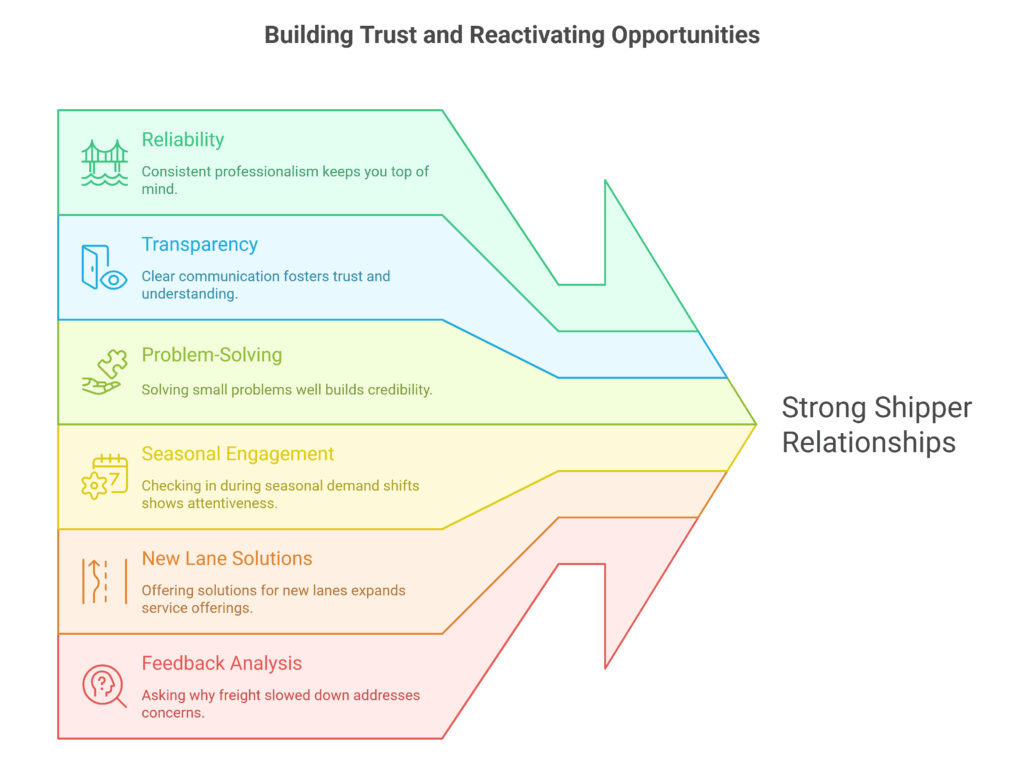
Building shipper relationships as a new freight broker means leading with reliability, transparency, and follow-through. Even if a shipper doesn’t move freight with you immediately, consistent professionalism keeps you top of mind (Supply Chain Council, n.d.).
Strong building shipper relationships as a new freight broker often starts with:
- Honest capacity assessments
- Clear communication
- Solving small problems well
Re-Engage Dormant Opportunities
Many brokers overlook one of the easiest growth channels: reactivating past shippers for more freight loads. These shippers already know you, which lowers resistance significantly.
Successful reactivating past shippers for more freight loads strategies include:
- Checking in during seasonal demand shifts
- Offering solutions for new lanes
- Asking why freight slowed down in the first place
“Building shipper relationships as a new freight broker is won through reliability and communication during disruptions, not just competitive pricing during smooth moves.”
Wondering what successful freight agents do differently when it comes to building lasting shipper relationships? Learn how top performers create trust, handle disruptions, and grow accounts long-term by applying the same principles outlined here.
Use Smart Prospecting Channels (Not Just One)
Relying on a single channel limits visibility. The strongest brokers diversify.
Industry Events and Trade Shows
Trade show networking to find shippers allows you to meet decision-makers face-to-face, which accelerates trust. Before attending:
- Research exhibitor lists
- Identify industries aligned with your strengths
- Prepare targeted talking points
Done right, trade show networking to find shippers can outperform weeks of cold outreach (Supply Chain Council, n.d.).
Digital Prospecting on LinkedIn
LinkedIn lead generation for freight brokers is ideal for researching prospects before outreach. It helps you:
- Identify shipping managers and operations leaders
- Personalize messaging
- Stay visible through content and engagement
Local and Niche-Based Prospecting
Tactics like local manufacturer prospecting for freight brokers and niche targeting to find high value shippers help you avoid competing on price alone. Focus on industries where you understand:
- Seasonality
- Compliance requirements
- Specialized equipment needs
“Trade show networking to find shippers only works when brokers arrive with clear targets and follow up quickly after the event.”
Do you approach industry events and local manufacturer prospecting with clear goals and follow-up plans, or are valuable contacts being lost after the first conversation?
Know When (and How) to Use Load Boards Strategically
Load boards are often misunderstood in shipper prospecting. While they’re typically seen as carrier-facing tools, using load boards to find new shippers can give freight brokers powerful market intelligence when used correctly.
The key is knowing load boards are not for chasing freight, they’re for spotting patterns.
1. Identify Repeated Shipper Activity
When the same shipper or facility appears frequently on load boards, it’s rarely accidental. Repetition often signals:
- Overflow freight during peak demand
- Gaps in their carrier network
- Inconsistent broker support
Tracking repeated shipper names allows you to build a shortlist of prospects who already need help, making your outreach far more relevant than cold guessing (Freight Data Analytics Group, n.d.).
This is one of the most underutilized advantages of using load boards to find new shippers.
2. Analyze Lane Consistency
Consistent origin–destination lanes tell you a lot about a shipper’s operation:
- Regular production schedules
- Predictable shipping volumes
- Potential for contract or mini-bid opportunities
When you see the same lanes posted week after week, it’s a signal that the shipper may lack:
- Stable carrier commitments
- Pricing consistency
- Capacity during certain days or seasons
Instead of pitching general brokerage services, you can reference specific lanes and timing, instantly differentiating yourself from generic outreach.
3. Spot Chronic Coverage Problems
Loads that sit unbooked, get reposted multiple times, or bounce between brokers usually indicate:
- Unrealistic pricing
- Poor communication with carriers
- Time-sensitive freight with weak contingency planning
These situations create opportunity. Shippers dealing with chronic coverage issues are often more open to conversations about:
- Backup capacity strategies
- Dedicated or semi-dedicated solutions
- Lane-specific carrier sourcing
This turns load boards into a diagnostic tool rather than a lead list.
4. Use Load Board Data to Improve Outreach Quality
The biggest mistake brokers make is calling a shipper and saying, “I saw your load on a board.”
That positions you as reactive, not strategic.
Instead, use insights quietly to:
- Tailor freight broker cold calling scripts for shippers
- Personalize email and LinkedIn outreach
- Demonstrate lane familiarity without revealing your source
This approach aligns load board intelligence with broader prospecting tips for freight brokerage shippers, making your outreach feel informed, not intrusive.
5. Combine With Other Prospecting Channels
Load boards work best when layered with:
- LinkedIn lead generation for freight brokers (to find the decision-maker)
- Email outreach campaigns for freight broker shippers (to warm the lead)
- Best ways to qualify shipper leads as a freight broker (to avoid bad freight)
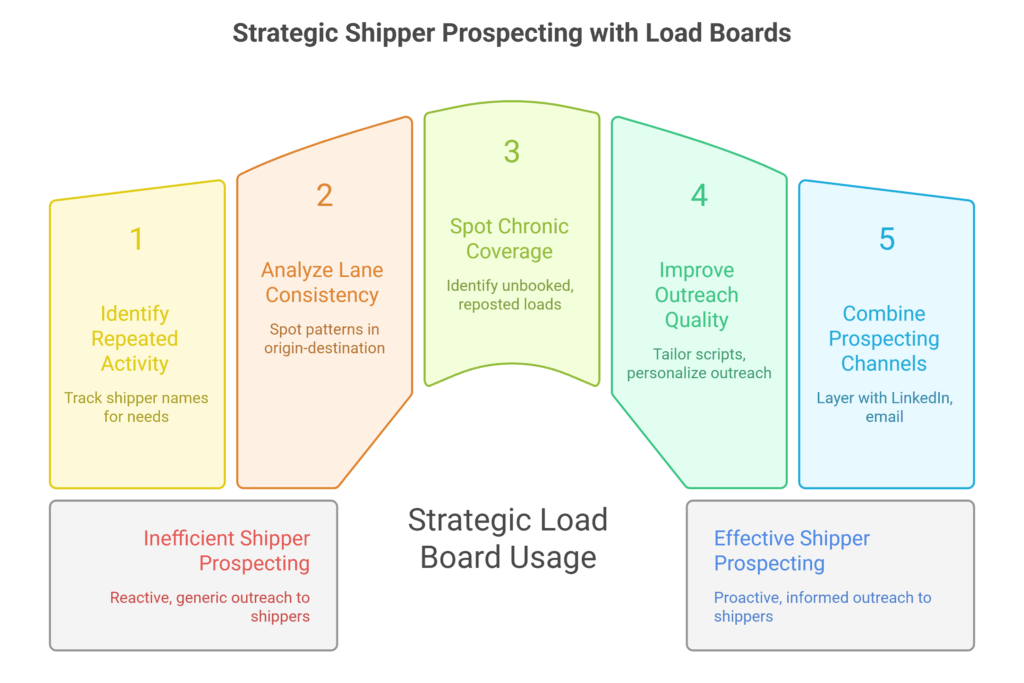
When combined properly, using load boards to find new shippers becomes a support system for smarter prospecting, not a standalone strategy (Freight Data Analytics Group, n.d.).
“Using load boards to find new shippers is most effective when brokers analyze repeated lanes and coverage gaps instead of chasing individual spot loads.”
What patterns have you noticed on load boards that could signal long-term shipper opportunities instead of short-term spot freight?
Turn Existing Clients Into Growth Engines
The fastest trust in freight brokerage is borrowed trust. A warm introduction from a satisfied shipper instantly lowers skepticism and shortens the sales cycle.
Referral-Based Growth
Implementing referral strategies to get more shipper clients turns strong service into a scalable growth channel. Shippers are far more likely to refer you when you’ve consistently proven reliability, responsiveness, and problem-solving ability.
The best time to ask for referrals is immediately after:
- A successful on-time delivery
- A tough issue you handled without disruption
- A cost-saving or capacity solution that delivered real value
“Referral strategies to get more shipper clients work best when the request comes immediately after a service win, not during routine check-ins.”
Are you proactively asking satisfied shippers for referrals at the right moments, or leaving potential introductions on the table?
Qualify Before You Chase
One of the most common mistakes freight brokers make, especially early on, is chasing every shipper opportunity that appears. Volume can feel like progress, but without proper vetting, it often leads to thin margins, operational stress, and strained carrier relationships.
Mastering the best ways to qualify shipper leads as a freight broker is what separates scalable brokerages from those stuck in constant firefighting mode.
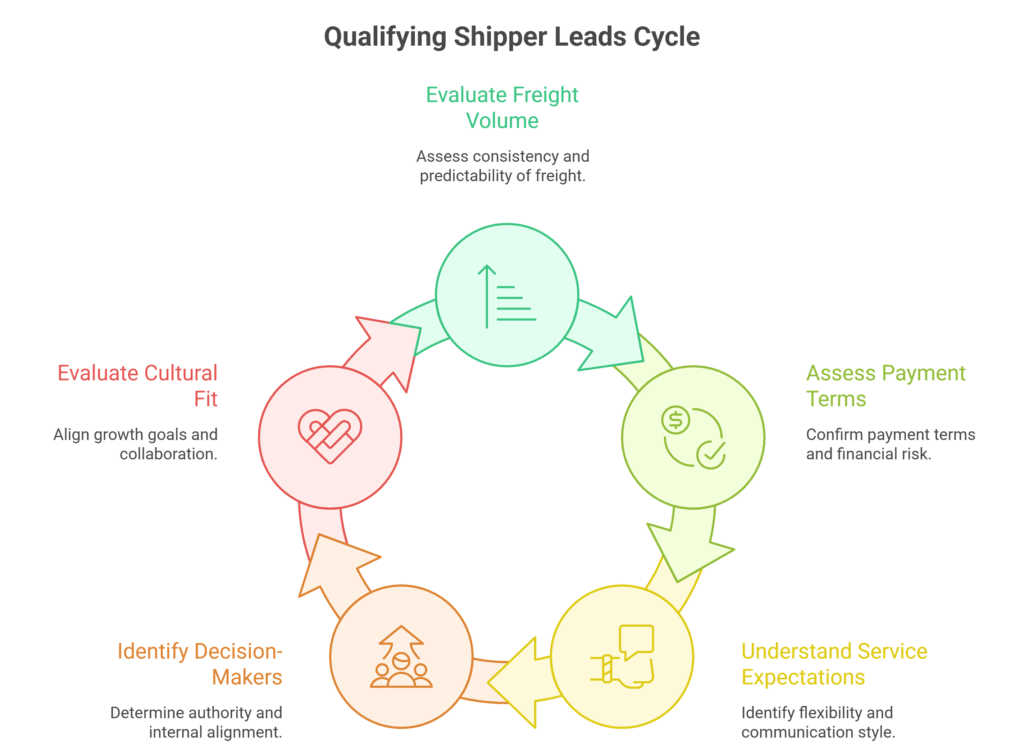
1. Evaluate Freight Volume and Lane Consistency
Start by understanding what kind of freight you’re actually being offered.
Key questions to ask:
- Is the freight recurring or one-time?
- Are lanes consistent week over week?
- Is volume predictable or highly seasonal?
Consistent lanes allow brokers to:
- Build dedicated or semi-dedicated carrier solutions
- Negotiate stronger rates
- Reduce last-minute coverage issues
One-off spot loads can still be useful, but relying on them as a growth strategy creates volatility and limits your ability to scale (Broker Risk Management Council, n.d.).
2. Assess Payment Terms and Financial Risk
Cash flow is the lifeblood of any brokerage. A shipper that moves high volume but pays slowly can quietly damage your business.
When qualifying, always confirm:
- Standard payment terms (Net 30, Net 45, etc.)
- Willingness to use quick pay or factoring-friendly terms
- Credit history and references, if available
Strong brokers understand that fast-paying shippers are often more valuable than high-volume ones. Proper financial vetting is one of the most overlooked yet critical parts of the best ways to qualify shipper leads as a freight broker (Broker Risk Management Council, n.d.).
3. Understand Service Expectations and Communication Style
Not every shipper operates the same way, and mismatched expectations can turn a good account into a constant source of friction.
Pay attention to:
- How flexible they are during delays or disruptions
- Their expectations around updates and visibility
- Whether they value solutions or just the lowest rate
Shippers who expect perfection without flexibility often create:
- Burned carrier relationships
- Margin erosion due to concessions
- Increased after-hours operational pressure
This doesn’t mean avoiding demanding customers entirely, but it does mean pricing and staffing appropriately if you choose to take them on.
4. Identify Decision-Makers and Internal Alignment
A common red flag in shipper qualification is unclear authority.
Ask:
- Who controls routing decisions?
- Who approves rates?
- Who handles issue resolution?
If you’re working with someone who lacks decision-making power, you may invest weeks quoting freight without ever securing committed volume. Clear internal alignment improves close rates and reduces wasted effort.
5. Evaluate Cultural and Strategic Fit
The strongest broker–shipper partnerships go beyond transactions.
Look for alignment in:
- Growth goals
- Long-term freight planning
- Willingness to collaborate on solutions
Shippers who view brokers as strategic partners, not just vendors, are more open to:
- Contractual commitments
- Shared forecasting
- Collaborative problem-solving
This level of alignment is what turns accounts into long-term revenue engines.
Why Qualification Enables Better Marketing and Growth
When brokers qualify leads effectively, every other growth activity improves. Cold calls become more targeted. Follow-ups become more relevant. Marketing feels intentional instead of reactive.
This is why disciplined qualification sits at the core of successful freight broker marketing strategies to attract shippers. You’re not just finding shippers, you’re finding the right shippers.
The best ways to qualify shipper leads as a freight broker focus on fit over volume, protecting margins and carrier relationships long-term.
Not sure if a shipper is the right fit for your brokerage? Explore flexible shipping solutions designed to align with your service capabilities, protect margins, and support long-term partnerships.
Frequently Asked Questions(FAQs)
1. What are the best ways to get direct shippers as a freight broker?
The most reliable methods combine direct outreach, referrals, and relationship-based selling. Learning how to get direct shippers as a freight broker requires consistency, not shortcuts.
2. Are load boards effective for shipper prospecting?
Yes, when used strategically. Using load boards to find new shippers works best when identifying repeat freight patterns rather than chasing one-off opportunities.
3. How long does it take to build a steady shipper base?
With disciplined prospecting tips for freight brokerage shippers and strong follow-up, many brokers see traction within 60–90 days, though long-term stability takes consistent effort.
Supercharge Your Shipping Pipeline
Finding new shippers isn’t about one magic tactic. It’s about stacking smart systems: outreach, networking, relationship building, and qualification. By combining cold calls, digital prospecting, event networking, and reactivation strategies, you create a pipeline that compounds over time. The brokers who win aren’t just active. They’re intentional.
Ready for more high-value shippers in your pipeline? Contact us to start building a smarter, more profitable shipping strategy.
References
- Broker Risk Management Council. (n.d.). Shipper qualification and risk assessment. Retrieved from https://www.brmcouncil.org/shipper-qualification
- Freight Data Analytics Group. (n.d.). Load board trend analysis. Retrieved from https://www.freightdataanalytics.com/load-board-trends
- Logistics Management Association. (n.d.). Freight brokerage prospecting methods. Retrieved from https://www.lma.org/prospecting-methods
- Supply Chain Council. (n.d.). Relationship management in logistics. Retrieved from https://www.supplychaincouncil.org/relationship-management
- Transportation Sales Institute. (n.d.). Cold calling frameworks for freight brokers. Retrieved from https://www.transportationsalesinstitute.com/cold-calling-frameworks