

Creating a business plan for a freight brokerage is not just a startup exercise, it’s a strategic process that defines how your company competes, operates, and scales. If you’re exploring how to write a freight brokerage business plan, the goal is to align market reality, operational discipline, and financial clarity into one cohesive roadmap (U.S. Small Business Administration [SBA], n.d.).
This guide walks through a freight broker business plan step by step, breaking down each essential component and explaining how it fits into a modern, competitive brokerage.
Start With a Strong Executive Summary
The executive summary is the most-read section of any business plan. It should quickly communicate your brokerage’s purpose, positioning, and growth potential (SBA, n.d.).
A strong freight brokerage executive summary example typically highlights:
- The problem your brokerage solves
- Your competitive advantage
- Your service focus
- High-level financial outlook
A clear freight brokerage executive summary example allows investors, partners, and lenders to understand your vision without digging into operational details.
“A strong executive summary isn’t a teaser, it’s a condensed strategy statement that proves you understand the business.”
If someone only read your executive summary, would they clearly understand why your brokerage will succeed?
Market Analysis and Industry Research
Your plan must be grounded in reality. This section validates demand and competitive opportunity through freight broker market analysis and research (Bureau of Transportation Statistics [BTS], n.d.).
Key areas to address include:
- Industry size and shipment volumes
- Capacity cycles and rate trends
- Competitive broker models
- Regulatory landscape
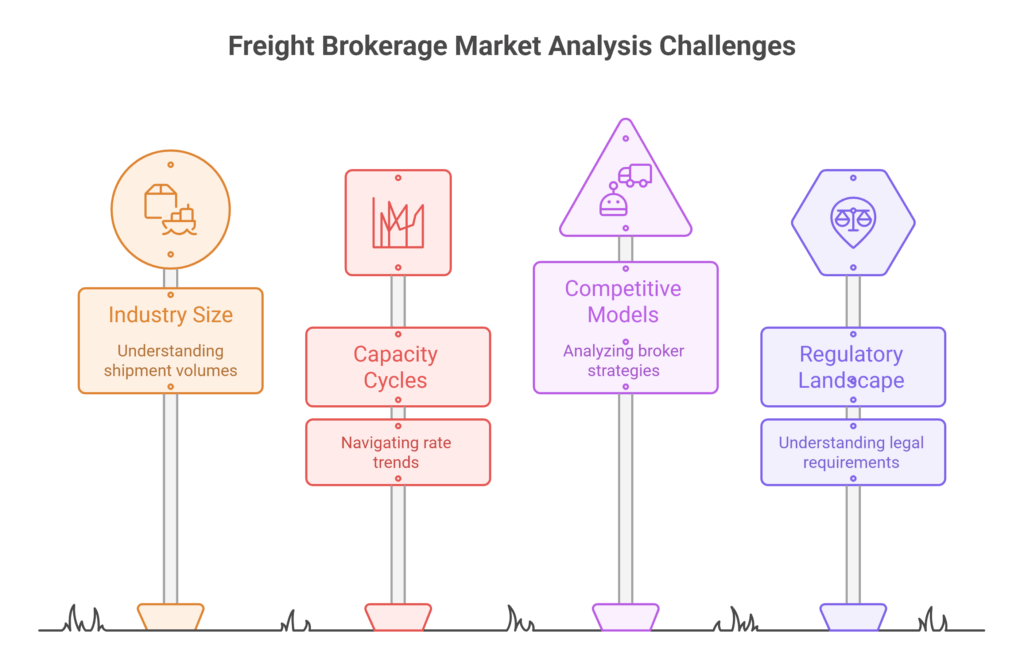
Thorough freight broker market analysis and research demonstrates that your brokerage decisions are data-driven, not speculative.
“Market research is less about predicting the future and more about avoiding blind spots.”
What assumptions about your market need stronger data to support them?
Niche and Target Market Definition
Freight brokerages that try to serve everyone usually struggle to scale. Defining a clear freight brokerage niche and target market creates operational focus and marketing efficiency (Federal Motor Carrier Safety Administration [FMCSA], n.d.).
This may include:
- Industry-specific freight
- Mode specialization
- Regional or lane concentration
A well-defined freight brokerage niche and target market improves pricing power and shipper loyalty.
“Focus is not limiting, it’s what makes growth sustainable.”
What type of freight do you understand better than your competitors?
Services and Revenue Model
This section explains how money flows through your brokerage. A clear freight brokerage services and revenue model builds trust and transparency (TIA, n.d.).
You should outline:
- Core brokerage services
- Optional value-added services
- Margin structure and pricing logic
A scalable freight brokerage services and revenue model proves that growth doesn’t rely solely on volume.
“Revenue models fail when they ignore operational cost realities.”
Which services truly add value, and which simply add complexity?
Operations Plan and SOPs
Strategy fails without execution. Your freight brokerage operations plan and SOPs define how loads are managed day-to-day.
1. Load Sourcing and Quoting
This is the starting point of every transaction. Your SOPs should clearly define how loads are sourced, evaluated, priced, and quoted to shippers (TIA, n.d.).
Key elements to document include:
- How shipper requests are received (email, TMS, phone, contracts)
- Required shipment details before quoting
- Rate calculation logic (market data, margin targets, lane history)
- Approval thresholds for discounted or high-risk loads
- Quote validity periods and documentation standards
Clear procedures prevent underpricing, inconsistent margins, and miscommunication with shippers. They also ensure that anyone on your team can generate accurate quotes using the same decision framework.
2. Carrier Onboarding and Compliance
Carrier selection is one of the highest-risk areas in freight brokerage. Your SOPs must clearly outline how carriers are vetted, approved, and monitored (FMCSA, n.d.).
This section should document:
- Required onboarding documentation (authority, insurance, W-9)
- Compliance verification steps
- Fraud and double-brokering red flags
- Carrier performance tracking criteria
- Rules for approving new or first-time carriers
By standardizing carrier onboarding, your freight brokerage operations plan and SOPs reduce exposure to fraud, claims, and service failures while protecting your brokerage’s reputation.
3. Dispatch, Tracking, and Issue Resolution
Once a load is booked, execution becomes the priority. This part of your operations plan defines how shipments are managed in real time.
You should clearly outline:
- Dispatch confirmation procedures
- Check-in and tracking frequency
- Communication protocols with shippers and carriers
- Escalation steps for delays, breakdowns, or missed appointments
- Documentation of exceptions and service failures
Well-defined dispatch and tracking SOPs ensure that problems are identified early, communicated clearly, and resolved consistently, rather than handled reactively.
4. Billing, Invoicing, and Collections
Many brokerages fail not because they lack freight—but because they lack cash flow control. Billing and collections must be treated as a core operational function.
Your SOPs should document:
- Required paperwork for invoicing
- Invoice creation timelines
- Payment terms by customer
- Carrier pay schedules
- Dispute resolution and follow-up procedures
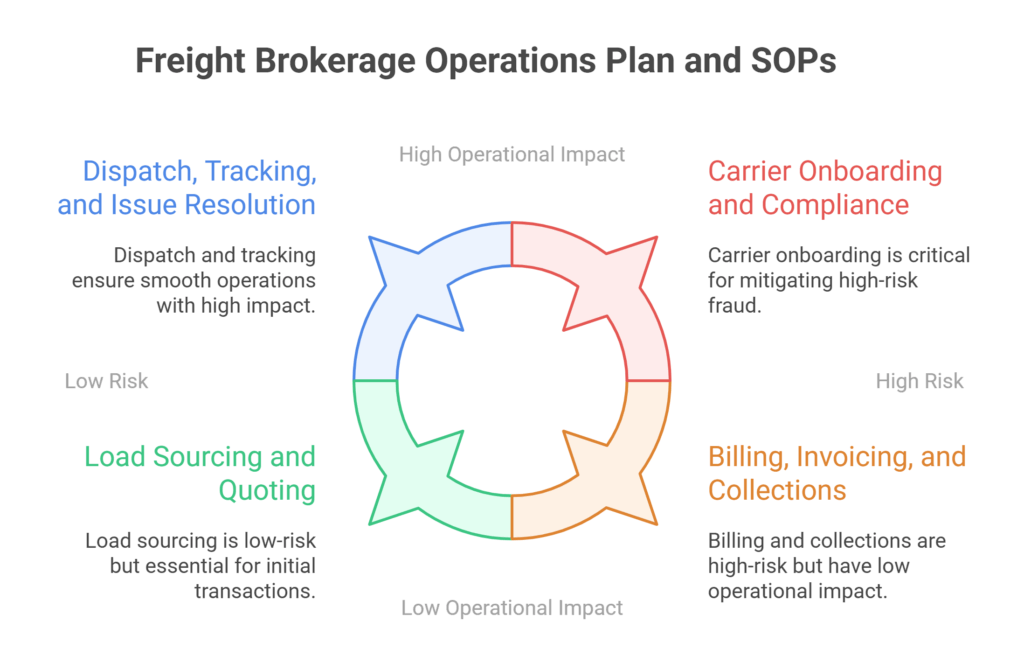
Clear billing processes ensure faster payments, fewer disputes, and better financial forecasting. They also protect relationships by setting expectations upfront.
Why SOPs Enable Scale and Stability
Documented operations do more than improve efficiency, they make growth possible. When processes are written and standardized:
- New hires onboard faster
- Remote teams operate consistently
- Errors decrease as volume increases
- Leadership can focus on strategy instead of firefighting
Well-structured freight brokerage operations plan and SOPs turn your brokerage into a system-driven business rather than a personality-driven one.
“Most brokerage problems aren’t sales problems, they’re process problems that surface once volume increases.”
Want to simplify and standardize your freight brokerage operations? Explore proven tools and support designed to help brokers build scalable systems.
Sales and Marketing Approach
Growth requires structure. Your freight broker sales and marketing strategy explains how you acquire and retain customers.
Key components include:
- Lead generation channels
- Sales messaging
- Relationship management systems
A disciplined strategy ensures sales efforts align with your market positioning (Harvard Business Review, n.d.).
“Sales consistency matters more than sales intensity.”
Is your sales process repeatable, or dependent on individual effort?
Business Goals and Milestones
Plans become actionable through measurement. Clear freight broker business goals and milestones translate vision into progress (SBA, n.d.).
Examples include:
- Revenue benchmarks
- Customer acquisition targets
- Operational efficiency metrics
Tracking freight broker business goals and milestones keeps growth intentional rather than reactive.
“Milestones turn ambition into accountability.”
Struggling to set clear growth milestones for your brokerage? Watch this video to learn how successful brokers build their business plan and scale intentionally.
Financial Planning and Startup Costs
Financial clarity is essential. This section outlines:
- Startup costs for a freight broker business
- Monthly operating expenses
- Cash flow expectations
- Financial projections for freight brokerage
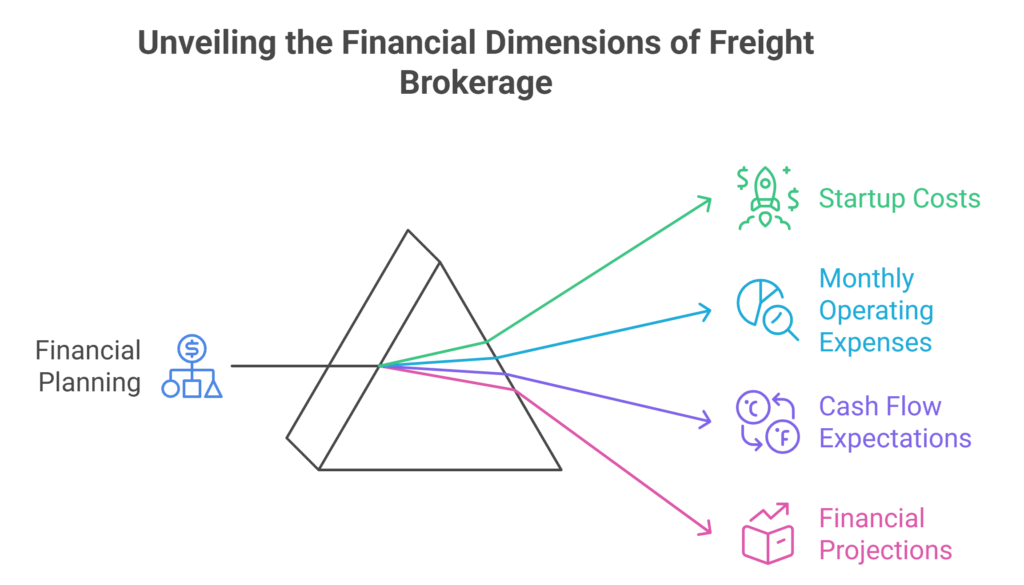
Strong financial planning prevents undercapitalization and supports informed decision-making (SBA, n.d.).
“Cash flow discipline matters more than revenue growth early on.”
How long could your brokerage operate if revenue slowed unexpectedly?
Risk Assessment and Mitigation
Freight brokerage involves risk. Addressing freight brokerage risk assessment and mitigation shows leadership maturity (FMCSA, n.d.).
Common risks include:
- Carrier fraud
- Rate volatility
- Credit exposure
- Compliance failures
Proactive freight brokerage risk assessment and mitigation builds resilience and trust.
“Risk ignored doesn’t disappear, it compounds.”
Concerned about compliance risks and carrier fraud? Learn how expert-backed risk management solutions can protect your brokerage.
Investor and Funding Readiness
If external funding is a goal, your plan must speak clearly to decision-makers. A freight broker business plan for investors emphasizes scalability, defensibility, and execution discipline.
Many founders begin with a freight broker startup business plan template, then tailor it to reflect their niche and operations.
When combined, these elements form a comprehensive freight broker business plan that supports growth, funding, and long-term stability.
“Investors fund clarity, not complexity.”
Does your plan tell a clear growth story, or just describe a business?
Frequently Asked Questions (FAQs)
1. How long should a freight brokerage business plan be?
Long enough to answer strategic, operational, and financial questions—short enough to stay practical.
2. Is a formal plan necessary for small brokerages?
Yes. Even small brokerages benefit from structured thinking and documented processes.
3. How often should a business plan be updated?
At least annually, or whenever major market or operational changes occur.
Plan With Purpose. Scale With Confidence.
A freight brokerage business plan is not a static document, it’s a strategic framework. By combining market insight, operational discipline, financial clarity, and risk awareness, you create a plan that guides decisions and builds confidence. Whether launching or scaling, a well-structured plan positions your brokerage for sustainable success.
Ready to build or refine a freight brokerage business plan that actually works? Contact us to align strategy, operations, and growth into one actionable roadmap.
References
Bureau of Transportation Statistics. (n.d.). Freight transportation statistics. Retrieved from https://www.bts.gov
Federal Motor Carrier Safety Administration. (n.d.). Freight broker regulations and compliance. Retrieved from https://www.fmcsa.dot.gov
Harvard Business Review. (n.d.). Business planning and growth strategy. Retrieved from https://hbr.org
Transportation Intermediaries Association. (n.d.). Freight brokerage best practices. Retrieved from https://www.tianet.org
U.S. Small Business Administration. (n.d.). Business planning guide. Retrieved from https://www.sba.gov