Brokering international freight is fundamentally different from domestic freight brokerage. While both involve coordinating shipments between shippers and carriers, international freight introduces additional layers of compliance, documentation, risk, and coordination that do not exist in domestic moves. Understanding these differences is critical for brokers, shippers, and agents operating across borders.
In this article, we break down how international freight brokerage differs from domestic, why those differences matter, and how experienced brokerages manage the added complexity in real-world scenarios.
What Is the Difference Between Domestic and International Freight Brokerage?
At a high level, domestic freight brokerage involves moving goods within a single country, while international freight brokerage manages shipments that cross international borders and involve multiple regulatory authorities. However, the operational differences go far beyond geography.
Domestic vs International Freight Brokerage: Key Differences
| Area | Domestic Freight | International Freight |
| Geography | Single country | Multiple countries |
| Documentation | BOL, rate confirmation | Commercial invoice, packing list, customs docs, Incoterms |
| Compliance | National regulations | Customs, trade laws, import/export rules |
| Parties Involved | Shipper, carrier, broker | Shipper, carrier, broker, forwarder, customs broker, ports |
| Risk Exposure | Moderate | Higher (delays, inspections, penalties) |
| Timeline Control | Predictable | Variable and dependency-driven |
International freight requires brokers to manage more stakeholders, more paperwork, and more risk, all while maintaining clear communication across time zones and jurisdictions (UPS, n.d.).
“International freight is not just a longer route, it’s a network of dependencies that require proactive management at every step.”
How do you ensure all parties involved in an international shipment are aligned before it leaves origin?
Why International Freight Introduces More Risk and Complexity
International freight brokerage adds layers of risk that simply don’t exist in domestic moves. These risks aren’t theoretical, they show up daily in documentation reviews, compliance checks, claims handling, and multi-party coordination (World Trade Organization, n.d.).
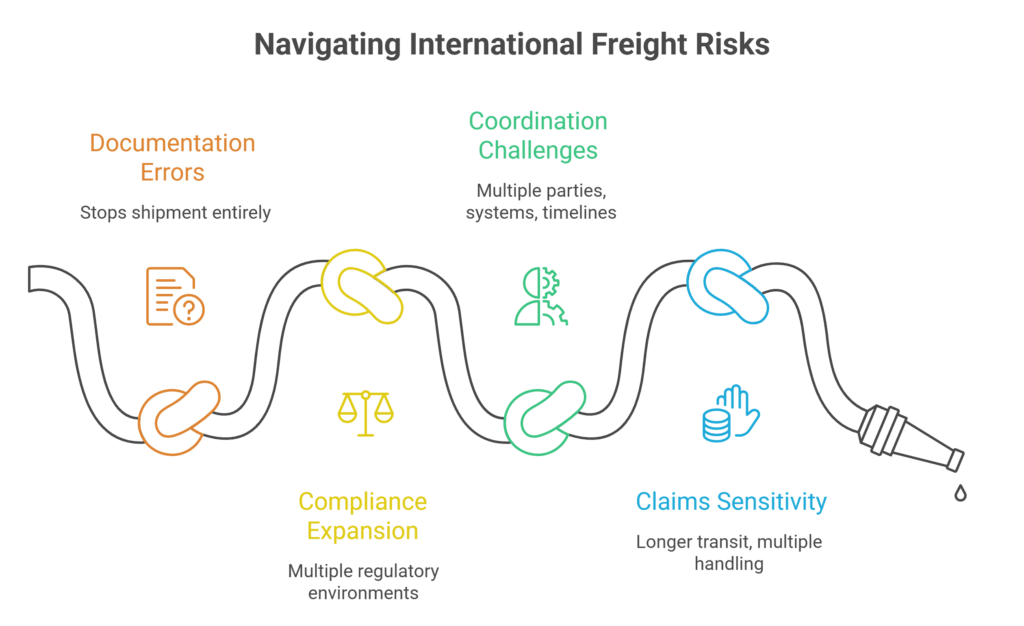
1. Documentation Errors Carry Higher Consequences
In domestic freight, documentation errors usually lead to billing corrections or minor disputes. In international freight, the same type of error can stop a shipment entirely.
In our experience brokering international freight, documentation risk increases because every document must align across multiple parties, systems, and authorities. When even one detail is off, the consequences escalate quickly.
Common documentation challenges we see include:
- Inconsistent commodity descriptions between the commercial invoice, packing list, and booking details
- Incorrect declared values, which can trigger customs holds or reclassification
- Misaligned Incoterms, leading to confusion over responsibility for costs, risk, or clearance
- Missing or incomplete documentation submitted too close to cutoff times
- Last-minute changes that aren’t communicated to all parties involved
What makes this more complex is that documentation errors are rarely caught at a single checkpoint. Instead, they surface downstream, during customs review, port processing, or carrier handoff, when correcting them is slower and more expensive.
From an operational standpoint, we’ve seen that many international delays happen before the freight even leaves the origin, simply because documentation wasn’t reviewed thoroughly enough upfront.
That’s why experienced international brokers approach documentation as a pre-move validation process, not an administrative task.
2. Compliance Expands Beyond National Regulations
From our experience brokering international freight, compliance is one of the least visible but highest-risk areas of the entire shipment process. It’s also where domestic and international freight diverge the most.
Domestic freight typically operates under a single regulatory framework. International freight, on the other hand, requires brokers to navigate multiple regulatory environments at the same time, often with overlapping or conflicting requirements.
What makes compliance especially challenging is that responsibility is rarely held by one party alone. Instead, it’s distributed across shippers, brokers, carriers, freight forwarders, and customs brokers, which means gaps can easily form if roles aren’t clearly defined.
In practice, compliance risk increases due to factors like:
- Export regulations at origin, including licensing, commodity restrictions, and declaration accuracy
- Import regulations at destination, which vary widely by country and commodity
- Customs classification requirements, where misclassification can trigger audits, penalties, or delays
- Security and screening rules, particularly for certain commodities or regions
- Changing trade policies, which can impact documentation or clearance requirements with little notice
One of the most common issues we see is the assumption that if a shipment is compliant on the export side, it will automatically be compliant on the import side. That’s rarely the case.
In real-world scenarios, shipments can be delayed or rejected not because of intentional non-compliance, but because:
- Required documentation was technically complete but not aligned with destination-country interpretation
- A commodity was described correctly for shipping purposes but incorrectly for customs classification
- A license or declaration was assumed unnecessary based on past moves, despite updated regulations
From an operational standpoint, compliance failures are especially costly in international freight because they tend to surface late in the process, often when the shipment is already at port or in transit. At that stage, options become limited, timelines stretch, and costs increase.
That’s why experienced international brokers treat compliance as an ongoing verification process, not a one-time check.
3. Why Coordination Becomes More Challenging in International Freight
From our experience brokering international freight, coordination is often the most underestimated source of delays and breakdowns. While domestic freight usually requires alignment between a shipper, carrier, and broker, international freight introduces multiple additional parties, each with their own systems, timelines, and priorities.
The complexity doesn’t come from any single handoff. It comes from managing all of them together, in the correct order, with accurate information flowing across every party involved.
In practice, international freight coordination becomes more challenging because it often involves:
- Freight forwarders managing international legs and bookings
- Customs brokers handling clearance at destination (and sometimes origin)
- Ocean or air carriers operating on fixed cutoff schedules
- Port and terminal operators with limited flexibility once freight arrives
- Inland carriers responsible for first-mile and last-mile moves
Each party relies on accurate, timely information from the others. When that information is delayed, incomplete, or inconsistent, the entire shipment is impacted.
One of the most common issues we see is that documentation or booking updates are communicated to one party but not cascaded across the full chain. A small change such as an updated pickup time, container number, or document revision, can create downstream confusion if every stakeholder isn’t aligned.
From an operational standpoint, coordination challenges often show up as:
- Missed port or vessel cutoffs due to late documentation or booking confirmation
- Delays caused by customs brokers waiting on information that another party assumed was already shared
- Inland carriers arriving before clearance is complete, resulting in idle time or rescheduling
- Conflicting instructions between origin and destination teams
Time zones add another layer of complexity. When parties are operating across different regions, delays in communication can stretch from hours into days if issues aren’t escalated quickly.
That’s why experienced international brokers approach coordination as an active, hands-on process, not a passive one.
4. Claims and Disputes Become More Sensitive
Claims exposure increases significantly with international freight due to longer transit times, multiple handling points, and varying liability frameworks.
In real-world scenarios, how claims are handled matters just as much as the claim itself. When agents or customers engage directly in disputes under pressure, communication can escalate quickly, increasing risk for everyone involved.
That’s why structured claims handling, with clear separation between agents and claims teams, becomes especially important in international brokerage. Controlled communication protects both relationships and outcomes.
“Every additional handoff in an international shipment multiplies the chance for delays, errors, and regulatory complications.”
Which risk do you think impacts international shipments the most: documentation errors, regulatory compliance, or coordination challenges?
How Does Operational Support Impact International Freight Brokerage?
Because international freight has more failure points, support speed and structure become critical.
In our experience, agents transitioning from other organizations often cite lack of internal support as a major challenge when handling complex shipments.
One consistent piece of feedback we hear is about response time. Agents regularly note that when they reach out for operational support, calls and emails are typically addressed within five to ten minutes, especially when an issue requires immediate action.
That responsiveness matters in international freight. Documentation discrepancies, customs questions, or carrier issues can escalate quickly if they’re not addressed in real time.
Real-World Agent Insight: Claims Handling in High-Risk Shipments
International freight also increases claims exposure, making how claims are handled especially important.
An agent recently shared that at a previous organization, claims handling was largely left to the agent. This meant agents had to communicate directly with drivers and carriers under pressure, often while emotions were running high.
At SPI, the process is intentionally different.
When a claim arises, agents are instructed to step back and allow the dedicated claims team to take over. This separation protects both the agent and the brokerage. Claims conversations can quickly become heated, and statements made in emails or calls can later be used against the broker during claim reviews or declinations.
By centralizing claims handling:
- Communication remains controlled and professional
- Risk exposure is reduced
- Agents can focus on customer relationships instead of disputes
This structure becomes even more critical in international freight, where liability, documentation, and jurisdictional complexity are higher than in domestic moves.
“Fast, structured operational support is the difference between a shipment arriving on time or getting stuck at a port halfway across the world.”
Looking for reliable back-office support to keep your international shipments on track? Discover our solutions
How Do Brokers Manage International Freight Effectively?
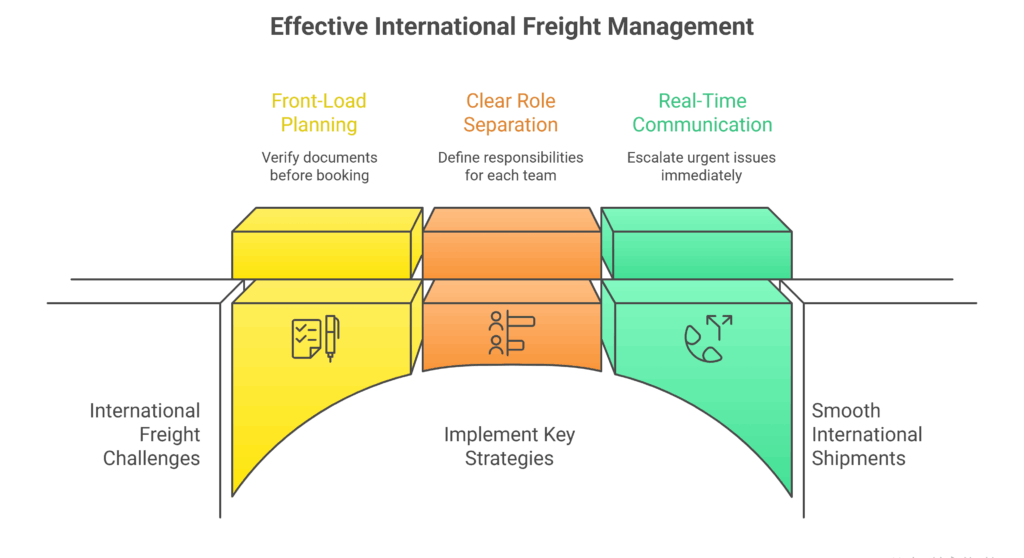
Step 1: Front-Load Planning and Documentation
In international freight brokerage, most problems don’t start in transit, they start before the shipment is ever booked. From our experience, the single most effective way to reduce delays, claims, and escalation later in the process is to front-load planning and documentation (C.H. Robinson, n.d.).
Unlike domestic freight, international shipments leave very little room for correction once they’re in motion. A mistake that could be fixed mid-route domestically often becomes expensive or irreversible once a shipment reaches a port or border.
Key practices for front-loading planning include:
- Verifying documents before booking: Ensure commercial invoices, packing lists, weights, and commodity descriptions are accurate and consistent. Even minor inconsistencies can trigger customs holds.
- Aligning Incoterms with shipper expectations: Misunderstood Incoterms can create confusion over responsibility for costs, risk, or customs clearance. Clarifying this upfront prevents costly disputes later.
- Confirming customs requirements early: Identify licenses, permits, or commodity-specific rules at both origin and destination. Early confirmation prevents delays at port or border.
- Pre-emptive problem checks: Identify potential bottlenecks, such as carrier cutoff times or documentation deadlines, and address them before shipment departure.
Real-World Example: A client was shipping high-value electronics from the U.S. to South America. During pre-move planning, we noticed that the declared values on the commercial invoice didn’t match the packing list. We coordinated with the shipper and carrier to correct the discrepancy before booking, preventing what could have been a multi-day customs hold. By catching this early, the shipment left on schedule, and the client avoided extra fees or inspection delays.
Front-loading planning isn’t just paperwork, it’s risk management in action, and it’s a key reason international freight requires more structure than domestic moves.
Step 2: Clear Role Separation
In international freight brokerage, clear role separation isn’t about hierarchy, it’s about risk control and consistency. From our experience, shipments are far more likely to stay on track when everyone involved understands what they own and what they don’t (UPS, n.d.).
International moves introduce higher-pressure situations: documentation questions, customs delays, carrier disputes, and claims exposure. When roles blur in those moments, communication often breaks down and risk increases.
That’s why effective international operations rely on clearly defined responsibilities:
- Agents manage customer relationships, setting expectations, providing updates, and serving as the primary point of contact for shippers. This keeps communication clear and prevents conflicting messages.
- Operations teams coordinate execution, ensuring documentation, bookings, and handoffs between parties stay aligned throughout the shipment lifecycle.
- Claims teams handle disputes and liability, managing sensitive conversations and documentation in a controlled way to reduce exposure during claims review.
Real-World Example: Recently, one of our agents was handling an urgent shipment from the U.S. to Europe. The shipper discovered a discrepancy in the commercial invoice two hours before the vessel cutoff. Thanks to role separation, the agent immediately communicated the issue to operations, who coordinated with the freight forwarder and customs broker to correct the documentation. Meanwhile, the claims team monitored the process in case any issues escalated. Because each team focused on its area of responsibility, the shipment departed on time, the shipper remained informed and satisfied, and potential liability was avoided entirely.
By allowing specialized teams to handle their respective responsibilities:
- Communication remains professional and consistent
- Agents stay focused on service and relationships
- Risk is reduced during high-stakes situations
In international freight, where timelines are tight and the margin for error is small, clear role separation helps prevent small issues from turning into costly problems.
Step 3: Real-Time Communication and Escalation
Even with excellent planning and role separation, international freight is unpredictable. Delays, documentation questions, or carrier issues can surface at any moment. From our experience, real-time communication and rapid escalation are essential to prevent minor issues from becoming major disruptions.
International shipments often involve multiple parties across time zones, including carriers, forwarders, customs brokers, and inland transport providers. Each handoff is a potential point of failure if information isn’t communicated quickly and clearly.
Operational best practices for real-time communication include:
- Centralizing communication channels: Avoid multiple conflicting emails or calls. A single point of contact ensures everyone is on the same page.
- Escalating urgent issues immediately: Time-sensitive issues like a customs hold, a missing document, or a carrier delay, must be flagged and addressed without waiting.
- Maintaining proactive updates: Even if there’s no resolution yet, keeping shippers and stakeholders informed reduces confusion and frustration.
- Tracking and documenting decisions: Quick decisions need to be recorded clearly to prevent disputes or misinterpretation later.
Real-World Example: An agent recently managed a shipment from the U.S. to Europe where customs flagged a certificate issue just hours before cutoff. The agent immediately alerted operations, who contacted the customs broker while keeping the shipper informed. Meanwhile, our claims team monitored the situation to ensure no liability exposure. Thanks to fast escalation and centralized communication, the shipment cleared customs and boarded the vessel on time, avoiding additional fees and delays.
In international freight, response time directly affects outcomes. Rapid communication and structured escalation prevent small issues from escalating into costly, time-consuming problems, and ensure shipments move efficiently across borders.
“Effective international brokerage is built on three pillars: thorough planning, clear role separation, and real-time escalation.”
Want to simplify complex international freight operations and reduce risk? Explore our freight solutions
What Are Common Mistakes When Brokering International Freight?
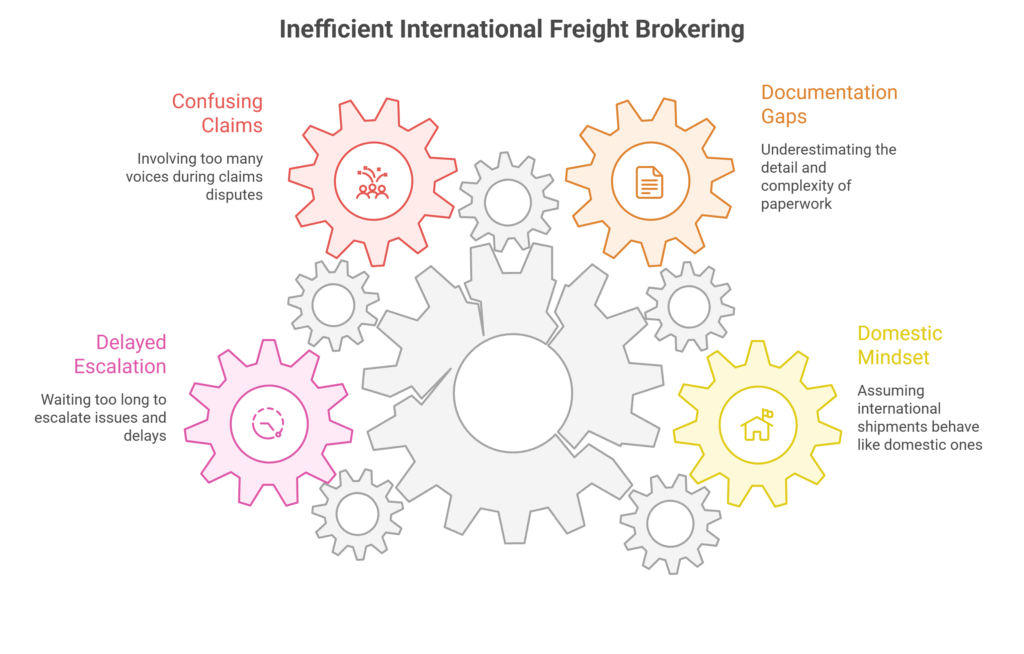
Based on real operational experience, common mistakes we see in international freight brokerage often don’t come from lack of effort, they come from assuming international shipments behave like domestic ones or from gaps in process and structure.
Here’s a deeper look at the most frequent issues:
- Treating international freight like domestic freight: Many brokers new to international shipments assume that domestic processes will work overseas. In practice, this is rarely the case. For example, a shipment may clear customs quickly on one leg but hit unexpected regulatory or documentation hurdles at the destination. If a broker treats it like a domestic move, they might fail to pre-validate documentation or confirm Incoterms, leading to delays that could have been prevented with early planning (C.H. Robinson, n.d.; Flexport, n.d.).
- Underestimating documentation requirements: International freight requires far more detailed paperwork than domestic shipments. Missing or inconsistent commercial invoices, packing lists, or certificates can trigger customs holds, inspections, or penalties. We’ve seen situations where shipments were ready to move, but a simple mismatch between the packing list and invoice caused multi-day delays all of which could have been avoided if documents had been reviewed and cross-checked upfront.
- Involving too many voices during claims disputes: In international freight, disputes can escalate quickly due to liability differences and multi-party involvement. When too many people weigh in; agents, carriers, shippers, and forwarding partners, communications can become confusing or contradictory. From our experience, this often leads to miscommunication and unnecessary escalation. Structured claims handling, where a dedicated team manages disputes while agents focus on customer communication, prevents confusion and reduces risk exposure.
- Waiting too long to escalate issues: Delays in escalation are particularly costly in international freight. For instance, if a customs question or carrier delay isn’t flagged immediately, a shipment can miss vessel cutoffs, incur storage fees, or trigger compliance issues. We’ve seen that even a few hours of delayed escalation can snowball into days of disruption. Fast, proactive escalation paired with real-time communication consistently mitigates these risks.
By understanding these common pitfalls and applying structured processes, clear role definitions, and early planning, brokers can avoid preventable disruptions and maintain smooth international operations.
Frequently Asked Questions(FAQs)
1. Is international freight brokerage riskier than domestic?
Yes. International freight involves more parties, more regulations, and higher exposure to delays and claims.
2. Can domestic brokers handle international freight?
They can, but only with proper support systems, compliance knowledge, and operational structure.
3. Why is claims handling more sensitive in international freight?
Because liability rules, documentation standards, and jurisdictions vary, making miscommunication far more costly.
Expand Without Risk
The key difference between domestic and international freight brokerage isn’t just distance, it’s complexity. International freight requires stronger planning, faster support, tighter communication, and clearer role separation.
Brokerages that treat international freight as an extension of domestic operations often struggle. Those that build dedicated processes, support systems, and experienced teams are better positioned to manage risk and deliver consistent outcomes.
Ready to grow your brokerage into international markets with confidence? Contact us to implement expert-backed systems for smooth cross-border operations.
References
C.H. Robinson. (n.d.). International shipping services. Retrieved from https://www.chrobinson.com
Flexport. (n.d.). How international freight forwarding works. Retrieved from https://www.flexport.com
UPS. (n.d.). International freight services. Retrieved from https://www.ups.com
World Trade Organization. (n.d.). Trade regulations and compliance. Retrieved from https://www.wto.org