Understanding how much it costs to start a freight brokerage is one of the most important steps before entering the logistics industry. While freight brokering offers low asset requirements and strong earning potential, many new brokers underestimate the common startup costs for freight brokers, leading to cash flow stress or early shutdowns (FMCSA, n.d.).
This guide delivers a realistic, detailed, and practical freight broker startup budget breakdown, covering licensing, bonding, software, office setup, and operational expenses, so you can plan accurately, launch smartly, and scale sustainably.
Freight Broker Licensing & Business Registration Costs
Licensing is the legal foundation of your brokerage. Freight broker licensing costs FMCSA requirements are federally mandated and must be completed before you can operate or invoice shippers (FMCSA, n.d.).
What You’re Paying For
1. FMCSA Authority Application (OP-1 Form)
The FMCSA requires all freight brokers to apply for operating authority using the OP-1 application.
- Cost: $300 (one-time, non-refundable)
- Paid to: Federal Motor Carrier Safety Administration (FMCSA)
- Purpose: Grants you legal authority to operate as a freight broker in interstate commerce
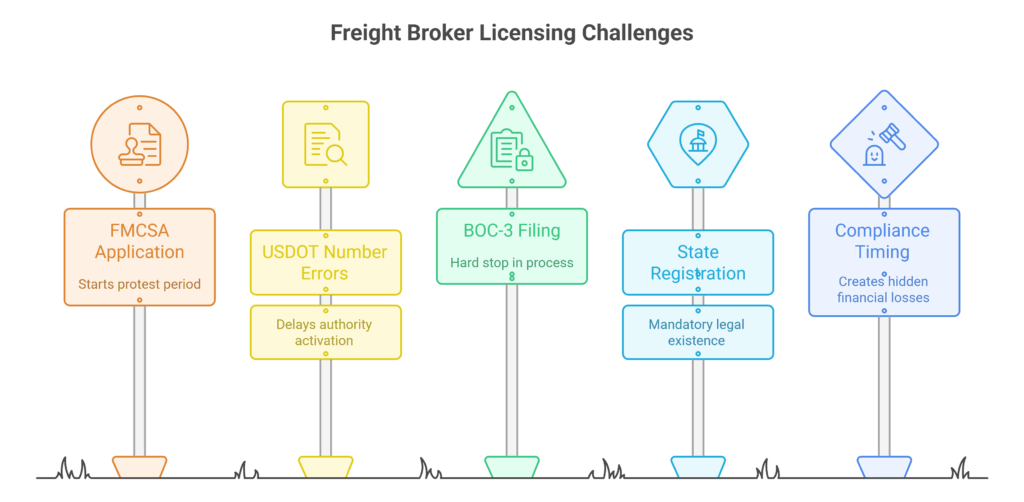
This $300 fee is often misunderstood. It does not activate your authority immediately. Instead, it:
- Starts a mandatory 21-day public protest period
- Triggers additional compliance requirements (bond + BOC-3)
- Begins the clock for completing all remaining steps
Even if your application is denied or delayed, the fee is not refunded, making it a fixed part of freight broker business registration and licensing fees.
Important: Filing this too early, which is before securing bonding, can result in paying for inactive authority time.
2. USDOT Number (Required but Free)
While freight brokers do not operate trucks, the FMCSA still assigns a USDOT number during registration.
- Cost: $0
- Purpose: Identifies your business in federal transportation systems
- Requirement: Mandatory for compliance tracking and public records
Although free, errors in USDOT registration (wrong business name, address mismatches) are a common reason authority activation gets delayed, an indirect cost many new brokers overlook.
3. BOC-3 Process Agent Filing
The BOC-3 filing designates legal representatives (process agents) in every U.S. state who can accept legal documents on your behalf.
- Cost: $20–$50 (one-time, with annual renewals sometimes bundled)
- Filed by: Authorized process agent companies
- Requirement: FMCSA will not activate authority without i
This filing protects shippers and carriers by ensuring there is always a legal point of contact for disputes. Though inexpensive, it is a hard stop in the licensing process.
4. State-Level Business Registration (LLC or Corporation)
Before or during FMCSA registration, your business must exist legally at the state level.
Typical costs include:
- LLC or Corporation filing: $100–$800 (varies by state)
- Annual reports & renewals: $50–$300/year
- Registered agent fees (if used): $50–$150/year
These costs are part of freight broker business registration and licensing fees, not FMCSA fees, but they are equally mandatory (National Association of Small Trucking Companies, n.d.).
Choosing an LLC is common because it:
- Protects personal assets
- Simplifies tax reporting
- Improves credibility with banks and surety providers
5. Compliance Timing & Hidden Costs
While the visible costs are easy to list, timing mistakes create hidden financial losses, such as:
- Paying bond premiums while authority is inactive
- Missing shipper opportunities due to delayed approval
- Paying refiling or amendment fees for errors
This is why licensing-related expenses play a crucial role in the average first year cost for freight broker businesses, even though they seem small on paper.
Total Estimated Licensing & Registration Cost Range
When combined, realistic licensing costs look like this:
- FMCSA OP-1 filing: $300
- BOC-3 filing: $20–$50
- State registration (LLC): $150–$800
- Misc. compliance/admin fees: $50–$200
Estimated total: $500–$1,300, excluding bonding and insurance
This amount represents the true baseline for freight broker licensing costs FMCSA-related compliance and must be included early in any freight broker startup costs checklist.
Why This Cost Matters
Without proper registration:
- Your authority will not activate
- Carriers will refuse to work with you
- Shippers cannot legally pay you
These licensing steps are unavoidable and must be factored early into your freight broker startup costs checklist.
“Experienced brokers recommend completing all state and federal filings before paying bond premiums to avoid paying for inactive authority time.”
Would you rather handle FMCSA and state filings yourself to save money, or outsource compliance to avoid delays and errors?
Freight Broker Surety Bond & Insurance Expenses
The freight broker surety bond cost 75000 requirement is the single largest barrier to entry for new brokers (SuretyBonds.com, n.d.). The FMCSA requires this bond to protect carriers and shippers against non-payment.
Bond Cost Breakdown
- Bond Amount: $75,000 (not paid upfront)
-
Annual Premium:
- Excellent credit: $900–$1,500
- Average credit: $2,000–$3,500
- Poor credit: $5,000+
In addition to bonding, brokers must carry insurance:
- Contingent Cargo Insurance: $300–$1,200/year
- General Liability Insurance: $400–$1,000/year
Together, these make up essential freight broker insurance and bond expenses, significantly impacting the average first year cost for freight broker operations (FMCSA, n.d.).
Why Bonding Is Critical
- FMCSA will not activate authority without it
- Carriers check bond status before booking loads
- Claims directly affect your bond renewal cost
“New brokers with limited credit should consult multiple surety providers, rates can vary drastically for the same credit profile.”
Should improving personal credit be part of your pre-launch strategy before starting a freight brokerage?
Freight Brokerage Software & Load Board Costs
Technology is the operational backbone of any modern freight brokerage. While freight brokering does not require physical assets like trucks or warehouses, it does require reliable digital infrastructure to manage loads, carriers, shippers, compliance, and cash flow. As a result, freight brokerage software costs TMS and load boards are not optional tools, they are recurring operating expenses that directly affect efficiency, credibility, and profitability.
Core Software Expenses
1. Transportation Management System (TMS): The Operational Core
A Transportation Management System (TMS) is the central platform used to run brokerage operations. It acts as your digital command center.
Typical TMS Cost Range
- $50–$300 per month, depending on features and user count
These costs fall squarely under freight brokerage software costs TMS and usually increase as your business grows.
Why TMS Costs Matter Early
Many new brokers assume they can “add a TMS later.” While possible, this often leads to:
- Lost documents
- Inconsistent pricing
- Poor visibility into profit per load
- Scaling bottlenecks
This is why freight brokerage software costs TMS should be treated as a core investment, not an optional upgrade, within your freight broker startup costs checklist.
2. CRM & Accounting Tools: Managing Relationships and Cash Flow
Beyond load management, brokers must track relationships and finances accurately. This is where CRM and accounting tools come in.
Typical Cost Range
- CRM & Accounting Software: $30–$150 per month
Why These Costs Are Often Underestimated
New brokers frequently under-budget for these tools because they don’t generate revenue directly. However:
- Poor invoicing delays cash flow
- Weak CRM tracking leads to lost sales opportunities
- Manual accounting increases error risk
Over time, these inefficiencies inflate the average first year cost for freight broker operations by reducing profitability rather than increasing expenses outright (American Transportation Research Institute, n.d.).
3. Communication & Tracking Tools: Daily Operating Essentials
Professional communication is critical in brokerage. Shippers and carriers expect fast, consistent, and documented communication.
Typical Monthly Costs
- Email & cloud tools: $10–$30
- VoIP or business phone system: $15–$50
- Basic tracking tools: $10–$20
Combined, these costs usually fall between $20–$100 per month and are often overlooked in early planning stages of a freight broker startup budget breakdown.
Why Communication Tools Affect Credibility
Using personal phone numbers or untracked email accounts can:
- Reduce shipper confidence
- Create missed messages
- Make dispute resolution difficult
While inexpensive individually, these tools significantly impact professionalism and reliability.
4. Load Boards: The Primary Capacity & Market Access Tool
Load boards are one of the most visible and recurring expenses in brokerage operations. For many startups, the freight broker load board subscription cost represents their primary gateway to carriers and real-time market data.
Common Load Board Costs
- DAT: $135–$450 per month
- Truckstop: $150–$400 per month
Why Load Boards Are So Critical Early On
For new brokers:
- There is no established carrier network yet
- Spot market freight dominates early bookings
- Speed matters more than long-term relationships
Load boards provide immediate access to capacity, but they also:
- Increase competition
- Compress margins
- Require strong negotiation skills
This makes them powerful solutions.
5. How Technology Costs Compound Over the First Year
Individually, software and load board expenses may seem manageable. Combined, they can reach:
- $300–$800 per month
- $3,600–$9,600 annually
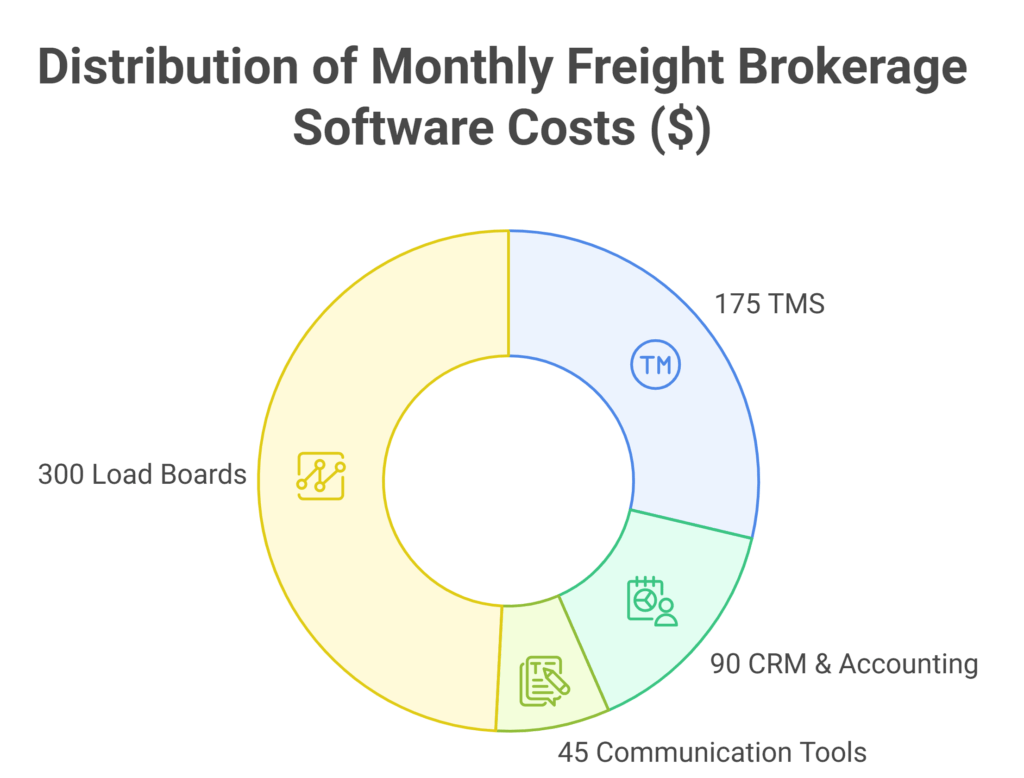
These recurring expenses play a major role in determining the average first year cost for freight broker operations, especially when revenue is inconsistent in the early months (American Transportation Research Institute, n.d.).
The key risk is not spending money, but spending it before volume justifies it.
“Successful brokers start with one load board and a basic TMS, then expand tools only when volume demands automation.”
Ready to streamline your brokerage operations with the right tech? Explore the best tools here
Freight Broker Office Setup Costs
Workspace decisions heavily influence startup costs. Many new brokers choose home based freight broker startup costs to minimize overhead (Small Business Administration, n.d.).
Home-Based Office Costs
- Computer & monitors: $1,000–$2,500
- Internet & phone system: $100–$200/month
- Furniture & supplies: $300–$800
This setup supports a low cost freight broker startup from home, dramatically reducing freight broker office setup costs.
Commercial Office Costs
- Rent: $800–$3,000/month
- Utilities & internet: $200–$500/month
- Furniture & equipment: $2,000+
For most startups, a commercial office increases the average first year cost for freight brokers without improving early revenue.
“Shippers rarely care about your physical office, they care about responsiveness, reliability, and problem-solving.”
Would lower overhead give you more confidence in your first year, or do you see value in a physical office presence?
Marketing, Sales & Working Capital
Beyond setup, operating capital determines survival. Many underestimate this portion of common startup costs for freight brokers (American Transportation Research Institute, n.d.).
Marketing & Sales Costs
- Website & branding: $500–$3,000
- Lead generation tools: $50–$300/month
- Email marketing & CRM: $30–$100/month
Working Capital Needs
- Carrier payments before shipper invoices clear
- Factoring fees (optional): 1–4% per invoice
- Emergency cash buffer: $5,000–$15,000+
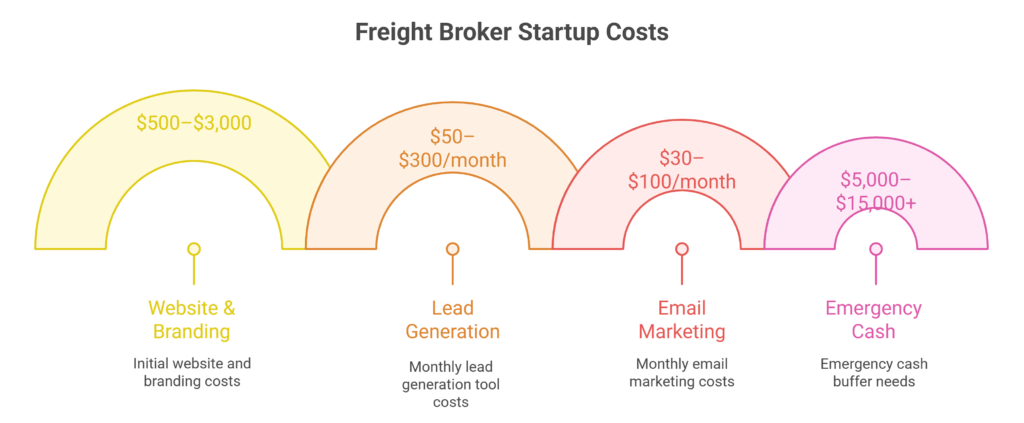
These expenses finalize your freight broker startup costs checklist and strongly influence long-term viability (FMCSA, n.d.).
“Most failed broker startups don’t fail due to lack of customers, but due to insufficient cash flow to pay carriers on time.”
Wondering how to scale your freight brokerage efficiently? Learn proven strategies here
Estimated Freight Broker Startup Cost Summary
- Low cost freight broker startup from home: $4,000–$7,000
- Moderate setup with full tools: $8,000–$15,000
- High-end launch: $15,000–$25,000+
These figures represent realistic freight broker licensing costs, technology, bonding, and operations combined.
Frequently Asked Questions (FAQs)
1. What are the common startup costs for freight brokers?
They include licensing, bonding, insurance, software, load boards, office setup, and working capital.
2. What is the average first year cost for freight broker businesses?
The average first year cost for freight broker operations typically ranges from $8,000 to $15,000.
3. Can I reduce startup costs by working from home?
Yes. Home based freight broker startup costs allow for a low cost freight broker startup from home without sacrificing professionalism.
Build Smart, Launch Lean, Scale Confidently
Knowing how much it costs to start a freight brokerage allows you to control risk, plan cash flow, and build a sustainable operation. A detailed freight broker startup budget breakdown is not just a planning tool, it’s a survival strategy.
When you understand your freight broker licensing costs FMCSA, bonding, software, and operational needs upfront, you launch with confidence instead of guesswork.
Ready to plan your brokerage launch and minimize financial risk? Contact us to get expert guidance and start strong.
References
American Transportation Research Institute. (n.d.). Freight broker startup costs. Retrieved from https://truckingresearch.org
FMCSA. (n.d.). Freight broker licensing and authority guide. Retrieved from https://www.fmcsa.dot.gov
National Association of Small Trucking Companies. (n.d.). Business registration guide. Retrieved from https://www.nastc.com
Small Business Administration. (n.d.). Home-based business guide. Retrieved from https://www.sba.gov
SuretyBonds.com. (n.d.). Freight broker surety bond guide. Retrieved from https://www.suretybonds.com